Monthly Archives: March 2019

So I’m a Spider, So What?, Vol. 5

By Okina Baba and Tsukasa Kiryu. Released in Japan as “Kumo Desu ga, Nani ka?” by Fujimi Shobo. Released in North America by Yen On. Translated by Jenny McKeon.

There are a few series where you simply have to wait a few volumes/episodes for it to get really good. In fact, that’s the cry of the obsessive fan trying to get someone to try things. “By the way, it only REALLY gets good about the 26th episode!” they say, and then cry as they watch the interest in their new friend’s eyes die. But it’s true. Take, for example, the series So I’m a Spider, So What?. The first few volumes, while entertaining, suffered from a very real problem, which is that the spider slowly making her way out of the dungeon, along with the endless leveling up and pages of stats, was not inherently interesting. There were moments of excitement in the fights, and some plot development, but having her totally separate from the rest of the main cast was annoying – especially as it turned out she was separated by time as well. But now the spider is on the surface and interacting with the world. The result? The best book in the series, by far.

As with prior volumes, the books are divided into two segments which alternate. The first deals with our spider, who has run into a fellow reincarnated student, who is a vampire baby. Her parents are human, though, “vampire” is just the role she got when reincarnated. Spider takes an interest in her, and ends up getting embroiled in a fight between two countries that is turning deadly. There’s also a very familiar elf who wants to get that vampire baby… and kill her. Oh yes, and there’s also the demon lord, who is rapidly becoming a bit… different, personality-wise, thanks to one of Spider’s other minds hacking away at her own. Now I know why I thought Ariel was our heroine when I first met her. She has the “narrative voice” in her outward personality. But the spider (who I won’t name just yet, but we do seem to find out her identity here) is actually, when we’re not in her headspace, socially awkward and mostly silent.

Meanwhile, in the future, the demon lord’s army is taking on the elf village. The elves were not exactly nice when we went into the village last time, and here we find they’re possibly worse than the so-called villains – they’re dismissive of humans, physically abusive towards Anna, the half-elf girl, and in general you are not all that troubled by the idea of them getting wiped out in this battle. Which is good, because it’s leaning that way. Sure, the kids’ teacher is the elf leader’s daughter, but there’s only so much she can do, especially as everyone doesn’t trust her. And there’s the revelation that most of the “missing” kids – and indeed, one who was presumed dead – are on the side of the demons. It’s troubling for Shun, who is still a very shiny and noble hero. That said, one of the two or three cliffhangers we get here implies that may be changing soon.

While the “spider” part of the book ends in a very satisfying place, the “hero” part of the book is riddled with “what happens neeeeeeeext?” questions. Sadly, we’ll have to wait till the summer to find out. Till then, though, enjoy a book with excellent plot and character development, less stats than previous books, and some gripping fights. Really loving this now.
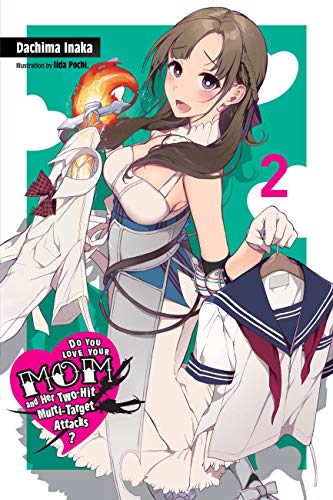
Do You Love Your Mom and Her Two-Hit Multi-Target Attacks?, Vol. 2

By Dachima Inaka and Iida Pochi. Released in Japan as “Tsujo Kogeki ga Zentai Kogeki de Ni-kai Kogeki no Okasan wa Suki desu ka?” by Fujimi Shobo. Released in North America digitally by Yen On. Translated by Andrew Cunningham.

Here we are with the second volume of everyone’s favorite parody. Last time, I was very pleased with the over the top humor and the fact that, desp[ite “lol incest subtext” being the premise, the book did not lean overheavily on any actual incest subtext. That’s still the case with the second book, which is not QUITE as funny but still has lots of amusing moments. Now that it’s an ongoing series, the author has to figure out how much it can rely on “this is a parody” and how much it actually has to take its plot seriously. Sometimes it doesn’t succeed – there’s a couple of stock fanservice moments in the middle of the book that are meant to be funny but made me cringe. Fortunately it fares better with its ongoing plot, which is comparing and contrasting Mamako to other moms in this game and realizing that she is, in fact, pretty awesome.

As the cover might have warned you, this second volume gets Mamako into a sailor suit school uniform. Our heroes find their next quest involves taking a week of school at a stock high school with NPC Teacher guy and a class so generic that their faces are literally ASCII art. Technically it’s kids-only. In reality, Mamako is there as an “observer”, and of course can’t resist taking up the spotlight and embarrassing her son. Also there is a pretty newcomer, Medhi, and her own mother (who is named “Medhimama” throughout the book, but I’m assuming that’s shorthand, as opposed to Mamako’s blatant actual name). Medhi is saddled with a classic “Education Mama” to the nth degree, who insists she be number one in everything. And while Medhi seems to be taking this with grace and patience, in reality she’s a seething cauldron of resentment waiting to go off.

Let’s get this out of the way immediately: the middle of the book has Mamako briefly molested by a tentacle monster, though it doesn’t get very far. There’s also a scene where Mamako has to apologize to customers for something (school festival booth), and her bouncing breasts are leered at quite a bit. These two tropes are not particularly part of what Mom Isekai is parodying, and so I am less inclined to give them a pass. They’re bad. Also, and possibly running the risk of taking this series too seriously, the relationship between Medhi and her mother is pretty abusive and toxic, a fact explicitly spelled out. As a result, I was a bit annoyed that Medhimama was possessed by some sort of illegal “dark item” (it came up last time as well, if I recall) that made her much worse. This makes it sound like the abuse was not her fault, which isn’t what the author wanted to say, I suspect. On the brighter side, the relationship between Mamako and her son is much better in this volume. He’s a good kid, and she’s a good, if overly affectionate, mom.

I still enjoyed this volume in general, even with my carps above. Those who like wacky parodies will still enjoy it, those looking for hot hot mom-son love will probably be frustrated. And it definitely needed more of Mrs. Shiraaase, who appeared far less this time around.

Ran the Peerless Beauty, Vol. 1

By Ammitsu. Released in Japan as “Takane no Ran-san” by Kodansha, serialization ongoing in the magazine Bessatsu Friend. Released in North America digitally by Kodansha Comics. Translated by Nate Derr.

One of the running themes of this blog has been about how a manga can be good even if it is not original. Trying to describe Ran the Peerless Beauty simply by the plot and characters alone might have a reader who’s very familiar with shoujo rolling their eyes and moving on, or at least asking how much it felt like reading a secret, 31st volume of Kimi ni Todoke. (Answer: a whole lot.) It’s true that the premise does not really surprise. But I enjoyed this first volume immensely. The romance was sweet, both leads are nice people who get along with a minimum of teasing. Ran is introverted without being a shrinking violet. Akira is ‘the popular guy’ but lacks the ego that frequently goes with it (I’m looking at you, Hatsu*Haru.) It’s also frequently funny without actually being a comedy. It’s kind of like finding a new burger place. It’s still a burger and fries, but man, it’s tasty. You want to come back.

We are introduced to the titular Ran, who is tall, gorgeous, gets great grades, is good in sports, family is well-off, etc. She’s so maxed out on perfect attributes, in fact, that most guys never even try to approach her. It doesn’t help that she’s fairly stoic and introverted. She’s on the school’s gardening committee, but that’s more to fill out its ranks than anything else. One day, while watering flowers and thinking about other things, she accidentally soaks one of her classmates, Akira. He’s a popular guy in her class, nice, talks to everyone… grades not so great, but hey. He thinks she’s cute. He also has a dark secret. OK, not so dark. His family runs a florist shop, and he’s very good with flowers! Ran discovers this, and the two gradually become closer.

I like these two a lot. Ran is sort of like a less intense Sawako, as she soon comes to appreciate things around her and open up to Akira. Akira is the sort of boy you’d call ‘refreshing’. The rest of the cast hasn’t quite opened up yet (Ran’s best friend is there to be the extrovert to her introvert, but we know little about her except that she had a boyfriend, then broke up with him.) Mostly, though, I enjoyed this so much as I did because of the little stylistic things. The artist has lots of side comments and funny background events that reminded me of the old cluttered Hana to Yume manga. It’s not a comedy per se, but there’s lots of funny bits that come from this, and I like that Ran’s family is a normal goofy shoujo family. Best of all may be the portrayal of the Student Council, who are all, men and women, the complete cliche of the “student council member”, as if they were chosen based entirely on their looks.

So yes, the plot is “cute buy meets cute girl and they cute together”, but that’s fine by me, and I found a great deal to enjoy here. There’s far too many Kodansha series that are digital only for me to keep up with, but this is going to be one I’ll definitely make an effort on.