Monthly Archives: March 2019

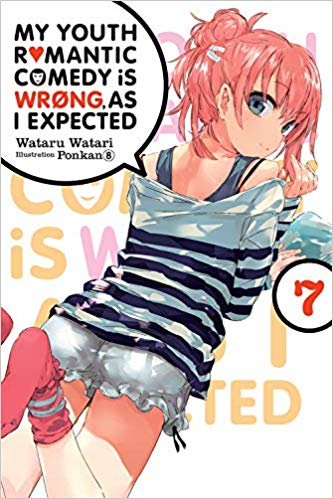
My Youth Romantic Comedy Is Wrong As I Expected, Vol. 7

By Wataru Watari and Ponkan 8. Released in Japan as “Yahari Ore no Seishun Rabukome wa Machigatte Iru” by Shogakukan. Released in North America by Yen On. Translated by Jennifer Ward.

After the bleakness of the last volume, it’s good to see that this one is at least slightly more light-hearted, though as always the author can’t seem to resist ending on a downhearted note. That said, things are a lot warmer here, and the extra side-story that adapts a drama CD even tries to retcon the last book by showing that Hachiman was eventually roped into an after party anyway. This brings together most of the main protagonists, and features what may be the funniest part of the book, where Hachiman’s “hobbies” are found to be wanting (people watching doesn’t count) and they try to find him some new ones. It does reinforce a running theme of this series, though, which is that as much as Hachiman wants to push everyone as far away from him as possible, there is a growing core of people who worry and care about him. The trouble is, some are also falling for him, and at this point, that’s not a good thing.

It’s time for the traditional trip to Kyoto, with temple visits galore, something that has most people excited, even Yukino, who seems to be far more into the trip than she pretends. That said, the Service Club also has a new request, and it puts the “romantic comedy” back in the spotlight. Tobe, best known so far as “Hayama’s #2”, is in love with Ebina, best known so far as “that BL fangirl”, and wants to ask her out, but is nervous, so wants to enlist the help of Hachiman’s group. Needless to say, given this group, this involves 2/3 crushing verbal abuse and 1/3 sympathy, and even Yui is finding it hard to bring the sympathy. The trouble is, as it becomes apparent, Ebina does not want that sort of relationship – not now, and not with Tobe. And that makes everyone nervous, because the way Hayama and Miura’s cliques are set up, if a confession results in awkwardness and pulling away, it will destroy both groups.

If you guessed the solution to this was “Hachiman taking things on himself so as to deflect everything to him”, then congratulations, you are familiar with how this series works. That said, much as it was interesting to see a more serious and even poignant side to Ebina, the “main” romance is mostly there to highlight the main love triangle of Hachiman, Yukino and Yui. There’s plenty of ship tease between him and both girls here, as he holds Yui’s hand as they go through a dark and creepy temple set, and sneaks out for ramen with Yukino and Shizuka (a chapter that features Yukino at easily her cutest and most vulnerable in the series to date). But, just as everyone knows with Ebina and Tobe, the reader is aware that if the love story advances further, the core friendship of these three is going to be broken. Especially if Hachiman keeps up his “please crucify me” solutions to everyone’s problems.

So the question is, what’s next? Can the Service Club maintain its status quo? Well, my guess is yes, as the next volume is “7.5”, and is a collection of short stories. (Note that unlike, say, Devil Is a Part-Timer, these .5 volumes were not released as DVD extras, and are therefore able to be licensed here.) That said, this seventh volume of OreGairu is a bit less bleak, but you’re starting to see that the train is rushing forward towards a final destination that may simply be “crash”.

Der Werwolf: the Annals of Veight, Vol. 3

By Hyougetsu and Nishi(E)da. Released in Japan by Earth Star Entertainment. Released in North America by J-Novel Club. Translated by Ningen.

The author described this as being a “slow” volume, which is a bit of a stretch given that one third of the way in our heroes are fighting a kraken. The plot of this book is essentially “Veight goes around to the rest of the Southern Territories and convinces them to join forces”. One area has the aforementioned kraken that needs to be taken out. Another, a town made of labyrinths designed to trap enemies, is already being targeted by the villainous Senate, and Veight and company have to convince people that a) they’re not responsible for the assassination of the ruler, and b) stop all the assassins who are. Fortunately he has help from a number of old friends as well as a new character, Parker, who is… well, he’s Brook from One Piece. Though he can at least disguise himself as “not a skeleton”. The puns, unfortunately, are still there. That said, does Veight even need help?

Veight continues to be the best reason to read these books. We’re used to harem protagonists that are clueless about the girls who like them, but Der Werwolf has little to no romance as of yet, so with Veight it’s more “he is unaware of his nature”. It’s not clear if he’s doing this deliberately to avoid the issue or not, but Veight’s tendency to pick the most dangerous solution has been noticed by most of his subordinates, and they aren’t very happy. It’s especially funny when he chastises others for the exact same thing, and is somewhat amazed when called out on it. To be fair, Veight probably COULD take out everything that goes against him by himself. We see more of his ludicrous “I can use magic and am also a werwolf” combos here, and they’re enough to get an enemy army to run away in fear.

The rest of the characters are not as good as Veight, sadly. I’d mentioned Parker was Brook from One Piece, and am wondering if “undead skeleton + puns” is a thing in Japan. There’s also a viceroy who decides, to make himself stand out, to act flamboyantly gay, and all the little stereotypical tick boxes are checked there, but fortunately he only shows up near the end. And we also get a glimpse of the Senate, which seems evenly divided between “evil” and “stupid AND evil”. Probably the best new character was Shatina, the daughter of the murdered viceroy, who starts off as a terrified teenager but, by the end of the book, has to be talked down from turning her city into a tool to get monstrous revenge on all those who have wronged her. The author would seem to agree, as the short story after the main book has her and Firnir, the centaur girl, bonding as they explore the underground labyrinth below Shatina’s own labyrinth of a city.

Der Werwolf’s most impressive feature continues to be its readability – you never get bogged down in prose the way you do in so many other light novels. I look forward to seeing more of Veight being ridiculously overpowered and totally unaware of it.

Aria The Masterpiece, Vol. 1

By Kozue Amano. Originally released in Japan by Enix, serialized in the magazine Stencil. This edition released in Japan by Mag Garden. Released in North America by Tokyopop. Translated by Alethea and Athena Nibley.

Third time’s the charm? This is definitely the year of lost causes getting another break. First we had Urusei Yatsura, cancelled over and over by Viz back in the 90s, getting a deluxe omnibus treatment. And now Aria, beloved by bloggers and a cult classic, but cancelled when ADV Manga collapsed and then cancelled again when Tokyopop hibernated, is getting its own deluxe treatment. These editions came out in 2016 in Japan, and this volume has the “Aqua” volumes, i.e. the start of the series before the Enix split that led to Kozue Amano moving to Mag Garden. It is a standard Japanese omnibus, meaning that it looks great but also eliminates most of the author’s end comment pages and extra side stories. What you get here are the first nine chapters, looking significantly better in this format than they did on first release here. The translation is the same, I’m fairly sure.

The series is a LOT more popular than it was back in the day, though, mostly as the anime was a bigger hit than expected. For those still unfamiliar, the series takes place on Mars, now renamed Aqua, sometime in the future. It’s been terraformed to be a water planet, and Neo Venezia is one of its stunning cities, done up to be just like Venice. This means they need gondoliers, and that’s where our heroine, Akari, comes in. She’s flying up from Earth… erm, Manhome… to join Aria Company, one of three companies in the city that are considered the cream of the crop. Of course, when she gets there she discovers that the company is just her and her mentor, Alicia. Plus President Aria, who I will discuss later. Even worse, her rowing technique, while awesome in terms of speed and flair… is less awesome as she’s rowing backwards. Fortunately she quickly gains skill, and also acquires a best friend/rival (who has a crush on Alicia) and a teasing guy friend/rival (who also has a crush on Alicia).

That said, as Aria fans know, the plot and characters are great, but they’re secondary to the scenery. Neo Venezia is the star here, and the larger format shows off the art to an even better degree. I especially loved the chapter that introduced Cait Sith, the huge, vaguely supernatural cat that will also, in a way, mentor Akari throughout the series. I was also very amused at how quickly everyone falls for Akari’s shining optimism and love of life. Aika attempts to be grumpy, with “no sappy lines allowed!” being a running gag, but it doesn’t work at all. It’s also not hard to see why everyone (including me) loves Alicia… she’s a fantastic gondolier, clearly cares for those around her, especially Akari, but most importantly, is the very definition of “ara ara”, the phrase that she spouts constantly in the original Japanese.

Manga or anime, Aria is the equivalent of a peaceful breeze running through your hair as you go down the river in a slow boat. It’s worth buying again.