Monthly Archives: May 2019

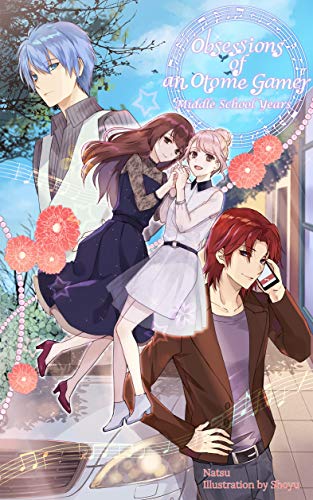
Obsessions of an Otome Gamer: Middle School Years

By Natsu and Shoyu. Released in Japan as “Ongaku de Otome wa Sukuenai” by the author on the Syosetu website. Released in North America digitally by Cross Infinite World. Translated by Charis Messier.

The first volume of Obsessions of an Otome Gamer stunned me, both in how ridiculously long it was and also how much I enjoyed it. This second volume is not QUITE as long, though it’s still about the length of a Tanya the Evil novel. But more importantly, it develops the characters from the first book, seeing them realistically learn from their mistakes, grow and mature… well, at least as much as they’re allowed to. Even when cliches are brought in, such as the rich younger sister of one of their teachers, they’re subverted, as she turns out to be a sweetie pie rather than an “ohohohohohohoho!” sort. And of course there’s the music, as Mashiro continues to have piano, not love, as her primary focus and gives the reader a crash course in classical music as well. That said, love is creeping in there, and the volume ends in a cliffhanger that will actually be decided via poll.

The title font is slightly more readable than the first volume, though I still think pink and white against a light background needed rethinking. As for the content, well, it’s Mashiro in her middle school years. After the events of the last book, Sou is in Germany, but he still hasn’t forgotten Mashiro, and she’s writing him and sending him origami trombones (far less origami in this book, alas). Kou, meanwhile, is also recovering from the bad impression he has seemingly hammered permanently into Mashiro’s mind, and I give him credit for being incredibly patient and trying his best to get back in her good graces. Since the first book came out, I have read three volumes of My Next Life As a Villainess, and it’s interesting to contrast Mashiro with Katarina. They’re both in otome game worlds and tend towards the dense when it comes to love, but Katarina is able to heal everyone’s problems through the sheer force of being her, whereas Otome Gamer is not that idealistic.

The author notes that the original title for this story was “The Maiden Can’t Save Through Music Alone”, and that brings me to Kon and her story. It’s dramatically necessary and worth it, as otherwise this sort of story would be as light and frivolous as they come, but it really is hard not to imagine that, whichever boy Mashiro ends up with, Kon is going to die. In her previous life she essentially sold her soul to Satan, and he’s in this book enjoying her despair and torment, despite the occasional setback (Mashiro recovers her past-life memories because, due to the game mechanics, she and Kon have maxed out their love and trust in each other). I would love to be proved wrong, but even Mashiro’s narrative has a lot of “I didn’t know it at the time, but…” that almost always signifies someone’s doomed. This sucks, I love Kon.

There are books for both boys being prepared, and there’s a poll that the publisher has put up so that readers can vote for which one gets published first. No, there isn’t a Kon Ending that I know of, though I do wonder if we’ll see a Bad End as an extra. In the meantime, fans of the first book and novels in this “otome game reincarnation’ genre will want to read this as fast as possible. And hey, why isn’t the publisher creating playlists of the songs for Spotify?

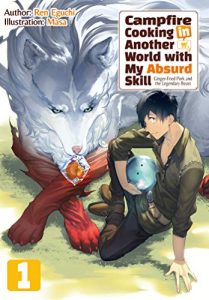
Campfire Cooking in Another World with My Absurd Skill, Vol. 1

By Ren Eguchi and Masa. Released in Japan as “Tondemo Skill de Isekai Hourou Meshi” by Overlap. Released in North America by J-Novel Club. Translated by Kevin Chen.

I’m very fond of what has become known as “slow life” light novels. The basic premise of them is that our hero/heroine ends up in another world and decides not to go adventuring or defeat the demon lord but to live quietly and enjoy themselves day to day. Now, of course, the narrative usually pushes against this, and a lot of slow life books have quite a bit going on. I’ve Been Killing Slimes for 300 Years and every single book by FUNA are good examples of the type. That said, an author has to be very careful when writing this sort of series, as there’s a difference between ‘relaxing” and “boring”, and the line can get crossed very easily. Killing Slimes’ heroine verges at times on the dull, but for the most part manages to muddle through and keep our interest. Unfortunately, the same cannot be said of Mukouda, the salaryman who ends up in another world with the skill “Online Supermarket”.

Mukouda is summoned to a fantasy world along with three other heroes. He, however, is not a hero – he’s a victim. He was accidentally summoned, and has a skill that is, well, not very useful, as well as stats that are merely slightly above average. The heroes look down on him, the kingdom looks ready to abandon him, and the entire “save us” business is shady to begin with. So he sets off with a little borrowed money and tries to make his way elsewhere. That said, his “online supermarket” allows him to use ingredients from Japan in his cooking… and for those who’ve read standard fantasy isekai, that’s a big deal. Sure pure salt! Amazingly soft bread! He also attracts the attention of others, including a legendary Fenrir who becomes his familiar in exchange for constantly feeding him, a baby slime whose growth rapidly outstrips Mukouda’s own, and Aqua from KonoSuba… erm, sorry, Ninrir the Wind Goddess, who will grant blessings for sweets, and is absolutely not Aqua from KonoSuba, despite, well, looking and acting exactly like her.

Honestly, if it were not for the hero, this would be more interesting than it is. Fenrir is a lot of fun. The baby slime is really cute, and the goddess is pretty funny. There’s hints of plots that could go somewhere here, and a whole menagerie of fantasy monsters that manage to be both threatening and tasty. I suspect in future books more options are found with the supermarket skill that can lead to cool things. The trouble is, though, that Mukouda isn’t fun. He wants to level up the easy way, and when thrown into situations where he’s force4d to fight for his life is a total coward about it. Which is, well, very realistic, but I’m not hear to read about you or me, I want to read about a light novel protagonist. Mukouda isn’t a ditz, or a snarker, or hot-tempered. He does not murder entire nations because they’ve pissed him off, like other bland protagonists I could mention. He’s just a guy who cooks.

If you enjoy isekai cooking novels, you can give this a try. I think this one volume will be it for me, though.

Blank Canvas: My So-Called Artist’s Journey, Vol. 1

By Akiko Higashimura. Released in Japan by Shueisha, serialized in the magazine Cocohana. Released in North America by Seven Seas. Translated by Jenny McKeon. Adapted by Ysabet MacFarlane.

The works of Akiko Higashimura have gotten incredibly popular in North America over the last few years, and of course in Japan she’s a top josei artist. Everyone knows Princess Jellyfish, and Tokyo Tatareba Girls is at least a cult hit. So it’s great to see a publisher pick up her autobiographical tale of how she became the artist she is today. And, as with many Japanese manga biographies, the story is filtered through telling us what a mess she was in high school, and how attempts to praise everything she did led her to have an inflated sense of herself. No one wants to read the story without struggle, after all. So Akiko has terrible grades, to the point where she can’t even pass the makeup tests. This wouldn’t bother her, because she thinks she can cruise into art school… but then she finds out just how far she has to go.

While other characters drift through here and there, mostly this is a story of three people. Akiko is the hapless art student with an immense ego; Futami is her best friend who, even in high school, has perfected the jaded seen-it-all snarker; and Kenzou-sensei is their art teacher, who teaches out in the middle of nowhere, seems to be constantly shouting and screaming, and hits his students with a kendo sword when they do things wrong – which is all the time. Akiko is absolutely horrified at this, but, after a brief attempt at giving up, keeps returning to the school. And it’s a good thing, too, as college is going to be rough. She doesn’t get a recommendation. She fails the Tokyo school that was her first choice. Is she really going to be able to realize her dream of being a shoujo manga artist?

Three’s a fun feel to this volume, even as you’re watching Akiko careen down her career path, hitting obstacles all along the way. I especially liked when she started to buy the “shady” test guides to help her study, the ones that teach you how to take tests rather than what’s actually on the test… and they helped her immensely, as that’s exactly the sort of learning she needed. As for Kenzou-sensei, he’s handled perfectly, with his seemingly violent nature balanced out by hidden (and not so hidden) acts of compassion. He’s clearly talented, and we see his “draw the same thing over and over and over till you have it memorized” teaching does start to have an effect on Akiko’s work. If there’s one thing that makes me wary, it’s that the narrative is making it thuddingly clear that this manga is going to end with his death; almost every chapter has a wistful, longing ending to it that kept making me think “OK, when’s he gonna die?”. Not at the end of this volume, and it’s five volumes long, so probably not for a while. But there’s an ominous feel to the whole thing.

If you’re interested in this author’s works, or just like seeing people struggling to make it, this is a great book to get. I’m definitely going to be reading more.