Monthly Archives: June 2019

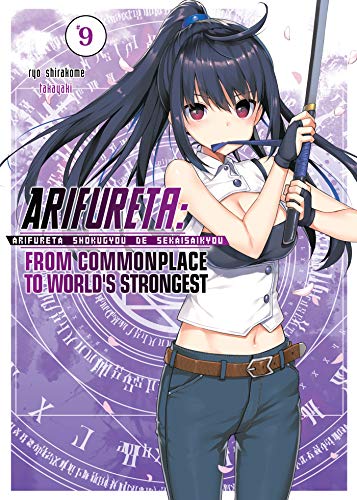
Arifureta: From Commonplace to World’s Strongest, Vol. 9

By Ryo Shirakome and Takayaki. Released in Japan as “Arifureta Shokugyou de Sekai Saikyou” by Overlap. Released in North America digitally by J-Novel Club. Translated by Ningen.

The last few Arifureta reviews have begun with me discussing some aspect of Hajime’s personality, but for the most part, after realizing he now has a way to return to Japan, Hajime’s character arc seems to be coming to an end. There is discussion here about how he can possibly fit in back home after all the changes he’s gone though, but Hajime’s attitude to this is basically “can’t do anything about it now, so will see what happens when it happens”. There’s also a side story towards the end of the book that shows that he’s not really as changed as everyone may think, as we see much of his core character even as a bullied high school student. Instead of discussing Hajime, I’d like to focus on the two characters who get the most attention during this volume (the first of a two-parter), and that’s Kouki and Shizuka. Who are suffering from the same problem but going in two very different directions.

The function of this final dungeon, aside from the snow and ice and a bunch of bigfoot monsters, is to make those who try to conquer it confront their negative traits. This starts as whispers in the ear, and ends with a full on “my evil twin” confrontation. We don’t actually see Kouki’s battle in this volume, but I’m going to go out on a limb here and say he’s not going to pass. In fact, I’ll even go further: I don’t think Kouki as an antagonist is going to be resolved in the series. I’m not sure it will get to the point where he’s an outright villain like Eri, but Kouki sees the world, and those around him, in black and white, and as long as he keeps doing that he’s never going to accept that Hajime isn’t “bad” in some way. It can be very frustrating to the reader – and indeed the other cast members, all of whom know exactly what his inner turmoil is but refuse to bring it up as they know once they do he’ll snap and that will be it. Expect snapping next book.

As for Shizuku, who is getting yet another picture on the cover, she not only has to confront her repressed love for Hajime, which has been bubbling up for some time, but also her repression of everything else in her life. We see her backstory as a girl who wants to do feminine things but has an amazing talent for kendo, and as a result is slotted in as ‘tomboy’ by almost everyone. Her friendship with Kouki’s who’s more an annoying little brother than anything else, also causes her to be ostracized, and it’s only Kaori who’s able to save her. (This also gives insight as to why she’s so willing to put up with Kaori’s eccentric behavior bordering on stalking towards Hajime – and why she refuses to admit her own feelings.) In the end, Shizuku’s main issue is that she needs to be more selfish. She takes a good first step at the end.

As noted, this turns out to be a two-parter, and the author says he’ll show the other cast members confronting their dark selves, including Kouki. I suspect they’ll conquer the dungeon, but the question is what will they do about the rest of the plot, which takes a back seat here aside from occasional mentions of Eri. The latest volume comes out in Japan next week, so we may need to wait a few months to find out.

The Promised Neverland, Vol. 10

By Kaiu Shirai and Posuka Demizu. Released in Japan as “Yakusoku no Neverland” by Shueisha, serialization ongoing in the magazine Weekly Shonen Jump. Released in North America by Viz Media. Translated by Satsuki Yamashita.

We’ve seen this series go back and forth between “all the demons are monsters who want to eat brains” and “not ALL demons”, and as a result it’s not really a surprise that you see Emma here, always the most idealistic of any group she’s in, attempting to reason with Leuvis towards the end of this volume. I mean, it makes sense. The demons don’t do this because they are required t or they’ll die. It’s hunting, which Emma admits that she has done as well. And what’s more, while she may loathe Leuvis for killing some of her new-found friends, she is not driven by a desire to end his life. So… can they come to an agreement. There are, however, a few flashbacks that help to show us that the answer is no, at least here at Goldy Pond. Reason and pluck will win the day elsewhere, but not for Leuvis, who spouts something about needing to be in conflict but we see what it really is is that he does this for the thrill.

For all that TPN has a reputation of existing on “will they die or not?”, there really aren’t TOO many deaths if you look at the course of the series. And we just had two more a volume or two ago. So I wasn’t really expecting any of the child soldiers here to get killed off, but the art made me wonder a lot of the time. In general, I don’t recommend breaking out the “monster is holding someone up by their head” pose unless you really plan to go through with crushing that head. That said, thanks to Flashbacks we do still get a few deaths – this is not a series for little kids. But we also do see their brief triumphs, and also taking care of the wounded back at home base. These kids are just as much of a family as the Grace Field kids are, despite the fact that it’s still coming down to Emma to fight the big bad.

Fortunately, reinforcements are on the way, as Ray and “that geezer” have finally caught up to Emma, and can help her just when it seems there’s no hope. I do wonder how this is going to play out. We’ve had a few volumes now with Emma on her own, but she’s best balanced with Ray and Norman beside her. We know Norman is alive now, but he’s nowhere near them. Ray is now there, though, and I think will be the first to point out that when a psychopath who loves to kill children for the sport of it taunts you, it’s OK to perhaps not give him one more chance. (He may then find out that he missed Emma doing exactly this – I mean, Emma may be badass, but it’s a very shiny sort of badass.) So, as we finish up this very well done Promised Neverland, one question is in my mind above all others: will the “geezer” guy finally be officially named in story?

Der Werwolf: The Annals of Veight, Vol. 4

By Hyougetsu and Nishi(E)da. Released in Japan by Earth Star Entertainment. Released in North America by J-Novel Club. Translated by Ningen.

One of the things that Veight has been lacking as we travel through these books is a strong enemy on the opposite side. The Hero was sort of a generic type, brought to life to have a climax to the book. The Senate are, as we see in this book, pathetic and ineffectual, trapped in political backstabbing and vituperation. Most of the ‘antagonists’ Veight goes up against in battle are either cannon fodder or won over to his side fairly quickly. He needs someone to fight against who’s actually good at what they do. Not TOO good, of course – the basic premise of the book still has Veight being super awesome while insisting he’s just a mild-mannered vice commander. But enough to force him to actually think out a couple of different plans – especially necessary given that his subordinates are trying harder and harder to make sure that he does not try to do everything himself. (They almost succeed. Almost.)

Conveniently, we’re starting to learn about countries and territories outside of “the northern parts of the country” and “the southern parts of the country”. There’s apparently nations past the demon forest, and on the other side of the dry desert. And there’s also a nation over the mountains up north, a nation who we see in this book really wants to get a fingerhold into Meraldia. To that end, they’ve joined forces with a few of the north’s cities who don’t like the Senate too much, and also sent over Eleora, their sixth princess, who is Veight’s distaff counterpart. She’s crafty, good at military matters, and also has a crack brigade of mages who reminded me quite a bit of Tanya the Evil much of the time. (She even has her own Visha, this one named Natalia.) Her nation, Rolmund, has succession issues, and this is very much a succeed or die sort of mission. Too bad there’s Veight.

There’s a lot of fun here. Every time Veight denies that he’s really strong or impulsive is wonderful, if only as it’s getting harder to believe he’s not doing it on purpose. Speaking of which, the funniest parts of the book involve coming up with a series of plays that will serve as propaganda. In reality, they’re basically bodice rippers, with each play involving a handsome actor playing Veight winning handily and causing his actress of the moment (playing Airia, Melaine, Firnir, etc.) to swoon and coo. Veight is rather embarrassed by all this, though the others (who no doubt hope Veight will catch a clue sometimes) have no issues. The final play we see involves Eleora and her own attack on Meraldia. I’m not sure whether she’ll join the list of women in love with Veight yet (honestly, I suspect it will be Airia if anyone), but the afterword definitely says the next book will involve Rolmund, so I’m sure we’ll see more of her.

I sometimes feel like I’m overpraising things, but I really can’t get enough of this series. Each volume is fun, easy to read, not too short or too long, has good characters and great humor, and makes Veight overpowered and harem lead-ey without him feeling like a stock light novel guy. Really, start reading these books.