Monthly Archives: June 2019

Komi Can’t Communicate, Vol. 1

By Tomohito Oda. Originally released in Japan as “Komi-san wa Komyushou Desu” by Shogakukan, serialization ongoing in the magazine Shonen Sunday. Released in North America by Viz Media. Translated by John Werry.

When you get a basic description of this series, it sort of sounds like a few other “aloof beautiful girl at school is really just super shy” titles. But Komi is a bit more complicated than that. The Japanese title can translate as “Komi Has a Communication Disorder”, and we certainly see that here, as she finds it nearly impossible to speak in front of others, let alone interact with them. And that’s a shame, as she really wants to have friends – 100 friends, in fact, like the Japanese children’s song. Fortunately, she has some help when starting high school. Tadano is an average, nondescript guy – in fact, that’s what he’s aiming for – but he’s seated next to Komi, not only earning him the hatred of all the other guys in the room, but also meaning he’s able to notice that she’s trying hard but not succeeding. And so he vows to be her first friend – and help her make more.
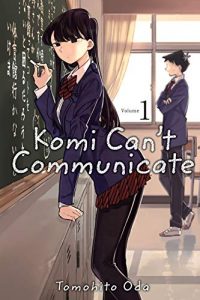
It’s not easy. Not only is Komi unable to properly communicate beyond writing on chalkboards, talking over the phone and the occasional babbling attempt to speak, but the school that they’re in is deliberately filled with “characters”, priding itself on individuality. This means even other introverts have a few eccentricities here and there. I’ll admit sometimes this works and sometimes this doesn’t. I liked Agari, who is a normal shy wallflower type, whose difficulties in talking to the class pale in comparison to Komi’s, but could have done without the “I’ll be your pet” gag ending to her storyline. Likewise one of the minor characters in this book, Yamai, reads like a worryingly stereotypical psycho lesbian, and I really hope it doesn’t go down that road.

There is also, however, Tadano’s childhood friend Najimi Osana. The most obvious of the pun-based names the cast all have, they are Tadano’s childhood friend. They are also non-binary. Najimi wore a man’s uniform and acted like a guy in middle school, is wearing a girls’ uniform and acting girly in high school, and is perfectly okay with this – and so is the rest of the cast so far, though Tadano has a few tsukkomi reactions to the whole thing. I’ve seen this sort of character in manga and anime before, but usually we the reader know what they gender assignment at birth is – not in this case. And that’s fine, as Najimi’s real role here is to be the super popular one with piles and piles of friends. This eventually includes Komi, though they get off on the wrong foot as Najimi finds Komi’s intense stare a bit terrifying.

In the end, though, this manga is about Komi. She’s moved a little further forward by the end of the first volume, but only a little – speaking to someone in person is still beyond her. I also love the way the art changes her face when she’s distressed or shy – she’s normally the gorgeous beauty, but her face turns wide and superdeformed when overwhelmed – which is nearly all the time. This was a fun series, and I look forward to following Komi’s growth.

Mushoku Tensei: Jobless Reincarnation, Vol. 2

By Rifuin Na Magonote and Shirotaka. Released in Japan as “Mushoku Tensei – Isekai Ittara Honki Dasu” by Media Factory. Released in North America by Seven Seas. Translated by Alyssa Orton-Niioka. Adapted by JY Yang.

The second book in this series covers about three years time, going from when Rudeus is 7 to just after his 10th birthday. It’s striking that we still haven’t really hit the teenage/adult years that most “in another world” titles skip to, although the ending to this volume may indicate a change is on the horizon. It does allow us to see Rudeus both mature as a child growing up, and also attempt to fix his mindset from his previous life that got him into trouble there as well. We also get a new female lead, since Rudeus was forcibly separated from his childhood elf friend (who gets one mention briefly here in an “oh, right, her” sort of way… which is typical for children who move, to be honest). Instead we have Eris, who is a giant ball of violence disguised as a child, and has driven away countless tutors both by being unteachable and also by beating the crap out of them. Naturally, Rudy is made of sterner stuff.

First of all, Rudy’s plan to pretend to get kidnapped so that he can show Eris the value of reading, magic and ‘rithmatic is astonishingly dumb, and it will come as no surprise that it immediately turns into a real kidnapping. The fact that it achieves its aims (Eris is willing to settle down a bit and learn) does not make it less dumb. Most of the rest of the book is devoted to The Taming of the Shrew, essentially, as Rudy slowly but surely gets Eris to learn how to read, write, do sums, practice magic and also dance in his spare time. Naturally, she falls for him hard. I’d say nothing happens as they’re 10 and 12 respectively, but something almost happens. It’s portrayed as overtly wrong and that’s fine, but I’m still thinking “wtf?” a bit. That said, Eris clearly states the fact that they’re too young is the only thing stopping her. Despite being a bit of a cliched angry tsundere, I like Eris. Well, I like Eris when she’s not adding “mew” to her sentences, another reminder that the author’s idea of fanservice is “just add it wherever and don’t worry if it makes sense character-wise”.

Then there’s that ending, which comes as a surprise. I’m not entirely sure yet what it means for Rudy and Eris (who I’m guessing are still together), but its devastation to the country that we’ve been in since the start of the series is pointed. The style had been very much relaxed and fun before this, but the final scene is done seriously and tragically, and works very well. It also shows us that Roxy will be getting back into the series soon, which pleases me, especially since it turns out that her tutoring royalty was a disaster as he was a royal brat. Given the sheer nature of what happened, I’m not sure this is easily fixed at all. That said, it’s certainly a great way to tell readers to get the next book, as I very much want to find out what happens and verify who is dead and who isn’t. As for the book itself, aside from the author sometimes being weirdly otaku, it’s still a very good reincarnation isekai. I can see why it has its reputation.

Crest of the Stars: Princess of the Empire

By Hiroyuki Morioka and Toshihiro Ono. Released in Japan by Hayakawa Bunko. Released in North America by J-Novel Club. Translated by Giuseppe di Martino.

I was excited when I heard that this got picked up by J-Novel Club. I’d read the Tokyopop so long ago that I’d forgotten almost everything about it, but I definitely remember enjoying it. It’s old-school science fiction, the sort that not only introduces you to the main characters but also builds an entire political galaxy, delves deeply into engineering and battle terms, and also invents an entire alien language for the reader to immerse themselves in, complete with not only translations but phonetic pronunciation. It’s also a novel rather than a light novel, so aside from the cover, don’t expect any interior illustrations. As for the story itself, it takes a while to get going, but once Lafier shows up and meets Jinto, things really start to take off, and the last quarter of the book is fantastic. It also leaves you on a cliffhanger, so I’m grateful more is coming.

The book opens on the planet Martin, where the seemingly arrogant and ruthless Abh Empire has just invaded. They basically have a choice – get taken over peacefully or not peacefully. Jinto, the 10-year-old son of the planet’s leader, rapidly discovers that his father not only chooses “peacefully” but also decides to become an Abh noble and leaves the planet… which means everyone suddenly hates Jinto by association. Seven years later and a far calmer and mellower Jinto has been going to schools to learn about his new status as an Abh (albeit not by genetics) and is ready to begin life as a quartermaster. He’s met by a young woman who is, like all people born Abh, gorgeous, and who also seems stunned he doesn’t recognize her. As a result, she asks him to call her Lafier, and they get on like a house on fire. Of course, this assumes that he can make it to his new position, as suddenly the Abh are under attack by the Human Empire.

I will get a few things out of the way here. First of all, it’s Lafier with an r, which is not what I’m used to from prior releases. It didn’t take too long to get used to it, through. The same cannot be said for the vocab peppered throughout the book, which is a LOT. At the start of the book every third word seems to get its own alien term, pronunciation guide, and English equivalent, and after a while it can verge on annoying. That said, it really does help to sell the Abh as a different culture. Plus as the book goes on previous alien terms are merely put in bold type, so you don’t actually have to deal with learning the words too much. The main reason to read the book, as I said, is Jinto and Lafier. They’re both great, immediately likeable personalities, and they bounce off each other well. The last quarter of the book has them dealing with a self-serving baron (who has his own harem, something that is NOT painted as a good thing) and I can’t wait to see him get his comeuppance.

There’s also some good, moving writing here as well, particularly in the doomed space battle 2/3 in. If you want some nice chunky sci-fi with lots of alien terminology, it’s absolutely worth checking out. Just don’t let the vocab lessons get you down.