Monthly Archives: November 2019

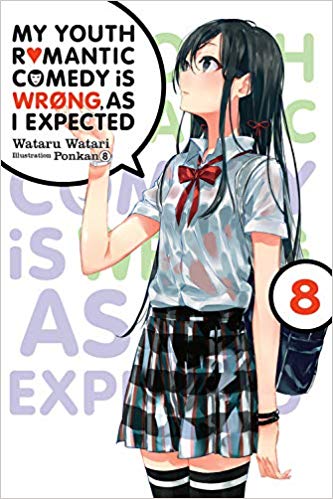
My Youth Romantic Comedy Is Wrong As I Expected, Vol. 8

By Wataru Watari and Ponkan 8. Released in Japan as “Yahari Ore no Seishun Rabukome wa Machigatte Iru” by Gagaga Bunko. Released in North America by Yen On. Translated by Jennifer Ward.

I have to hand it to the author, they are very very good at making me, as a reader, feel thrilling highs and desperate lows. Unfortunately, due to the nature of this series as a whole, each book always seems to end on a low, and so I often end up being depressed after a new volume of it. That said, I do still want to learn what happens next, even if I suspect it will once again be a journey where I grind my teeth and yell at everyone to actually have a decent talk with each other. But the nature of our three protagonists is such that that’s not going to happen – if they did, the series would have ended back at Vol. 3. Instead, buckle up for another adventure with Hachiman, whose cynical and roundabout narrative voice make me want him to meet Zaregoto’s Ii-chan someday. On the bright side, when he suggests his one solution to any problem, people are finally there to tell him to take his idea and shove it.

The soccer club manager we met in the short story volume has been nominated for Student Council President. She doesn’t want to do it, but also doesn’t want to deal with fallout of her dropping out or sabotaging herself. So she asks the club to help out. Hachiman suggests writing a bad speech so that everyone blames the speechwriter (him). This goes over like a lead balloon. Instead, first Yukino and then Yui decide to run against her, which will solve the problem, but also mean they likely would not be in the club any more. This also leaves Hachiman with nothing to do. After the middle of the book, which I will get to in a bit, he bands together with the rest of the main cast and comes up with a third option: convince Iroha that she really WOULD be a good Student Council President, thus removing the original request. Sadly, he does this without thinking of Yukino or Yui, particularly Yukino, and the result is the worst victory ever.

That said, the best reason to get the book are two scenes in the middle of it. The first has Hachiman and Hayama on the double date from hell, as his old classmate from middle school, Orimoto (the one he confessed to) and her friend want to get in with Hayama and he begs Hachiman to come along as he clearly doesn’t want to deal with this. After spending most of said date listening to Orimoto mocking and belittling Hachiman, Hayama snaps and tears them apart, pointing out the close relationships Hachiman has gained in high school. Tellingly, Hachiman is more upset by this than anything else. The second scene, my favorite, has Hachiman, at his lowest ebb, returning home and coming across Komachi, who he’d had a fight with at the start of the book. They make up quickly, and the ensuing conversation that follows is possibly the warmest, most heartwarming scene he’s had in the whole series to date, as he asks Komachi for her help and she talks about how worried she really is for him.

So the middle will make your heart grow three sizes, and the ending will make your face turn pale. But that’s typical of this series, which might better be called My Youth Romantic Soap Opera Is Wrong As I Expected. Like most soap operas, it makes you want to read the next book.

Don’t Toy with Me, Miss Nagatoro, Vol. 1

By Nanashi. Released in Japan by Kodansha, serialization ongoing in the magazine Magazine Pocket. Released in North America by Vertical Comics. Translated by Kristi Fernandez.

One of the bonuses that come with buying a volume of the manga that you’ve already read in a magazine or online is the interstitial art that goes in between each chapter. Many manga, particularly comedies, tend to have these, usually little ‘tags’ that follow the chapter, meant to add something to the reader’s perspective or give them another good laugh. Sometimes it can be fairly pointless, but sometimes it’s actively welcome. Don’t Toy with Me, Miss Nagatoro is definitely a case of the latter. The interstitial art for the first few chapters shows a blushing Nagatoro, rushing away from the scene, wondering if she got her point across or took things too far. It makes it very clear that her previous actions were based on “girl who teases the guy she likes”. This is important, because, while it has righted itself by the end of the volume, the initial chapters of this series skew waaaaay too far towards the “bullying” end of the spectrum rather than “toying with”.

The protagonist is unnamed, as far as I can tell, and is generally called ‘senpai’ by the other lead, Nagotoro. He’s a bit of a schlub, and has a hobby of drawing manga. One day his underclassman, Nagatoro, discovers this and proceeds to grab his manga, read it aloud, and mock it mercilessly. As the volume goes on, she proceeds to take every opportunity possible to viciously attack him, and he is, understandably, feeling a little aggravated by this. Eventually, though, he discovers that she seems to only be like this with him, showing quite a different face to other guys that she’s around. What’s more, by the end of the book the reader, if not the senpai, realizes that she’s doing this because she’s got a crush on him. Of course, her methods may still involve bullying, but, well, that’s how she communicates, right?

There’s been a mini-genre in Japan of this sort of series, ranging from cute and innocent (Teasing Master Takagi-san) to unthinking and broad (Uzaki-chan Wants to Hang Out). Nagatoro takes a third tack. Nagatoro’s teasing verges on cruel, particularly at the start of the book, and if it had stayed that way I might have decided to drop it. It can be hard to get through. The tone softens as it goes along, if only a bit, though, and we start to see more of Nagatoro’s softer, more vulnerable side – and also see her get a bit flustered, particularly when she’s doing things like accidentally talking to her senpai via video chat. It’s important we come to like Nagatoro because unfortunately the senapi, as befits his lack of name, has far less character. He’s a bullied kid who cries a lot, and is quite good at art. If Izuku from My Hero Academia had given up on being a hero and gone to art school, he might be this guy.

So a bit of a mixed bag, but I like where the direction is going. We’ll see if it can keep it up.

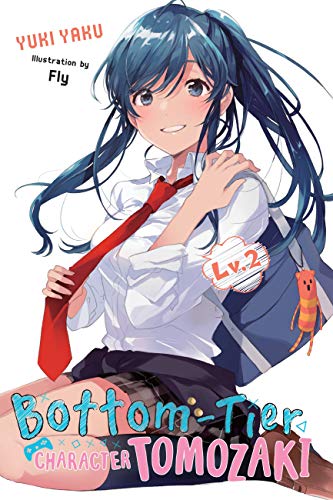
Bottom-Tier Character Tomozaki, Vol. 2

By Yuki Yaku and Fly. Released in Japan as “Jaku Chara Tomozaki-kun” by Shogakukan. Released in North America by Yen On. Translated by Winifred Bird.

Having started to successfully negotiate life the way that he does games, Tomozaki now runs up against more treacherous waters. Inviting a group out for a lunch accidentally turns into a shopping trip (MUCH harder for someone like him), and he has to ask his library friend out to see a movie, something that would be adorably cute but unfortunately gets derailed by the main plot. The main plot being Mimimi, the overenthusiastic and hyper classmate of his, running for Student Council President… against Hinami. As we discover that Mimimi has a long history of coming in second to Hinami, and see just how far above everyone else Hinami really is, Tomozaki decides that he wants to help Mimimi take her down by winning the election. But is he really good enough to do that now? And isn’t this just ignoring the larger issues that Mimimi has? More to the point, is being the best at everything really something you can criticize? All this, and it’s only the second volume.

We’d seen a hint of Mimimi’s hidden depths in the first volume, but the second one goes into far more detail. (My suspicion is that each girl on the cover art will be the focus of the book in question, so expect library girl to take center stage next time.) It can be hard to constantly find yourself hitting an insurmountable wall, and even harder when it’s a person. There’s a core of self-loathing to Mimimi’s behavior here, as she can’t see a way past what she’s doing without feeling angry with herself. The “what’s the second highest mountain in Japan?” question was a good way to demonstrate it to Tomozaki – with everyone watching Hinami at number one, who’s going to look at the next best? But, as we hear towards the end, Hinami has felt that anger and frustration as well – in fact, it’s what led to this entire situation. As Tomozaki says towards the end of the book, nobody did anything wrong here.

There’s also a lot of good stuff here about student council elections in Japanese schools, and how you have to balance what kids want vs. what teachers will let you talk about. The reader is absolutely meant to root for Mimimi and Tomozaki here. That said, the reader also suspects the result will be as inevitable as Hinami says it is. (I’m still not sure how the author wants us to feel about Hinami – getting a very “Medaka Kurokami” vibe about her.) And then there’s Tomozaki, who does make some good steps forward here (I really liked his buying the hair wax), but needs to stop framing everything as “this is what normies do” and putting himself outside that box. Also struck by a naïveté I was not expecting from him – even I knew what Mimimi did to Tama, but he’s baffled by it the entire book.

So, to sum up: I enjoyed the plot, I liked the characters, the writing felt smooth and readable (very good translation here), and it doesn’t feel quite as much like a self-help guide compared to the first. Overall, it was excellent. Cannot wait for the next book.