Monthly Archives: June 2020

My Next Life As a Villainess: All Routes Lead to Doom!, Vol. 6

By Satoru Yamaguchi and Nami Hidaka. Released in Japan as “Otome Game no Hametsu Flag Shika Nai Akuyaku Reijou ni Tensei Shite Shimatta…” by Ichijinsha Bunko Iris. Released in North America by J-Novel Club. Translated by Marco Godano.

At last, our cast has managed to graduate from school and become real adults. That said, working at the Ministry seems to be giving Katarina and company the same opportunities that they had in the 3nd and 4th books, which is to say going around investigating magical problems. More importantly, though, Katarina has discovered that Fortune Lover had a sequel that came out after her death (courtesy Sophia’s still unconscious memories – Sophia herself sadly seems to function only as a plot device this book) which features the return of villainous, one-note Katarina Claes… and this time there’s no exile involved, it’s jail or death. Now she has to charm new characters (read: new love interests) all while dealing with being put into the Magical Department that all the weirdos go into… not that Katarina is weird, of course. Oh no.

So yes, be reassured that the plot is moving forward at last. That said, I’m not sure how I feel about Fortune Lover II, which seems like a convenient way to simply have the same stuff happen. It certainly widens the cast, albeit at the expense of the original “harem”, who all get far less to do this time around, with the exception of Maria, who is in Katarina’s group for the practical exam they’re taking. (She does not end up in the department of weirdos.) This includes a trans character, though I’m not quite sure how we’re supposed to read her. The “girly macho” type is a Japanese stereotype mined for comedy, and there’s quite a bit of that here as well – she clearly makes Katarina uncomfortable. That said, Katarina does at least gender her correctly and use her preferred name, which the rest of the cast does not. (I’m not sure how much of that is down to translation, though.) It remains to be seen if this is progressive or just awkward.

As for the new “love interest” we meet in this book, Dewey, he’s meant to compare and contrast with Maria, being a younger boy from her hometown, also poor and relatively unloved, who studied hard and got into the Ministry at a young age and is not fond of a) people who pity him, b) asking for help, or c) nobility. Naturally, Katarina rubs him the wrong way. Fortunately, their practical exams blows up into a major crisis which turns out to involve a dragon (something thought to be mythical, even in this “magic exists!” world) and Katarina knows the best way to deal with it… throw rocks and sticks at it. OK, that didn’t work, but it distracted the dragon long enough for her magical darkness puppy (from Book 4) to get REALLY BIG and defeat it. (Katarina’s relationship with dark magic is something I hope we get into in future books… there’s already Ministry officials wanting to examine her.) I’m not sure Dewey has fallen in love with Katarina like everyone else in her orbit, but at least he knows she cares.

Despite the gimmicky Fortune Lover II jumpstarting the plot, this is a good volume in the series, and I’m happy we’re away from school life. Whether the author can handle the huge cast is another question – Jeord gets a chapter to himself here (and it’s good – the anime did him no favors, frankly) but I suspect we’ll be dealing with Katarina’s workplace friends more and more. Fans of the anime should still enjoy it, however.
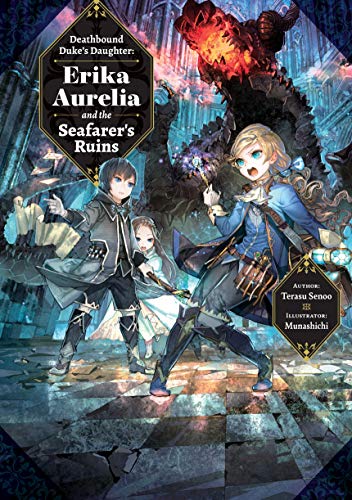
Deathbound Duke’s Daughter: Erika Aurelia and the Seafarer’s Ruins

By Terasu Senoo and Munashichi. Released in Japan as “Shini Yasui Koushaku Reijou to Shichi-nin no Kikoushi” by M Novels (Futabasha). Released in North America digitally by J-Novel Club. Translated by Roy Nukia.

We’ve had isekais for years now, and are used to “so what is the slight difference that makes this one worth reading”. Otome Game Villainesses, though, is still a relatively recent genre. That said, the fact that it seems to be exploding in popularity means that we can start to compare and contrast them that much faster. So, for those who would like a far more intelligent protagonist than Bakarina, or for those who want less emphasis on the romance aspect of these sorts of books, here’s a really nice choice for you. That said, Erika lacks Katarina’s empathy and emotional well of kindness, mostly because one was a happy-go-lucky high school girl who got hit by a truck while thinking about an otome game, and the other is a young OL who’s spent her entire life being slutshamed and the subject of rumors, and who finally was murdered by someone with a “grudge” against her for existing. It’s no surprised that Erika is a bit more jaded – even as an eight-year-old.

So you know the drill, she’s woken up as a villainess – a bratty young woman whose death kickstarts the plot of the game she was playing. That said, this is years earlier, and the event that makes her so loathed is one she knows – don’t let the younger sister of one of the “targets” die because of her neglect. She succeeds in making young Anne a fan of her right away, but Claus is dealing with inferiority complexes and preconceived biases, so is a tougher nut to crack. He’s interested in the ruins that her kingdom is known for – and so is the sister, which makes it more annoying when they both deliberately vanish one evening, leaving Erika to try to catch them so that Anne’s death doesn’t lead to her own demise. Unfortunately, Erika reckons without her super, super bad luck in general, and also her past life making her more than a little death-seeking, even if it’s only unconsciously.

As you can see, the bulk of this is not so much “otome game villainess tries to stop dying” as “kids go on a big underground adventure”, and it’s all the better for it. They’re mysterious moving labyrinths, deathtraps galore, golems, and a big bad with a big grudge. Erika and Claus work well together, and you can see why he ends up falling for her despite their young ages. Though Anne is the one who can tell that she’s not really looking for any romance, especially after her last life. As for Erika herself, despite seemingly being weak in terms of alchemy, she’s actually quite the savant, something noted by her older brother in a side story, where he worries that she’s going to take after their shady (and now dead) mother. (Amusingly, Erika was wondering if HE was the evil one earlier, but they both seems to be OK.) Most importantly, the book is simply fun, a short, quick read that will please most fantasy readers as well as “otome game villainess” fans.

Each book in the series has a Harry Potter-style title, so we’ll see what Erika Aurelia and the _______________” gets up to next time. In the meantime, this is an excellent addition to J-Novel Club’s Heart line.

Ascendance of a Bookworm: I’ll Do Anything to Become a Librarian!, Part 2: Apprentice Shrine Maiden, Vol. 4

By Miya Kazuki and You Shiina. Released in Japan as “Honzuki no Gekokujou: Shisho ni Naru Tame ni wa Shudan wo Erandeiraremasen” by TO Books. Released in North America digitally by J-Novel Club. Translated by quof.

(This review contains more spoilers than usual. I’ll try to keep the big ones to after the cover art.)

To my annoyance, the book starts off with a scene between the villains, each trying to prove that among the sneering evil bastards, they are the MOST sneering evil bastards. To my relief, it’s all uphill from there – as always, Bookworm’s books are long but they feel like they’re too short. Myne is trying to get her kid’s picture books off the ground, which involves experimenting with colored ink as well as getting new wax for their stencils. the second quarter of the book has a lot of the arts and crafts we’ve come to love from this series. (It also has the author, in probably the funniest part of the book, write in “Myne and Lutz as an adult married couple” and have it be DEAD ON.) Unfortunately, right at the start of the book an abandoned baby arrives at the orphanage, and Myne, trying to convince a reluctant Delia to care for it with the others, makes a big deal of Delia being the child’s big sister. This sets off a terrifying change of events that will shake up the lives of everyone – and result in a major fatality.

Though we’re not quite going to be leaving the temple yet, I suspect this may be the last we see of Delia as a major character. I had wondered if Myne would ever manage to win her over to betraying the high bishop, and sadly the answer is “not really”, though this isn’t helped by everyone keeping secrets from Delia because… well, she’s a spy. At least she avoids execution. Indeed, this book is filled with executions and threats of executions galore, and it’s a reminder of just how dark this world can be when it’s not about “hey, let’s make paper!”, and when the archduke is pondering whether it would be easier to simply have Myne’s family executed, you get the chills. Fortunately, Myne has her fingers in too many pies to make this really feasible, especially given that her printing press is the proverbial genie that cannot be put back in the bottle. No, instead of everyone around Myne getting executed, the simplest thing is for Myne to die.

And so we end this arc, with Myne dead. Fortunately, we have a new heroine in Rozemyne, who is the hidden daughter of a noble adopted by the archduke, and who happens to look, talk and act just like… OK, yes, Rozemyne is Myne, something most people are immediately made aware of. But the cover story is very important, and the scene where Myne has to say goodbye to her family as a family is heartbreaking. We know they’ll meet again (if anything else, I’ve seen Tulli on a few book covers coming up), but it’s not the same. Indeed, the cover story is magical, to the point where even Myne’s magical contracts change names. As for the Archduke himself… well, I admit, I didn’t see the reveal coming, though others may disagree. Certainly he helps to rescue Myne in the nick of time from a hideous fate. We’ll see how the double act holds up in the next arc. (The book proper ends about 2/3 in, and we get some very good post-Myne short stories, including some subtleties in regards to the High Priest’s aide, and how his seething cauldron of anger is not as secret as he’d like.)

The next arc is titled ‘Adopted Daughter of an Archduke’, and as such I expect a lot of noble life, probably some bullying – Rozemyne will likely find it hard. That said, she’s now in a majorly important position, the daughter of the MOST important man, and as we saw here, has enough mana in her to whip up a prayer to 5 or 6 gods, all at once, and have it work fine. No need to worry, even if Myne has left us, Rozemyne should be just fine. This was an excellent volume in the series, despite the “I am eviler than the most evil person!” villains.