Monthly Archives: April 2021

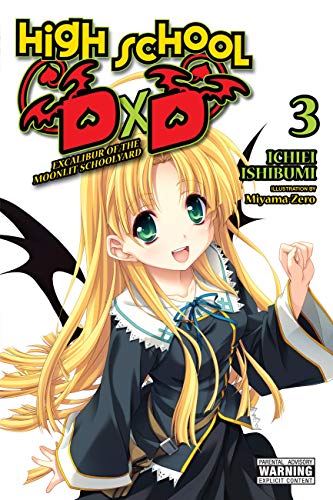
High School DxD: Excalibur of the Moonlit Schoolyard

By Ichiei Ishibumi and Miyama-Zero. Released in Japan by Fujimi Fantasia Bunko. Released in North America by Yen On. Translated by Haydn Trowell.

I had resolved, with this third volume of High School DxD, that I was going to stop talking about the constant teenage sex fantasy talk, nudity, and general fanservice and simply focus on plot and character. Theoretically, anyone reading a review of the third volume of this series already enjoys it, and does not need me going on about how it’s all a bit much. Therefore, I would simply glide past the fanservice and discuss other things. It’s very, very hard to do that, though. This is not a book like Accel World, where if you ignore the art and the ages of the characters it’s almost a normal harem battle novel. The sex is baked DEEPLY into the very fabric of the series. I could talk about character motivation, except we now see a THIRD demon whose plan is to gather a harem (and the second one had succeeded), and Issei explicitly says that he’s fighting in the final battle because he’s going to get to suck Rias’ nipples as a reward. It is what it is.
So, the plot, as there is one. Kiba finally gets a volume to explain his backstory, and it’s pretty wretched. It’s also pretty clear that he ids consumed by vengeance against holy swords. Thus it is an unfortunate thing that several holy swords have shown up in town, either being wielded by fallen priests, fallen angels, agents of the Church… or Issei’s childhood friend Irina, who he didn’t even realize was a girl. Needless to say, all these swords here is not a coincidence, and there’s a fallen angel at work here. Can our heroes manage to actually work together – minions of the angels and actual demons – to fight against a common enemy? Can Kiba manage to keep it together enough to get the revenge he’s sought for so long… and is revenge really the right answer? And can this series keep teasing sex while delivering precisely nothing? Signs point to yes.

I didn’t mention the other new character in this book, who seems to join the regular cast at the end. Xenovia starts off as an angel with a heaping of faith and a tendency to go off half-cocked, and ends it as a somewhat bitter demon… with the exact same tendency. She looks fun. Irina is far more pointless, and I think would have been better served being introduced in a different book. This book does, however, do something very well, which is for the climactic battle, which Kiba has far more invested in than Issei (nipples aside), it shifts to Kiba’s POV. You’d think this would be obvious, given it’s Kiba’s arc and resolution, but it can frequently be very hard to wrench the narrative away from the usual POV character, so I’m calling this a victory. Two more things: Koneko is still the minorest of the main characters, but I liked her more here. And a scene showing off how poor Irina and Xenovia really are shows the author is very good at humor when it’s not revolving around tits.

This series is pretty much review proof, but I will note: fans will enjoy it. Also, Asia looks very cute on the cover.
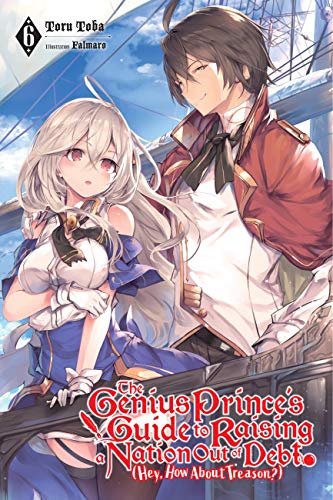
The Genius Prince’s Guide to Raising a Nation Out of Debt (Hey, How About Treason?), Vol. 6

By Toru Taba and Falmaro. Released in Japan as “Tensai Ouji no Akaji Kokka Saisei Jutsu ~Sou da, Baikoku Shiyou~” by GA Bunko. Released in North America by Yen On. Translated by Jessica Lange.

This volumes shares many of the same things that I criticized the last volume for – it’s very rushed, Falanya doesn’t really appear, etc. – but I found it a much better read than Book 5. Possibly that’s because this is the first book to really feature Wein as a side character in his own series. We’ve seen Wein being an “influencer” before, and in fact it’s probably what he excels at more than anything else. But in this book we see Wein caught up in a power struggle that has nothing to do with his country – or so we think – and choosing to pick a side and help one of the contenders for the throne. This volume is Felite’s as much as Wein’s. The book shows off his own similarity to Wein in a few ways – notably their kickass bodyguard/confidante who seems to be in love with them – but thankfully is not creating a Wein clone, as he feels like his own person.

Wein now has a seaport, but unfortunately no one trusts him enough to trade with him. Fortunately, his hostage/enemy is there with an answer: she knows of a nation to the South that is amenable to trade, and she can help negotiate. So we’re off on a sea voyage… which Wein quickly regrets. And yes, part of it is that he gets seasick, but there’s also the fact that the ruler who he’s supposed to be negotiating with has been assassinated, and Wein is captured and stuffed in a jail cell. Fortunately, not only does he manage to bluff his way into having a far nicer jail cell than everyone else, but he’s also kept directly next to the OTHER big name prisoner… Felite, the second son of the former ruler. The first son is the one doing the assassinating. The winner will be the one who can claim the famed Rainbow Crown, an icon of the country.

The author said last time that this volume would be a slice-of-life, which it isn’t, and he apologizes for being totally unable to write such a thing. Still, we do get some of the cast in swimsuits… though really, Wein only has eyes for Ninym. Despite another girl telling him that they’re engaged (he never has any choice in the matter), Ninym is simply too high a bar to clear, and the first thing Tolchiela says after this is “It’s OK, I’ll allow mistresses”. That said, we also see some Flahm here who are also not roundly hated by everyone, and it’s apparent that they worship Natra for being the first country to actually not oppress then. If this series ever does end, I suspect it’s with Ninym recognized more officially. As for the rest of the book… it’s a fun little adventure, and Wein is mostly in smart bastard mode rather than whiny freakout mode. Plus, sea battles.

The next book promises to bring us back to the Empire, so I expect we’ll see more of Lowellmina than the running gag we got here. That said, we also saw that the series’ Big Bads are also still around, and determined to have everything end in chaos. Wein is their kryptonite, so dealing with him is getting more and more important. I’m looking forward to seeing what comes next.

Baccano!: 1932 Summer: Man in the Killer

By Ryohgo Narita and Katsumi Enami. Released in Japan by Dengeki Bunko. Released in North America by Yen On. Translated by Taylor Engel.

After a very depressing 1700s volume of Baccano!, it’s nice to be able to get a book that is back at “home base”, so to speak: the 1930s. And this book is markedly lighter in tone, despite featuring a series of murders and an examination of what sort of person you have to be in order to commit said murders. It was originally written as an extra for those who bought the Baccano! anime DVDs Vol. 1-5 in Japan, then fleshed out for this book. That said, let’s face it, the main draw is on the cover art. If you asked any Baccano! fan which two characters absolutely should not meet because the world might end if they started talking to each other, Elmer C. Albatross and Graham Specter would be right at the top. Oh, don’t get me wrong, after a brief misunderstanding they get on like a house on fire. But that is the trouble. The last thing anyone like Graham, who Shaft can barely rein in at the best of times, needs is Elmer’s philosophy of life.

This takes place about seven months after Drugs and the Dominoes and about a year or so before The Slash, and features a few of the characters from both books. It also serves as an odd epilogue to The Rolling Bootlegs. There is a serial killer in the city, Ice Pick Thompson, whose nickname comes from his murder method. We meet Lester, a reporter who’s been ordered to follow the story even though he really would rather avoid it; Mark, a young boy who has decided to kill himself… till he meets Elmer; and Graham, Shaft and company, who are just hanging around the city but keep getting dragged into the plot. Is this just a crazy serial killer, or is there a method to their madness? What does this have to do with the Gandors? What does this have to do with Szilard Quates? And can Isaac and Miria really become literal time? Or money?

The thing that interested me most in this book is the villain, which makes a refreshing change from the usual villains we’ve seen in Baccano!, who tend to be very obvious from the start – art least from the reader’s perspective. This one is meant to be more of a mystery – though really, not that much of one, as there’s something fishy from the start. Which is fitting, given they’re more on the Dallas Genoard end of the villain spectrum than the Fermet end. I also want to note how impressed I am with Graham and Shaft, who are not Japanese but nonetheless make the perfect manzai team. When Sham made Shaft one of his vessels, he basically created the perfect tsukkomi, as well as the only one capable of stopping Graham – not that he ever actually succeeds. The best thing about the book, though, is probably Mark, a quiet, tragic character walking around a sea of loudmouthed extroverts.

If you enjoyed being back in the 1930s, worry not, we’re soon going to be there on a more permanent basis. But first we have to wrap up the 1700s arc, and finally find out what happened on the Advenna Avis. Next time we go to 1711 and see how Huey’s holding up after Monica’s death.