Monthly Archives: April 2021

My Friend’s Little Sister Has It In for Me!, Vol. 2

By mikawaghost and tomari. Released in Japan as “Tomodachi no Imouto ga Ore ni dake Uzai” by GA Bunko. Released in North America by J-Novel Club. Translated by Alexandra Owen-Burns.

In my last review, I compared this book to McDonald’s fast food, and nothing here changes that opinion. I enjoyed it a great deal. It has characters who I enjoy reading, dialogue that’s a lot of fun, and clearly has a long-term goal in mind as opposed to just being written volume to volume. On the other hand, wow, the plot beats here make me cringe. “Let’s save the drama club!” is not something that a self-respecting series should be doing when it’s only the second book, and the ludicrous coincidences that lead to our leads ending up in the production are even worse. Now, I get the sense the author knows this, as the situation really is pretty ludicrous, but yeah, don’t read this for the plot. That said, it should make this pretty fun to adapt when it becomes an anime, and Iroha will no doubt please fans who are already over the moon for Uzaki and Nagatoro, though I warn you her dialogue is a bit slang-filled.

This volume picks up right where the last one left off, as Akiteru tries to figure out how to respond to Mashiro’s confession, and Iroha knows about this confession but has to pretend she doesn’t. Akiteru knows he has to respond quickly and decisively, because he’s read dumb romantic comedy light novels. Unfortunately, it turns out that while he tries his hardest to be the best Eliezer Yudkowsky he can be, he is not quite able to get past the fact that he’s really goddamn happy he got a confession -though it takes him most of the book to figure this out. As for Iroha, well, she’s dealing with jealousy as well, plus her dimwitted senpai not figuring out her feelings (which Mashiro sure can by the end of this book), and it’s even affecting her voice acting work. Hrm, this sounds complicated, maybe saving the drama club *is* what’s needed…

As I’ve said before, Akiteru interests me, mostly as I think he’s screwed up in a very different way from cynics like Kyon or nihilists with a heart of gold like Hachiman. His raw panic when Iroha points out he’s overslept by an hour, and desperation to get to school on time so it doesn’t mess up his regimented life, is very telling. There’s no denying that he’s excellent at directing, be it games or plays, and despite his own denials, he’s a pretty good actor too. But improvisation seems to be a kryptonite for him. The only reason he can do the play is he’s so familiar with the material, and the problems with Mashiro and Iroha that he “solves” here are done after thinking them out in bullet points in his head. The first epilogue suggests that he’s going to have to figure out a way to break through that soon, as he may need to improvise even more in the future.

Despite adding a new cast member to the game group (a classmate of Akiteru’s who is a genius sound designer), this still feels like only three of the cast are really important, and I’m hoping we’ll flesh out the others soon. Unfortunately, next time it looks like the one I didn’t want fleshed out will be getting the spotlight. I smell an arranged marriage… In any case, this is a lot of fun unless you take light novels too seriously.
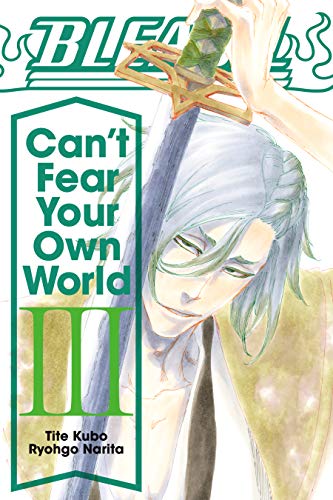
Bleach: Can’t Fear Your Own World, Vol. 3

By Ryohgo Narita and Tite Kubo. Released in Japan by Shueisha. Released in North America by Viz Media. Translated by Jan Mitsuko Cash.

The first half of this book is, to put it bluntly, a slog. It’s the giant fight against Tokinada that I’d been expecting, but for the most part it’s content to not be “Bleach, only well written” like the first two books but “actual Bleach”, which means that everything moves at the pace of a lethargic snail who’s having trouble getting going in the morning. Tokinada shows off his zanpakuto, whose gimmick is that it can copy the attacks of other Zanpakutos, which also means that he is Monoma from My Hero Academia and thus we can hate him even more. Fortunately, around about the halfway point, several things happen that make the book better. We get some lore we actually care about, Hisagi shows up to remind us he’s the star of these books, and we get some truly interesting characterization from one of the minor big bads I mentioned last time, who finally finds a thing to care about. That said, Nanao is still useless. It is Bleach after all, I guess.

The fights pretty much divide up how you’d expect. The super overpowered kid takes on Zaraki, and Tokinada takes on literally everyone else. Tokinada reveals his motivations for being the biggest smug asshole in all of Bleach (and given this is a series whose villains are ALL smug assholes, that’s a high bar), and these motivations will be very unsurprising to anyone who has read Baccano!, also by this author, as Tokinada and Fermet really do have an awful lot in common. Meanwhile, Hisagi has a chat with our overpowered child before all this begins, and reasons that the way that they’ve been raised means that they’re unable to decide anything on their own or have a moral center. He thus decides to make it his goal to raise this child right. And it turns out that he’s got a solid ally on that one, too. Now if only they could somehow stop Tokinada. Perhaps… if Hisagi finally figured out his bankai?

Bleach tends to run on cool moments, with everything in between just filler while you wait for the next one, so it’s good to see that there are a few here, the best of which is Hisagi stopping Zaraki from fighting Hikone – stopping Zaraki from a fight he’s pumped up for is damn near suicidal, but his reasoning is excellent, and even Zaraki has to agree, to the astonishment of everyone else. Hisagi’s fight with Hikone, using his newly discovered bankai, is also pretty damn cool. And I was pleased to see less death in this book than I expected, though given this is a book that resurrected damn near everyone killed off in the last Bleach arc to show they aren’t really dead, I should not be all that surprised. I also liked the lore that was given to us (which should have been in the actual manga, as is mentioned in the afterword) about the past of the Soul Society and what terrible things keep it going.

That said, Christ, this book is too long. It’s not as long as the 2nd book, but it’s still 285 pages when 185 could have easily sufficed. It’s essential reading for Bleach fans, but everyone else can easily skip it.

Oh yes, love to see Grimmjow shipping IchiHime.

A Mysterious Job Called Oda Nobunaga, Vol. 3

By Kisetsu Morita and Kaito Shibano. Released in Japan as “Oda Nobunaga to Iu Nazo no Shokugyou ga Mahou Kenshi Yori Cheat Datta Node, Oukoku o Tsukuru Koto ni Shimashita” by GA Novels. Released in North America by Yen On. Translated by Noboru Akimoto.

When I reviewed the first volume in this series, I mentioned that it was by the same author of I’ve Been Killing Slimes for 300 Years, but was its polar opposite. After finishing the series, I’ve realized that may not be entirely true. The books are both written for male audiences, but very different kinds of audience. One emphasizes masculinity, the glory of battle and the constant conquest of women. The other barely has any men in it at all, is relaxed and laid-back, and very deliberately has its heroine trying not to work hard at anything. But they are both, in the end, stories about ridiculously powerful people, who we do not really see lose a fight over the course of their series, amassing a string of young women who adore them. They’re found family in the case of Azusa, and concubines/wives/lovers in the case of Alsrod, but really, all Azusa needs now is a massive fortress to defend.

If you are here for surprising twists late in the narrative, I advise you to find some other series, as you could have predicted every single plot beat in this book before you picked it up. Alsrod puts down a rebellion against him – composed of his brother in law and his father in law – and rewards them as traitors deserve. He then pauses, as the king has decided that it’s now time for him to do the fighting, and spends time on his own demesne waiting for the inevitable failure of the royal army to do anything and their pathetic call for help. When this occurs, he is quick to fight, breezing along towards the enemy and having so few issues that his fellow soldiers remark on how easy this is. Inevitably, the king grows terrified of his power and brands him a traitor. But that’s OK, because he has a badass group of women he’s bedded, who are ready to fight wars, argue politics, and even become queen for him. (And then abdicate, because let’s face it, one can only go so far.)

I will mention to horny readers looking for sex that, while there are at least a dozen if not more scenes mentioning Alsrod getting it on with his many women, there are precisely zero that go into the act beyond “and then we did it. Afterwards, in bed, we discussed…” etc. This book is not here to arouse it is here to show you what an awesome, virile man Alsrod is. And oh yes, there’s also Oda Nobunaga. He still offers the occasional bit of advice, mostly on how to build a really good castle. But, as Nobunaga himself admits, he was murdered before he could get to the “conquer the kingdom” part, so Alsrod has gone further than him. Indeed, that might be the purpose of this book. Look, here’s our hero, and he did what Oda Nobunaga could not. And they all lived happily ever after.

The author admits that, while there might be more tales to tell, he’s not going to be doing it, so this is the last book. Which is a very good thing, as I think the book wears out its welcome exactly at this point. It is absolutely the perfect length for what it is. I recommend it to fans of Oda Nobunaga… well, OK, maybe for those who play the Nobunaga’s Ambition game.