Monthly Archives: March 2022

Bond & Book: The Long, Long Good-Bye of “The Last Bookstore”

By Mizuki Nomura and Miho Takeoka. Released in Japan as “Musubu to Hon: “Saigo no Honyasan” no Nagainagai Owari” by Famitsu Bunko. Released in North America by Yen On. Translated by Nicole Wilder.

If you are reading and enjoying Bond & Book, as well as the author’s prior series Book Girl, then I am going to assume that you are a fan of books. Not just “Oh hey, I like reading” or “I always get the new release of Index when it comes out”, but someone whose entire life is tied up in reading and the titles that have impacted them. Certainly this series is both about and for those people, and while it takes the time to explain the books that it focuses on, there’s a greater depth if you’ve already read the stories in question. Not that I expect too many light novel readers will rush out to buy The Field Guide to Extinct Animals, but certainly The Seagull and The Scarlet Letter are very important to this volume, and being familiar with both stories lends them an added emotional impact. Which is surprising, as the author already knows how to pack quite an emotional punch without the references.
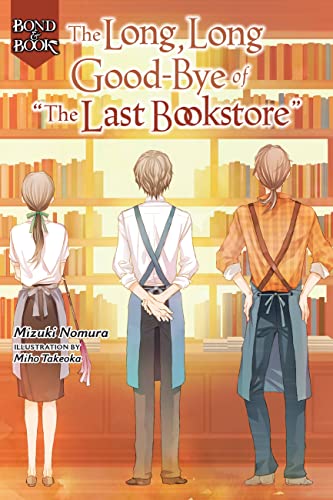
After introducing us to what seemed like our main cast in the previous book, this volume sees Musubu on his own. the reason for that is that he’s gone to a distant town where the bookstores have been shutting down one by one. Only one is left now, and its owner just died in what was seemingly a tragic accident. Now it too is going to close, and Musubu is there to make sure that the books are cared for in their final days there. This irritates Minami, the bookstore’s longest-serving part-timer, who not only felt a close kinship with the former owner but is creeped out by this teen who says that he can talk to books – and they talk back. As the days pass and the closing of the bookstore becomes a major event in the town, will we find out about the owner’s past history and secrets?

Unlike the first volume in the series, this one is more of a novel than a short story collection – in fact, the afterword makes me think the author wrote this one first. It overflows with the love that you can get from reading a beloved book, and how that love can also lead to different things. A couple who loved each other from afar when they were teens reunite years later thanks to The Tomb of the Wild Chrysanthemum. A boy who has become terrified of earthquakes is given a fun series about aliens to read that will calm his mind. And, in the main plotline, an actress and a writer both have ties to this bookstore and its owner, and they’re more than just the Chekhov and Hawthorne stories that wrap around their lives. The ending of the book is incredible, wringing emotions out of you, and making you think that, years from now, maybe Bond and Book will be the series that lodges itself in your heart.

There’s two more volumes out in Japan, and this delights me. I just want to read more from this author, whatever it is. And I want to go back and re-read The Seagull. (Not The Scarlet Letter, though. Sorry, Nomura-san, your work can only take me so far.)
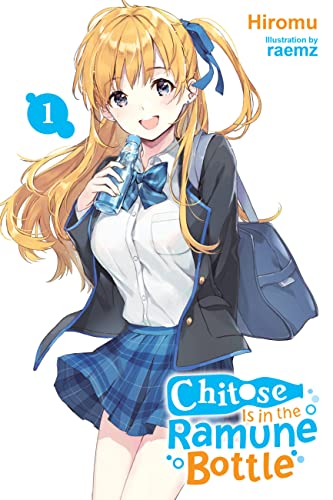
Chitose Is in the Ramune Bottle, Vol. 1

By Hiromu and raemz. Released in Japan as “Chitose-kun wa Ramune Bin no Naka” by Gagaga Bunko. Released in North America by Yen On. Translated by Evie Lund.

Manga and light novel trends tend to feel into each other, with parodies, homages, and deconstructions of the hot new thing happening three years later and becoming the next hot new thing. Nowhere is this more apparent than the halls of Gagaga Bunko, home to the cover art where every series looks exactly the same. Gagaga, I’m sure, must also have fantasy and isekai titles… but those aren’t licensed here. Instead we started with My Youth Romantic Comedy Is Wrong As I Expected, where a cynical so-called loner psychoanalyses the nature of high school cliques. Then we saw Bottom-Tier Character Tomozaki, easily the most popular of the subgenre of “the popular kids can even turn you, a loser, into one of their own”. And now we get Chitose Is in the Ramune Bottle, where the main character IS the popular kid, and you will be surprised and shocked that he too has something to say on the nature of popular kids and high school cliques. Everyone’s riffing on someone else.

No, that’s not Chitose on the cover – Chitose Saku is our hero, a handsome cool high school kid who enjoys school and hanging out with his equally popular friends. He has several girls who are interested in him. He’s almost immediately made class president. He’s living the good life. And now he has a job to do, as the teacher has asked him to try to get Kenta, an otaku nerd type, to come back to school – he’s stopped going after getting shut down by a girl he confessed to. Chitose goes along with this, managing to get Kenta out of his room with a nice combination of encouragement, hot girl and good old fashioned violence. But Kenta, who whines about how Chitose gets everything handed to him and an easy life as a popular kid, decides to show Kenta how to actually make an effort.

As you can see, this synopsis bears more than a little resemblance to Tomozaki (Kenta is even named Yamazaki), and we do indeed get the “let’s shop for clothes that are not otaku schlub” and “here is how to actually converse with another person” scenes. At the same time, it also mocks that trend of “self-help” books as unrealistic, showing how difficult it can be to try to change your image and personality and not immediately get attacked. There’s a whole lot of jerks in this book, and the way Chitose and his friends handle them is a good look at “don’t punch down”. As for Chitose himself, he’s a protagonist who cries out for more than one book, so it’s a good thing this won an award and got a series. There’s hints of his past as well as his need to live up to his reputation that might get darker in later books. But overall, he and his friends are very likeable, fun people. If you’re reading this as you heard it was “romcom starring the popular kids”, you won’t be disappointed.

I will note that Chitose can come across – deliberately, he’s clearly doing it on purpose – as smug much of the time, and this may grate on readers who are more used to cynical sad sack narrators. That said, I am very curious to see how this handles being an ongoing series and how much we can peel back Chitose’s hero complex.

Goodbye Otherworld, See You Tomorrow: The Traveled Path and the Box of Hope

By Kazamidori and Nimoshi. Released in Japan as “Sayonara Isekai, Mata Kite Ashita” by Fujimi Fantasia Bunko. Released in North America digitally by J-Novel Club. Translated by MPT.

There’s a wonderful moment in this book where someone points out to Keisuke one of the big reasons that he’s constantly identified as someone from another world, and it’s because he actually has optimism and positivity despite the fact that the world has ended. It’s an important thing to have, especially going forward as there are fewer and fewer people. Fortunately, that’s not quite true, as Keisuke coming into her life has made Nito a massive ball of sunshine and cuteness, to the point where it’s practically weaponized to use against the rest of the cast in this book. That said, the book is not all good times and fluffiness. As you read you will feel a war going on between positivity and hope on the one hand, and melancholy and regrets on the other. One side does win, but it’s a struggle, and while we don’t have suicide attempts like the first book, this book has some people who have mostly given up on life.

While the previous book had Keisuke and Nito traveling around to various places and interacting with the folks they find there, this book mostly centers around one area. Arriving at a village temple, they stay there for a few days with the old woman who cleans it when she’s not busy running her shoe workshop. Also there is Charolles, a young woman who is searching for the ending of an incomplete book that she once read. A little ways away, in a more built-up area, is a theater containing Paula, a wannabe dancer, and Jill, a very shy singer, as well as Monty, a guinea pig the size of a man who smokes a pipe. Naturally, over the course of this book, Keisuke and Nito find that all these characters have pasts with each other in some way, and are also consumed by fears. There’s only one way to solve this: have a festival!

There is some terrific trans representation here, with the reunion of Paula and Fago hitting the reader hard. I also enjoyed seeing the terminally introverted Jill force herself to interact with the others and even sing in public in order to help Paula. That said, my favorite character here was Charolles, who gets the most screen time and also most of the art within the book. (I was vaguely annoyed we did not get art of Paula and Jill.) Charolles’ journey is very similar to Nito’s, but she’s older and more cynical, and she’s the one who I was most worried about finding dissolved in a pile of crystals by the end of the book. Fortunately that does not happen, but she also very pointed does not join Keisuke and Nito on their travels (possibly sensing their relationship is a lot more romantic than either wants to say.) I hope things work out for her.

This volume has an open ending, but there’s no more volumes out in Japan, so if it does continue it will be a while. Still, I definitely recommend it. Great characters, great moody writing, and emotional.