Category Archives: condemned villainess goes back in time

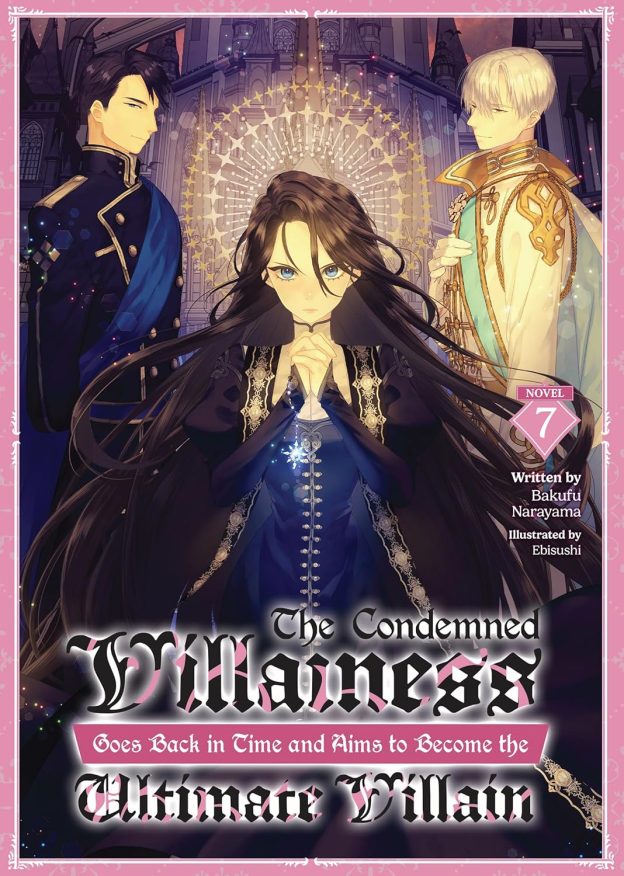
The Condemned Villainess Goes Back in Time and Aims to Become the Ultimate Villain, Vol. 7

By Bakufu Narayama and Ebisushi. Released in Japan as “Danzaisareta Akuyaku Reijō wa, Gyakkō-shite Kanpekina Akujo o Mezasu” by TO Books. Released in North America by Airship. Translated by Alyssa Niioka. Adapted by Vida Cruz-Borja.

Please note that spoilers are far more unavoidable than usual this volume. If you want to remain unspoiled, please try to read the review after the book. I’ll stick the cover art here to hopefully mask it.

So, let’s talk about the Unreliable Narrator. Starting off by spoiling a 100-year-old book for you, the most famous example is probably Agatha Christie’s The Murder of Roger Ackroyd. It upset a lot of people when it came out, and folks who were especially invested in trying to figure out the mystery, rather than reading it as a cracking good yarn, especially felt betrayed. They said it was cheating, not playing fair. The author said that all the clues were there if one kept an open mind. And the narration did actually play fair. There were omissions, and subterfuges in it. But you didn’t see a whole chunk of book being given first-person narration by someone who then turned out to literally be lying solely to the reader. That’s why this volume makes me mad.

The book alternates, at least for the first half. Claudia’s part of the book has her learning that the Church has chosen a new Saint, and that she is one of the two who have been chosen to help the Saint during her canonization, which will involve not touching men, not eating meat, etc. She’s also dealing with a refugee problem, which is tricky because, as both her brother and her maid/best friend point out, she gets too emotionally invented in everything. She also gets very mad at herself for not seeing things that are only obvious in hindsight and not being perfect. Typical Claudia, in other words. The other half of the book follows a sister in a girls-only monastery who gradually opens her heart to the injustice of the world, saves a young boy from being whipped to death, and uses her new Saint position to help war-torn refugees. Then the author says “whoops, I had the switch on her back set to good by accident” and everything turns terrible.

I’m not sure if I was supposed to be fooled by the Sister (nun)/Sister (sibling) thing, but it was made pretty obvious from the start that this was supposed to be Fermina. And I thought I was going to see… well, exactly what I saw, but I thought we’d go about it a different way. The first half has lots of Fermina’s POV, as we see her viewpoint gradually change as she’s exposed to good people and also the injustice of this world. And then she’s picked up by the Church, who we’ve already seen are going to be evil so Claudia can suffer. I was pretty sure we were either going to see sweet lies poured into her head, or literal brainwashing, but that had been signposted, so I was fine with it, and the Claudia stuff was excellent. Then the Saint POV disappears from the narrative for about 100 pages, and I went “uh oh”. Then we get the final Fermina POV chapter, where she reveals that in fact this was all a setup from the start, which she knew, and she’s secretly been as evil as ever. This is not a case of “if you read the unreliable narrator right you can guess it”, this is a case of “LOL, you fell for it!”. SO ANNOYING. Especially as I was OK with Fermina learning a hard lesson and getting better only to fall again, and am very unhappy she’s as one-dimensional as ever.

This has a nasty cliffhanger, which you can likely guess, and I’ll keep reading. But boy, this left a bad taste in my mouth.
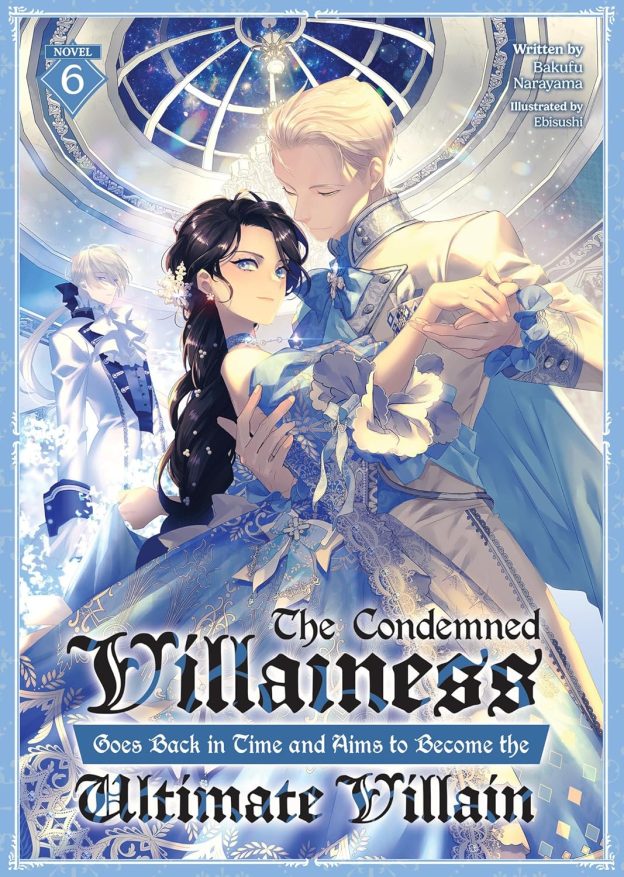
The Condemned Villainess Goes Back in Time and Aims to Become the Ultimate Villain, Vol. 6

By Bakufu Narayama and Ebisushi. Released in Japan as “Danzaisareta Akuyaku Reijō wa, Gyakkō-shite Kanpekina Akujo o Mezasu” by TO Books. Released in North America by Airship. Translated by Alyssa Niioka. Adapted by Vida Cruz-Borja.

Last time I felt that the series got a bit too dark, and I’m pleased to see that this one is not quite as bad. Despite the fact that this volume contains ghosts, ritual sacrifices, and the like, Claudia’s worries are far more about the fact that she’s getting bullied by all the older women in the kingdom – at the request of the Queen, of course. Let’s face it, if you’re going to be the future Queen, you need to be better than everyone at everything, and that includes how to handle petty bullying. If there’s just one issue with the book, it’s that these two plots don’t intertwine as well as I wanted them to, and it felt at times as if the author had two books that they couldn’t quite make work and so decided to combine them into one. It’s still a very readable series, and I like Claudia, but I am starting to tap my fingers a bit.

Claudia continues to go on her Princess Training World Tour, with several stops organized by Lady Sunset, whose husband is the Queen’s older brother. Lady Sunset is there to ensure that Claudia does not wilt under pressure, or (even worse) snap and get angry under pressure. We see Claudia attend a tea party, an embroidery party, and a ball, all of which feature catty middle-aged nobles whose job it is to belittle Claudia and hit her where it hurts – which usually means talking bad about her stepmother. In addition to all this, she and Helen go off to a monastery for two weeks, to learn asceticism and see how difficult it can be for people who don’t have servants to do everything for them. Unfortunately, the remote castle where the monastery is has a small problem… ghosts.

There are as always some things here I found quite interesting. The embroidery party shows off how each of these catty women trying (at the orders of the Queen) to bully Claudia has territory of their own, and that territory naturally has specialties. Claudia being Claudia, she’s able to tell that the tea “accidentally” spilled on her embroidery is from the spiller’s own land, and praises it. As for the embroidery itself, she praises the wool being used, and wouldn’t you know it, the woman whose territory specializes in wool is struggling to find buyers right now. Claudia doesn’t need to make connections with these women – she’s hella powerful already – but she knows by doing so it makes the country stronger. I also liked the ghost story’s suggestion that a woman in the past may also have been living a second life, and her “precognition” was just her not being quite as good at Claudia at hiding that. Perhaps this world just does time-looped villainesses every so often, as a treat.

This was a decent book, though I felt it didn’t pull together as well as it might have. The bigger issue may be that I’m checking to see when the series is scheduled to end, and the answer is “not for the foreseeable future”. Where’s my wedding cover art?

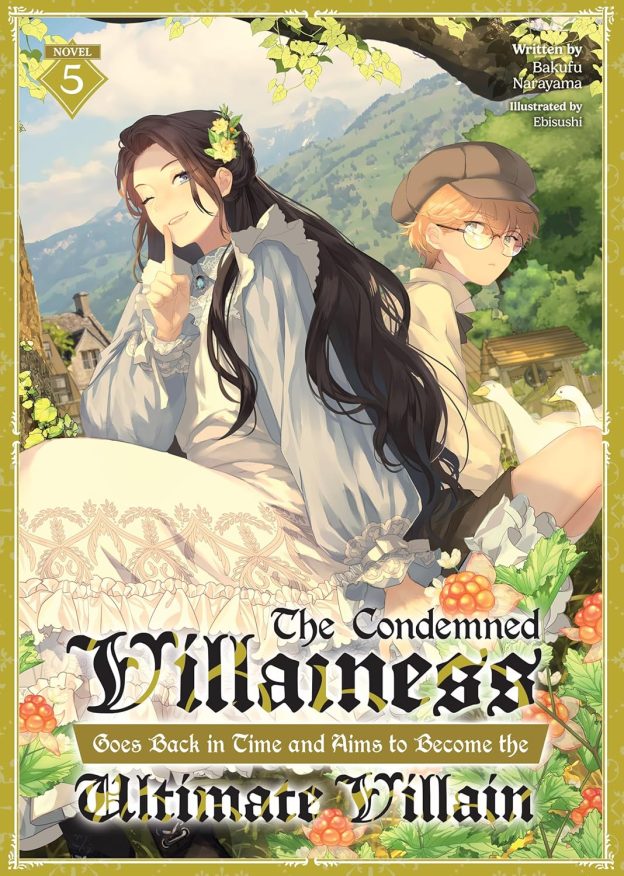
The Condemned Villainess Goes Back in Time and Aims to Become the Ultimate Villain, Vol. 5

By Bakufu Narayama and Ebisushi. Released in Japan as “Danzaisareta Akuyaku Reijō wa, Gyakkō-shite Kanpekina Akujo o Mezasu” by TO Books. Released in North America by Airship. Translated by Alyssa Niioka. Adapted by Lex Reno.

Content warning: this book’s main plot contains, and my review discusses, pedophilia, grooming, and brainwashing people through drugs and gang rape. The last two are implied but not seen, the first two are definitely seen. Reader discretion is advised.

I’ve called these books difficult to read before, but none of them quite hit like the middle of this book, in which Claudia has to deal with a village of people whose “Chieftess” (does that word get gendered?) is easily one of the worst antagonists in the series to date – see above for why. Fortunately, this is what Claudia and Sylvester are here to fix, though both of them castigate themselves that they didn’t even know it was happening till she conveniently got kidnapped. Sometimes being royalty means finding out about problems that people are deliberately keeping from you. Especially when they’re once again a plan of Nigel’s, the series’ overall big bad, who isn’t in this book but whose presence is felt. Corruption turns out to be – literally – an incredible drug.

By now everyone agrees that the running for the fiancee position is over, and Claudia and Sylvester’s engagement party date is set. Unfortunately, before this can happen, Claudia and Helen – out on the town incognito, with Claudia also disguised as a maid – run into a boy who is dressed as a child detective – because he is one, in fact – and he’s on the run from some goons. They quickly hide in a cart… which then drives off to a remote village, and that village turns out to be the one the boy (Kiel) was investigating. (Helen was able to get away and is getting help.) They find the villagers are all very happy and content… a bit TOO happy and content. The whole village feels a bit like The Stepford Wives. What’s more, people seem to occasionally disappear for no reason. What’s really going on?

So yeah, as indicated earlier, things are very screwed up in this book. What started as a discovery of a pain reliever that allows the village to make a bit of extra cash has suddenly become a village-wide “ritual” when the girls in the village have their first period or the boys have their first “nocturnal emission” to drug them with an aphrodisiac and then have the others in the village rape them till they grow happy with it. The girls in the village who have NOT gone through this yet are quick to side with Claudia and Kiel. The chieftess in particular is a hedonist and pedophile, who literally gropes Kiel to see if his balls have dropped, and openly leers at Claudia. The book is well written as always, and help arrives in the nick of time. But I have to ask, was this trip really necessary?

The series is still ongoing in Japan, and a glance at the blurbs of future books suggests things don’t get easier for Claudia even after her engagement. Hopefully, though, they involve a few less things for me to warn the reader about.