Category Archives: duchess in the attic

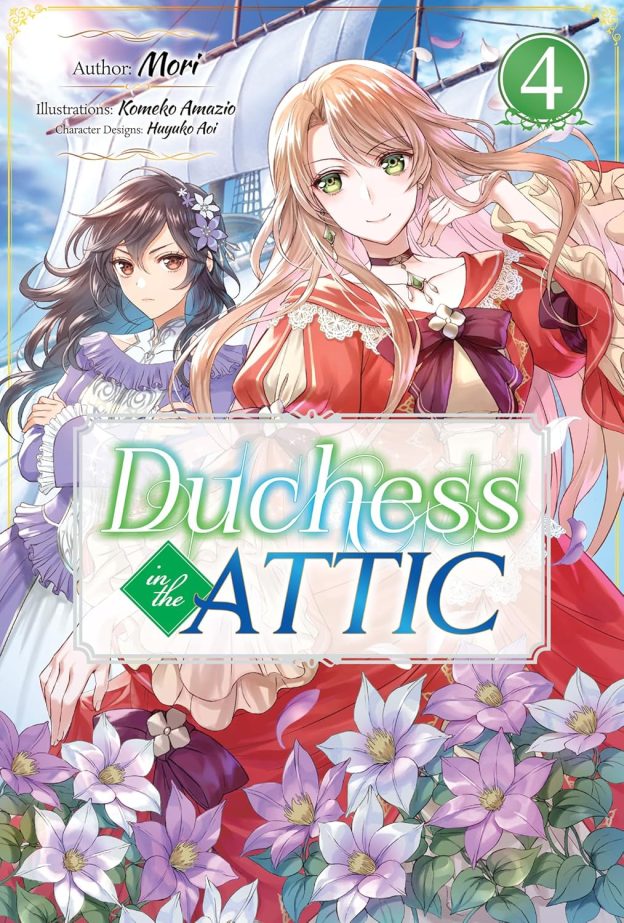
Duchess in the Attic, Vol. 4

By Mori and Huyuko Aoi. Released in Japan as “Yane Urabeya no Kōshaku Fujin” by Kadokawa Books. Released in North America by J-Novel Heart. Translated by piyo.

So first of all, I need to tell you all something important: despite being kidnapped here, Opal is not locked in an attic. The only sign of the title of the series are at the start, where she waxes nostalgic about the old attic days with her husband, and later on, when she waxes nostalgic about being locked in the attic while she’s being kidnapped. For the most part, what this book is about instead is Opal passing on her wisdom to the generation after her. We meet a troubled young royal, who is trying to avoid an engagement to someone she doesn’t love, and is a bit difficult and hard to deal with. Everyone except Opal spots the similarities immediately, and even Opal eventually admits it. That said, Ellie is a lot more naive and childish than Opal was in the first book, so has a much higher bar to clear. Also, she’s a princess, while Opal was just high nobility. Still, it’s never too early to learn how to get kidnapped.

Opal and Claude are on vacation when they are called back by the King, who asks Opal to mentor the willful princess of Lumeon, who has lost her parents and grown up with bad tutors and has basically become a spoiled brat. After being half-cajoled, half-blackmailed into it, Opal sets out on a sea voyage, first disguised as a commoner (where she meets a troubled woman and her adorable daughter and tries to help get them some work), and later on posing as a flighty airheaded duchess, where she enchants the guy who is trying to con the princess (also incognito) and switches to conning her instead. Fortunately, as Opal gets to know Ellie, she finds that a lot of her spoiled brat is just a very lonely girl acting up as it’s all she can do. Unfortunately, this series is still about the difference between the haves and the have nots.

There’s a lot of Opal being smug and solving her own problems here, but the series also is very clear that she has a tendency to “be one step behind”, as shown by the troubled mother and adorable daughter she meets on the boat, who we later find ended up working in a sweatshop. This is not Opal’s fault, but it does show that someone like her, who does try to save what’s right in front of her, can’t be everywhere. Her brother Julius is still better than her at most of these things, though he fails to be better than her at villainess-type parties, as she absolutely crushes the two ladies who are trying to destroy her reputation with the King. Essentially it’s telling us that even in her early 30s or so (I think that’s her approximate age), and with a husband and kid, she still has a lot to learn.

Fortunately for her, this series still isn’t over. This isn’t essential shoujo light novel, but it’s a good one for those who like women trying to march shoujo light novels into the 20th century kicking and screaming.

Duchess in the Attic, Vol. 3

By Mori and Huyuko Aoi. Released in Japan as “Yane Urabeya no Kōshaku Fujin” by Kadokawa Books. Released in North America by J-Novel Heart. Translated by piyo.

(This review discusses a plot twist near the end of the book, but I will wait till paragraph three to do so.)

This is a very odd series, in that it’s technically meant to be a thriller of sorts, where we see Opal struggle against events that are conspiring against her. But she’s never seriously in danger, and knows it. And we, the reader, are fine with that. We’re not reading this series to see Opal being threatened by goons, we’re reading this to see Opal being smug, and boy howdy do we get that here. We also get another attic, and this time she stays in it for an extended period. I sometimes wonder if the author thinks of Opal in the attic, and then writes a plot to get her into it, rather than the other way around. As for the book itself, well, it’s taking the events of Books 1 and 2 and telling the reader we should have been paying far closer attention to them.

After the events of the last volume, which ended with someone trying to break up Opal and Claude, she heads off to their new lands without him. There she finds an old-fashioned, Satan-hating land maintainer, a butler who screams “I am evil”, and a footman that she immediately dislikes on sight. Fortunately, she does have her loyal maid Nadja. Unfortunately, while on her way to inspect mines, which requires her staying at a ludicrously opulent mansion that looms over a poor neighborhood, she finds herself kidnapped, locked in an attic, and held for ransom, along with Nadja. At least she gets things to read from that footman she dislikes. As for why she’s been kidnapped, well, the anti-royal faction have decided to have their revolution, and she makes a great hostage. Supposedly. If their revolution were going well.

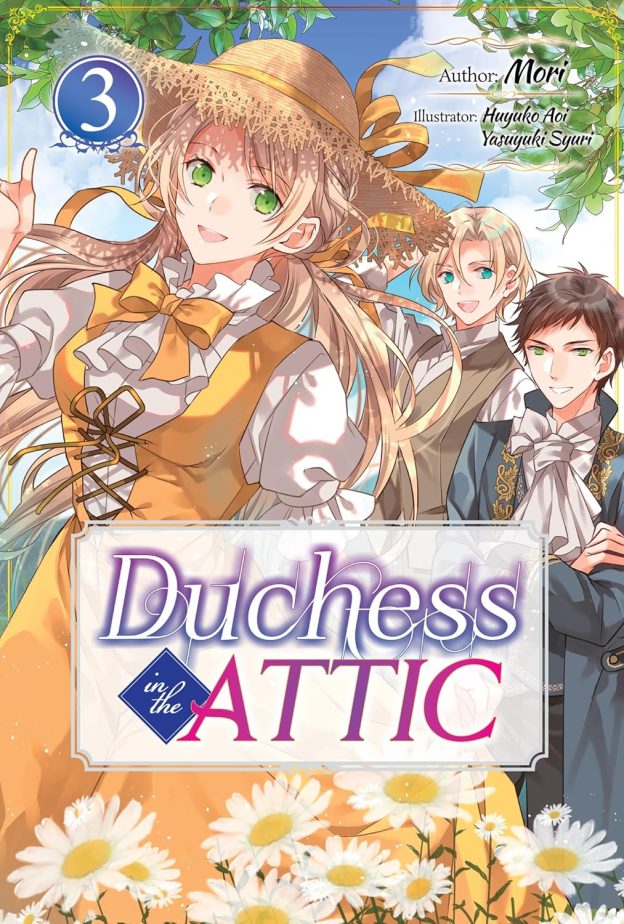
So, one mystery I love is The Murder of Roger Ackroyd, by Agatha Christie. It’s not loved by everyone, however, and gets into “is it OK to withhold vital information when you are a first-person narrator?”. This book does the same thing, with Julian, the footman. I already knew he was going to be more than just one of the three bad guys. For one thing, he’s on the cover, pictured happily next to Claude and Opal. For another, he gets a big interior illustration the moment he first appears. That said, I assumed that he would be, y’know, an old friend of Claude’s who’s being a spy. Which, admittedly, is 100% true. But he’s also someone we’ve been hearing about since the very, very start of the series, always present by his absence, and Opal’s immediate dislike of him should have been a bigger clue. No one fights quite like a brother and sister, after all. This also makes the climax of the book, which should be tense and anxious, hilarious, as the two cannot stop sniping at each other. It’s glorious.

The first book had a definite ending, and then it continued. This third book also has a definite ending, and yet there is more. I’m looking forward to it a great deal, though.

Duchess in the Attic, Vol. 2

By Mori and Huyuko Aoi. Released in Japan as “Yane Urabeya no Kōshaku Fujin” by Kadokawa Books. Released in North America by J-Novel Heart. Translated by piyo.

I admitted to being very surprised that there was a second volume of this very “finished in one book” series. Even the title, Duchess in the Attic, was not something that was going to make sense going forward unless something silly happened. (The author agrees with me there: it’s an artifact title, and a few jokes are made about her moving back to an attic if things with Claude go south.) So I wondered what was left to learn about Opal now that the series was ongoing. As it turns out, not much about Opal herself – she’s much the same person she was in the first book, if a bit more unforgiving of fools. But the systemic power of the nobility and the misogyny rife throughout multiple kingdoms is very much still a problem, and Opal wants to solve that. If the first book was about Opal rescuing herself, this book is about her trying to rescue others. She’s a philanthropist. Of course, there are a few things to work out first, and that’s what this book is about.

Opal and Claude are off to his new homeland, Taisei, to get married. This involves meeting some of his friends, who regard Opal as a terrible choice of spouse. And the King, who seems to be one of those mischievous kings. Many subplots are introduced, but we don’t really deal with any of them, because the bulk of the book actually takes place back in Socille, as Opal hears that Beth, her former abusive maid who was working for Hubert and Stella, has been fired because she got pregnant. Investigating, it turns out that the father is a rogue noble, Keymont, who apparently has spread his seed far and wide, and other women have children by him. Deciding that enough is enough, Opal decides to shame him at a public gathering to get child support for his conquests, only for things to blow up far more than she intended.

There is no small amount of romance in this. Opal and Claude love each other, and get very jealous when any of the opposite sex shows interest. There’s also the very awkward conversation they have where Opal tells Claude that, despite being married for almost a decade, she’s still a virgin (it’s implied he is as well). But the main reason to read this book is not the romance, it’s the politics and the worldbuilding. These are two kingdoms that are essentially right around where the late Victorian/early Edwardian period was in this world, and progress is happening so fast that it’s unnerving people. Why, it’s gotten so bad that a noble rake can’t even go around robbing common people for the lulz anymore. The other political part of the book is its feminist stance, which is awesome. I loved Opal’s reaction when Hubert indicated Beth’s pregnancy was her own fault – marveling at an Immaculate Conception.

Opal still hasn’t seen her new domain yet, and I have a feeling that the third book will have things go a lot more poorly for her than this one did. Still, I found this just as enjoyable as the first.