Category Archives: how a realist hero rebuilt the kingdom

How a Realist Hero Rebuilt the Kingdom: Short Story Chronicles

By Dojyomaru and Fuyuyuki. Released in Japan as “Genjitsu Shugi Yuusha no Oukoku Saikenki” by Overlap Bunko. Released in North America by J-Novel Club. Translated by Sean McCann.

Siiiiiiiigh. No, that’s not a sigh over the content of the book, it was quite good, and I enjoyed it very much. That was a sigh over the fact that it is, like a lot of this type of book, unreviewable. It’s a short story volume that serves as the final volume of a long-running series, so I’m not going to be selling it to anyone but folks who have read the other 20 books, who will buy it regardless of what I say. It’s micro-stories, so I can’t even do a nice summary of them that uses up 1/3 of my word count. But come on, they’re fine. They mostly seem to cover what happened just before or just after some of the more notable scenes in the series, and a few of them try to cover characters or relationships that weren’t delved into much before. Mostly, though, it’s one last round-up of the folks who you enjoyed reading about for nearly a decade. Machiavelli, thankfully, is absent.
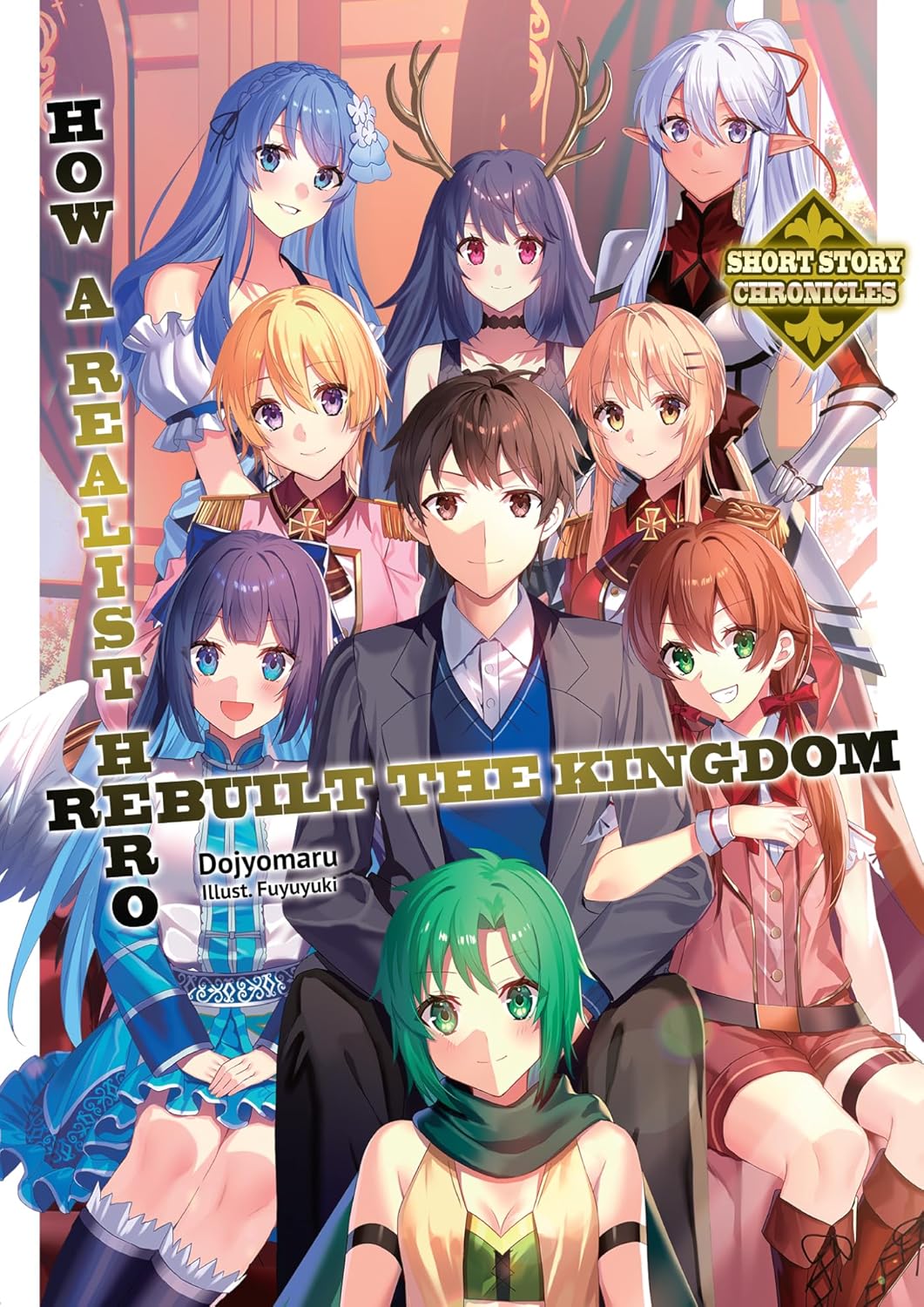
The cover shows Souma with his eight wives, including the surprise final wife Juno. The wraparound story takes place about two decades or so after the final book, with Juno’s son and Aisha’s daughter going up north to go adventuring, which sadly gets immediately aborted when they run into jerks who insult their moms, meaning that beatdowns are coming… for the jerks. Luka is, much like Souma, a bit potato-ey, but like all his moms, he can kick eight kinds of ass… in fact, literally like his moms, that’s his power. Misha is an eight-year-old dark elf, meaning she’s old enough to see the world, despite the worries of her mom. And we also meet Shanti, adopted daughter of Mugal and Fumi (no, I don’t remember them either), who wants to battle now and is very pissed off Luka won’t do so. (She hasn’t gotten permission from her dad yet.) Oh yes, and Musashibo is there, and everyone knows who he is.

That takes up about 30 pages. The other 376 (!!) are the micro-stories. I have no idea if these are “bookstore exclusives” or what have you. I liked seeing more of Serina, who’s perfect for this sort of book: funny and didn’t really get a lot of screen time explaining why she fell so hard for Pancho. Likewise, there’s a series of stories showing Maria going round to visit the wives, not really getting their permission but more showing that she’s one of them now. Everyone likes each other in this. That may be its big weakness, of course. Since it covers nineteen books where we know what’s happened already, these stories are generally a bit boring. That said, who wants angst and drama at a time like this? This is heartwarming out the wazoo, the main women (it’s mostly driven by the women) are great, and it ends as it began, with Souma and Liscia riding a horse through town, only now he can ride, and she’s in front of him.

So yes, this is the final end, full stop, I’m sure there won’t be any more. Maybe. Bye, Realist Hero. You were far better than anything Eliezer Yudkowsky has come up with.
How a Realist Hero Rebuilt the Kingdom, Vol. 20

By Dojyomaru and Fuyuyuki. Released in Japan as “Genjitsu Shugi Yuusha no Oukoku Saikenki” by Overlap Bunko. Released in North America by J-Novel Club. Translated by Sean McCann.

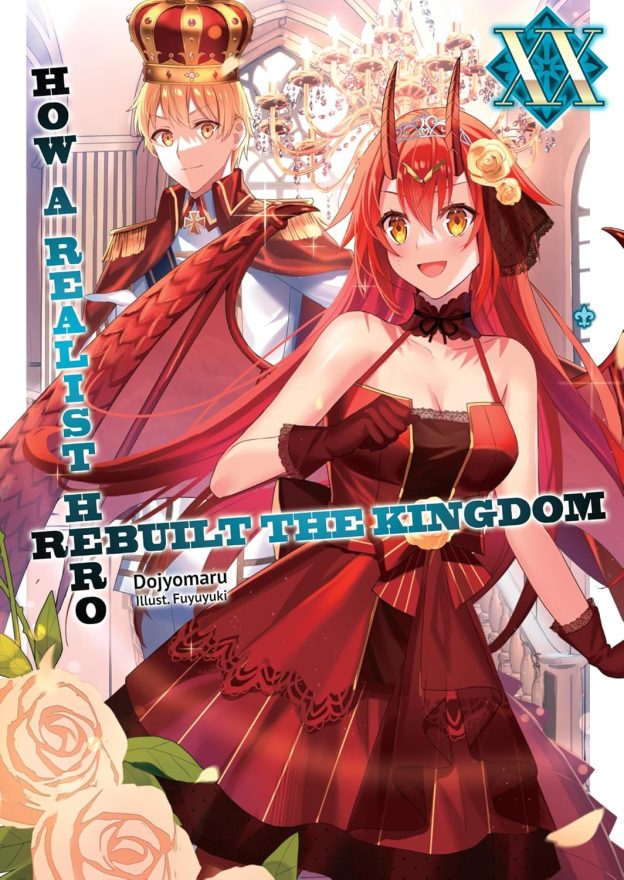
Yes, I know, I jinxed it. I was looking forward to this being the final Realist Hero volume, and lo and behold, there’s a short story collection still to go. Still, for the most part, this does serve as the “epilogue” to the series the author wanted, for better or worse. For worse is laid out right there on the cover, which might be the most bizarre choice of cover art for a final volume ever. (The short story volume, realizing this, will have Souma and his wives instead.) Of all the plot points I wanted this series to resolve, “who does Souma’s son marry?” was pretty low on the list, and the fact that the answer is Carla does not fill me with glee. To her credit, Carla brings up all the reasons I hate this pairing, but Souma essentially shoots them all down by telling her “Face it, Carla, it’s Chinatown”, and she ends up going through with it anyway. Sigh. What else do we have here?

In addition to the Carla subplot, we see the rumor that Souma has a secret love child (who turns out to be Souma’s actual child and not secret at all); Souma and the other nations open an airline service using dragon knights; Lombard struggles with ruling the new Kingdom of Remus, broken apart from Fuuga Haan’s old empire; Lucy runs a wedding planner service, and brings the reader up to date with more couples getting married; Merula goes back to the spirit kingdom, no longer exiled, but finds herself homesick fairly quickly; Julius and Tia deal with their carved-out bit of the former empire; Jeanne and Lumiere try to discuss politics, but their old friendship and Lumiere’s lingering guilt gets in the way; the rumors that Souma has a secret eighth wife turn out… wait, they’re true?; the former king and queen pay a visit to Georg’s widow and greet her “new” mysterious masked husband; and Anne, the former Saint and Fuuga’s abandoned ally, imprisoned for her own safety, is having post-war trauma and nightmares, and needs therapy.

As you can imagine for an epilogue that’s essentially a short story collection of its own, the contents are highly variable; made more difficult that I didn’t keep a spreadsheet when I read this series, so once again tend to forget anyone who isn’t Souma or his wives. I did enjoy the resolution of Juno’s plotline. The last of the women in love with Souma, marrying her off to someone else would have felt cheap. At the same time, it makes sense that she’d want to be a “secret” wife out of the royal limelight. Plus it allows Souma to use the mascot costume on a regular basis. I also liked how Anne’s story was handled. Her plotline is frankly horrific, and we’re reminded that she was 12 years old, manipulated by everyone around her, and forced to watch all her allies executed or slaughtered. Moreover, the fact that she’s never seen herself as anything but a tool now means she sees herself as nothing. The idea of animal therapy as a start is a great one.

We even get a “lady or the tiger” ending, where we’re told Souma eventually died of old age surrounded by his family… OR DID HE? This final volume of Realist Hero tried to dot i’s and cross t’s, and succeeds about half the time.

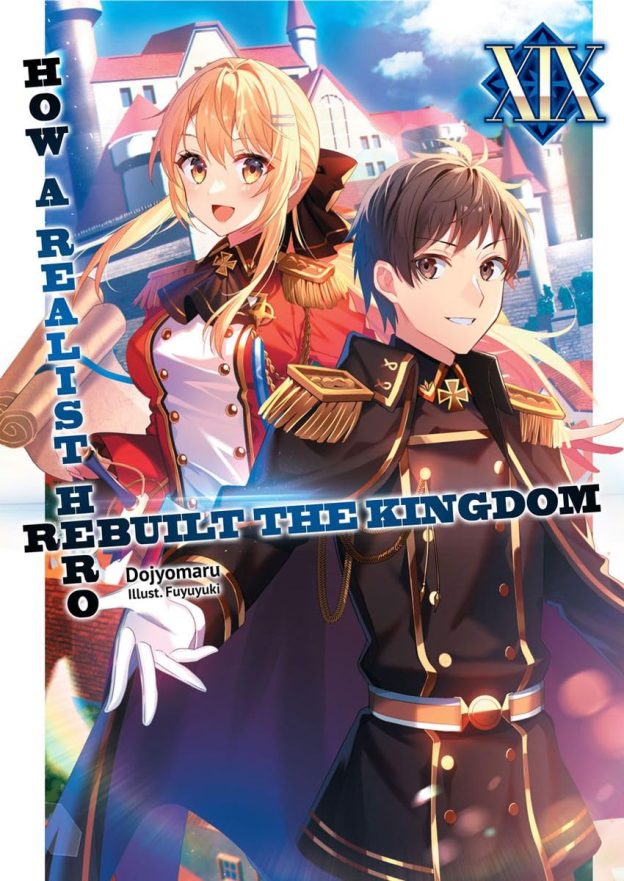
How a Realist Hero Rebuilt the Kingdom, Vol. 19

By Dojyomaru and Fuyuyuki. Released in Japan as “Genjitsu Shugi Yuusha no Oukoku Saikenki” by Overlap Bunko. Released in North America by J-Novel Club. Translated by Sean McCann.

There are certain long-running light novel series that I review that I consider “grandfathered in”. What that means is I’ve been reading them for years, and I know that they’re not really all that good any more, but I set a lower bar just because… well, I’ve been reading them for years. Now, obviously, sometimes a series doesn’t even clear that low bar, and I drop it some 15-20 volumes in. In Another World with My Smartphone was blessed with an obvious “please stop reading here” volume, whereas The Irregular at Magic High School decided to shove its homophobic right-wing protagonist in my face one too many times. Realist Hero has not hit that low bar. It’s still readable, I feel no desire to stop one volume before the end. That said,. there is a moment here where our heroes are fighting the villain, and get mad at him for still being single and not having married like everyone else in this series, where I wondered if this was written by the ghost of Shinzo Abe.

We left off with Souma having revealed that there’s a whole new world of adventure to be had in the North, thus impacting the morale of all of Fuuga’s troops, as well as Fuuga himself. Unfortunately, that’s not quite enough to stop the battle that’s going to be happening today, and now Fuuga knows he has to deal with everything right now or he’ll lose. What follows is a lot of battle, and Fuuga loses. (I don’t regard this as a spoiler because you have read the previous 18 volumes. Did you think Souma would be killed?) Souma manages to swing the battle in such a way that Fuuga is able to retreat with honor (persuaded to do so by, you guessed it, a pregnant wife), but his dreams are dashed. Unfortunately, he is smarter than some of his generals, who have a “war or nothing” mentality. The fragile peace can’t last forever…

This series, for the most part, does not kill people off, something I joked about last time, when it killed off the two oldest men in the cast who had already lived full lives and didn’t have young wives and children. This penultimate volume can’t QUITE do that, but it does manage to avoid killing off any of the named supporting cast on Souma’s side. The same cannot be said of the enemy, and I spent most of the book wondering if the author actually had the moxie to legitimately kill Fuuga off. (The answer is that they leave it vague, but I’m pretty sure the 20th volume will answer “no, he did not”). That said, Yuriga’s family definitely suffers some deaths, as they’re divided between two warring states, and some of them are simply battle hungry. Of all the “it’s better to have a family” hammers that get dropped on our head by the book, the best is Aisha’s fight with Nata, where she declares him boring because his battle style has nothing he cares about behind it but his own bloodlust. She kills him as an afterthought. That was some actual good writing.

Most of this, though, is Realist Hero writing. It’s ending in the next volume, which the author already says will be “epilogues” about all the characters. It’s long overdue, but I’ll read it when we get it. (And hopefully it won’t come back with After stories. Looking at you, Arifureta.)