Category Archives: imperial reincarnation

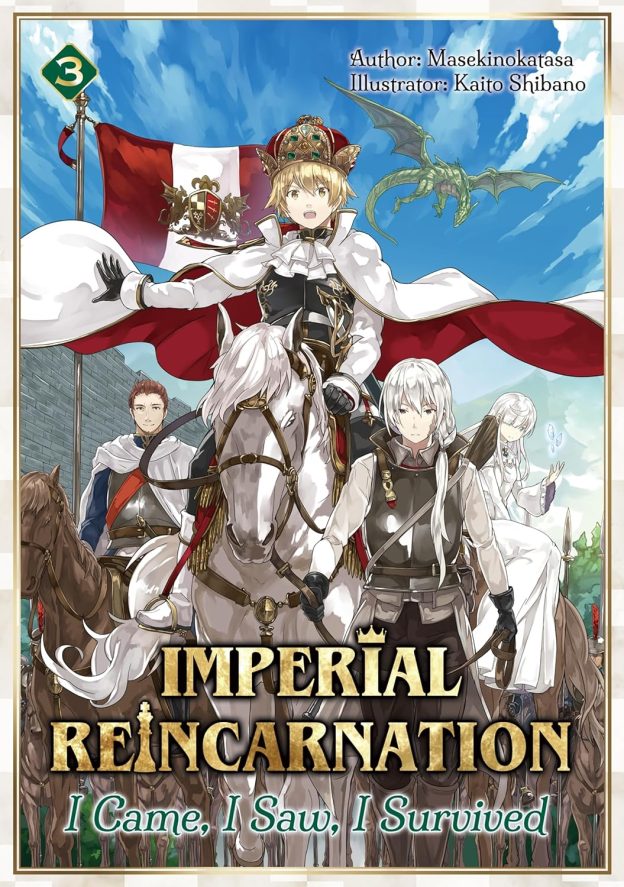
Imperial Reincarnation: I Came, I Saw, I Survived, Vol. 3

By Masekinokatasa and Kaito Shinobu. Released in Japan as “Tenseishitara Koutei deshita: Umarenagara no Koutei wa Konosaki Ikinokoreru ka?” by TO Books. Released in North America by J-Novel Club. Translated by Jason Li.

I appreciate that even now that we’ve had our coup and Carmine is allowed to not act like an idiot all the time, the best scenes in the book are still either him trying to be very clever and then realizing everyone was already way ahead of him, or him realizing that he’s kind of screwed up but can’t say anything about it. The latter is possibly the most darkly funny moment of the book, when his imprisoned mother pushes her lover out of the tower to his death, and everyone wonders why there were no bars in the window, and Carmine quietly realizes he removed them when it was Vera-Sylvie’s tower and forgot to replace them. OOPS. More awesomely, when Carmine points out (and you can see his logic) that he has to be on the battlefield leading the charge, he immediately gets some extra help he really does not want, because they know what he’s like, and “I might need to sacrifice myself” would be on the table unless they take it off.

The entire volume consists of the aftermath of Carmine taking power and trying to consolidate it, figure out who he can trust and who he has to execute, and preparing for war, as the sons of the folks he just murdered are declaring themselves independent and amassing armies. He can’t even really trust his own allies – his spymaster, at one point, deliberately makes himself less trustworthy to remind Carmine not to trust even those he’s closest to 100%. He’s always going to be the Emperor, which means he’s always going to be at risk of getting killed. His biggest concern besides allies is money and weapons, as well as an army to use those weapons. Money is the biggest worry, which is why he has to try to make a deal with the largest merchant company in the world right now. Fortunately, she, um, comes to him and offers a great deal? Not suspicious at all!

The most interesting part of the book was probably the meeting between Carmine and Hilaire Fechner, the head of the Golden Sheep Trading Company. Her behavior throughout the exchange, and even the interior art, makes you think of her as basically Mikuru from Haruhi, the sort who’s always crying and apologizing – she literally comes in apologizing in such a Japanese style Carmine suspects she too is reincarnated from Japan. Then of course we see her making deals and revealing secrets that essentially end up with everything going the way she wanted. You would expect most authors to at least confirm a little that she’s really crafty and this is an act, or have a side story from her POV later. But no, all we have is Carmine’s realization that she’s putting one over on them – the act doesn’t drop even for the reader, and it could be that she’s really like that. I want to see more of her.

You really, really need to be prepared for the lead character to ramble on about military alliances and trade agreements for 250 pages. If that’s your cup of tea, and you don’t mind that Carmine is still too young to have this series get TOO harem-ey, this could be right up your alley.

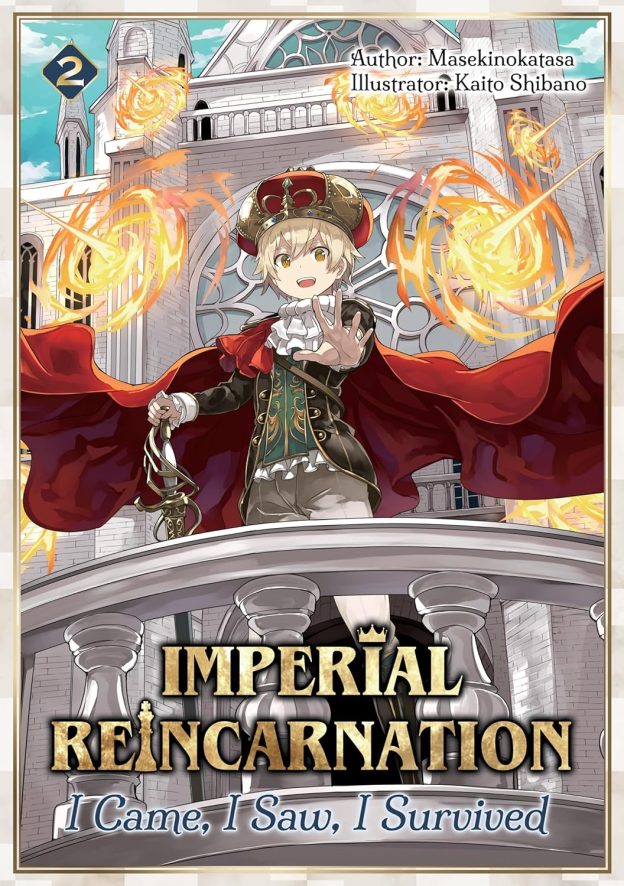
Imperial Reincarnation: I Came, I Saw, I Survived, Vol. 2

By Masekinokatasa and Kaito Shinobu. Released in Japan as “Tenseishitara Koutei deshita: Umarenagara no Koutei wa Konosaki Ikinokoreru ka?” by TO Books. Released in North America by J-Novel Club. Translated by Jason Li.

I admit, I had expected the build-up to the imperial coup (literally, the Emperor is doing the couping) to be longer than this. In retrospect, though, this actually feels about right. The series knows that there’s only so much we can take of Carmine pretending to be a dumb little puppet while gradually gaining trusted allies and learning vital bits of information. Especially given that he’s also still having to fight off assassination attempts. But it does show, as Carmine reminds us in this book, that the battle against the Chancellor and the Minister of Ceremony is only the beginning, and that we end this book with an Emperor who may finally have revealed his true self but is also left with an Empire that is still on the verge of collapse. This is only the beginning, and he’s going to need more things – allies, military power, and most of all money – to avoid history coming down on him very hard indeed.

This book divides pretty neatly in two. The first part of the book shows him touring the Empire, where he has to fend off another attempted assassination, try to win over some potential allies, and also be exposed to the horrors of war, which he knows very well he bears responsibility for indirectly, puppet or no. He’s revealing his true self to more and more people at this point. In the second half he learns the truth behind the Illuminatus, and that he is not the first person to be reincarnated into this world. And finally, all his plans come together, as he manages to have a faction send their troops to take over the empire because of treason, and then demonstrates – as he’s being crowned – what the reward actually is for traitors.

The first book had a substantial role for Rosaria as Carmine’s love interest, but also teased two other girls who may also end up with him. Nadine gets more focus here, and at first seems to be a standard cliche – Carmine sees her at the start of this volume and thinks “so this is what tsunderes are like”. But she also has to be imprisoned in order for Carmine’s plot to not get discovered too early, and it becomes apparent that she’s the most “normal” of the three girls – and therefore the most vulnerable, especially as she’s not put in a gilded tower like Vera-Sylvie, but put in the traitor dungeon, which is exactly what you’d expect a cliched dungeon to be like. Carmine literally has to send an ally to help her so that she doesn’t kill herself in despair. But her simpleness is also her best quality – she’s determined to mold him into a good Emperor, and though she can’t spot the act consciously like Rosaria can, she does spot it unconsciously – and when the truth is revealed, seems overjoyed to be of use to him after all. These are good kids.

By the end of the book Carmine is 12, in power, and in trouble. We’ll see if he can age further in the third book. This can be dry at times, but is also rewarding for those who like OP politics light novels.

Imperial Reincarnation: I Came, I Saw, I Survived, Vol. 1

By Masekinokatasa and Kaito Shinobu. Released in Japan as “Tenseishitara Koutei deshita: Umarenagara no Koutei wa Konosaki Ikinokoreru ka?” by TO Books. Released in North America by J-Novel Club. Translated by Jason Li.

I pay more attention to publishers than most, as readers of my reviews know very well. I’ve talked before about how, if I see something is GC Novels, my rate tends to be 9 failures for every 1 success. If I were to name the opposite, it would probably be TO Books, which is not quite the reverse ratio, but I do find that books I would not normally have tried (Otome Heroine’s Fight for Survival, for example) tend to be better than I’d expect. This was the main reason why I took a flyer on this title, which is in a genre I have mostly forsaken at this point. And, sure enough, I found it quite interesting. Well, let me clarify that. I found the actual plot and characters interesting. There is, however, a MASSIVE PILE of backstory in this book, which our emperor is not only expected to learn, but expects US to learn. It feels like homework.

Our dead Japanese man, who can’t recall much about his past life than that it was rather boring and unfulfilling, gets his memories back RIGHT from birth, and finds that he is now Carmine, the new Emperor of the Bundarte Empire. Unfortunately, he is an actual baby, and has not gained his isekai memories (such as they are) when he’s 7 or 8. Or perhaps that is fortunate, as our newborn emperor knows very well what fates historically await child emperors, and decides that the best thing he can try to do is pretend to be a good little puppet, and perhaps a bit stupid, while trying to secretly find out what’s really going on. Unfortunately, what he finds out is that his Empire is on the verge of collapse, and that everyone has taken one of two sides in the political maneuvering, neither of which are his side. On the bright side, he discovers magic exists, and that he’s good at it.

As mentioned above, the thing I least liked about this book was the history lessons, which will likely be important later but which I promise you I have already forgotten. The best part was probably the alternate narrative that I was slowly sussing out as the book went on. Carmine narrates most of the book, and shows us that he’s trying to put on an “I am an incompetent child” persona to avoid getting assassinated, and that, for the most part, folks buy it. Whenever we focus away from Carmine on other characters, we see that he’s actually very bad at the facade to anyone with half a brain. His eyes simply look too clever. I also very much liked his betrothed, Princess Rosaria, who pretty much immediately spots that he’s faking but also falls for him relatively quickly because of this dissonance. She then turns around and shows that she is even smarter than him, which impresses him in turn. This is still a relationship too young to go anywhere (and some concubines are promised as well – I think we meet both of them here, if I’m right), but it’s cute nevertheless.

The first book is about the first eight years of his life. It’s still ongoing in Japan, and later books promise we’ll see him reach adulthood. I’ll keep reading to discover how. Good stuff if you like reincarnation and college textbooks about Prussia.