Category Archives: rascal does not dream

Rascal Does Not Dream of a Beach Queen +

By Hajime Kamoshida and Keji Mizoguchi. Released in Japan as “Seishun Buta Yarou wa Beach Queen no Yume wo Minai +” by Dengeki Bunko. Released in North America by Yen On. Translated by Andrew Cunningham.

One refreshing thing about this series is that, while it was running, it lacked all the SS or .5 volumes stuffing in tons of short stories to drag out the plot. Which is good, as this series already felt like fifteen volumes was too long. But it’s over now, and so it’s time for Vol. 16, the first of two short story collections. Fortunately, for me if no one else, these aren’t microstories. There’s only three. The first story was a bonus that came with the Blu-Ray release of the anime. The second story was a freebie for fans who went to the movie. And the third is actually written for this book. Given that, they take place before Sakuta’s plotline is resolved, but they feel more relaxed regardless. The first story has a bit of drama, but it’s drama Sakuta is uninterested in. The second has drama, but mostly as a character beat for Sakuta. And the third is pure fluff. Perfect short story collection, in other words.
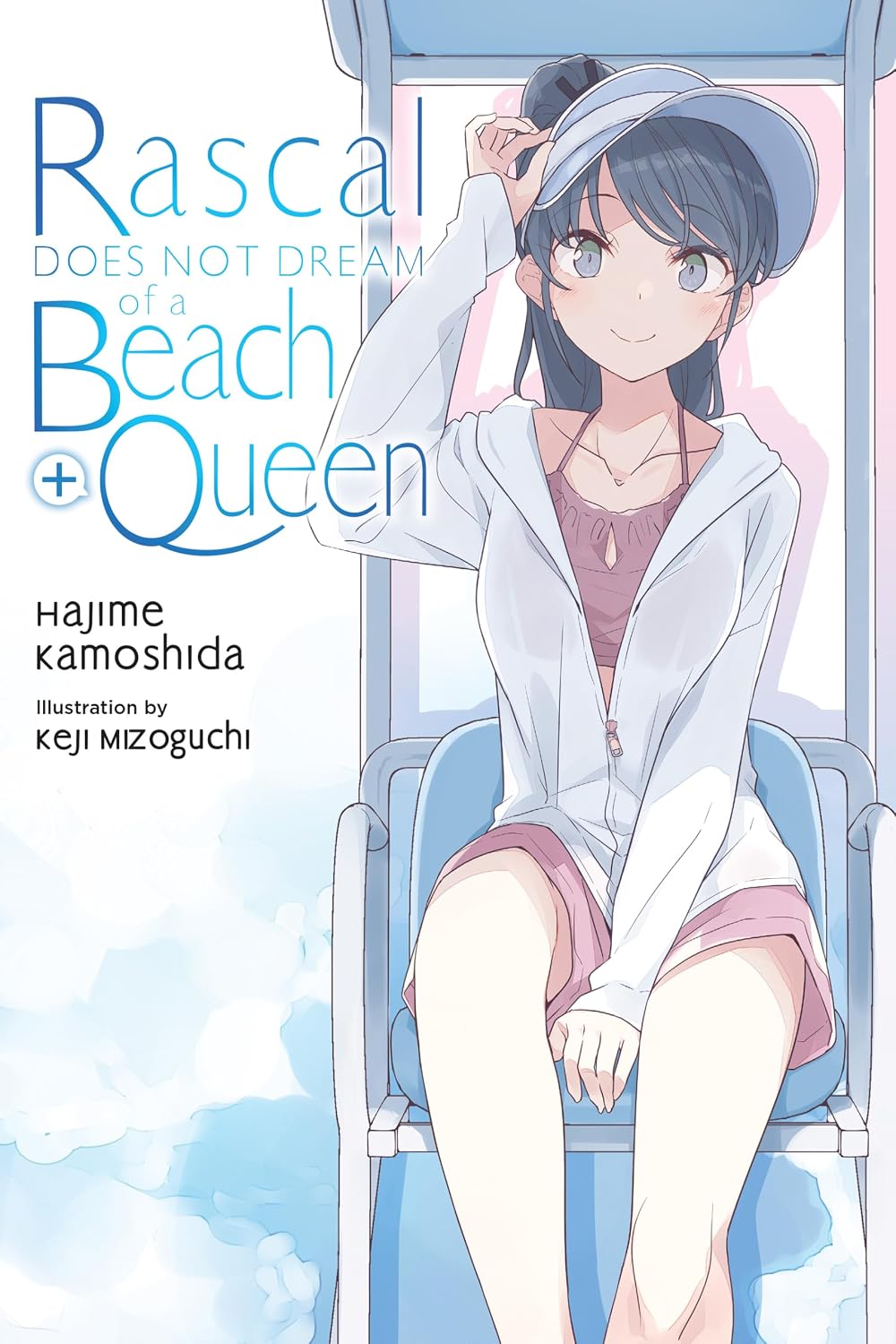
The first story takes up the bulk of the book. It’s the athletic festival in Sakuta’s final year of high school, and Mai is even coming at lunchtime to give him sandwiches. Unfortunately, despite being an alternate, he keeps having to do events as the star athlete has disappeared. Sakuta tracks her down, only to find that the disappearance is quite literal. In the second story, Sakuta and Mai go on a cute Christmas date, but Sakuta keeps seeing another girl, and he’s having these horrible emotions come to the surface. In the third story, Sakuta laments that, because she’s so famous, he and Mai can never go to the beach. She then surprises him with a trip to an exclusive summer residence with a pool… though he does have to also have his sister, Nodoka, and Uzuki tag along.

I’m going to try not to spoil the first story too much, but I was very surprised, I will admit. In fact, at first I thought what I was suspecting was a big fake-out, and it would be something far more prosaic. But no, it actually WAS what I was suspecting. The writing reads a bit like it was written for teenage guys a bit (because, well, it was), but hey. I did also appreciate that we get no resolution because Sakuta does not care about anything other than Mai, and so walks away. The second story relies very much on you remembering what happened in Books 6 and 7, and how even when a death is rewritten so that reality doesn’t have it, the grief still has to go somewhere. The third story is, as I said, pure fluff, but will definitely appeal to fans of Sakuta and Mai – they’re practically married here, as Mai notes.

There’s a second SS collection, which apparently does actually take place after the main series. Till then, fans will enjoy this.
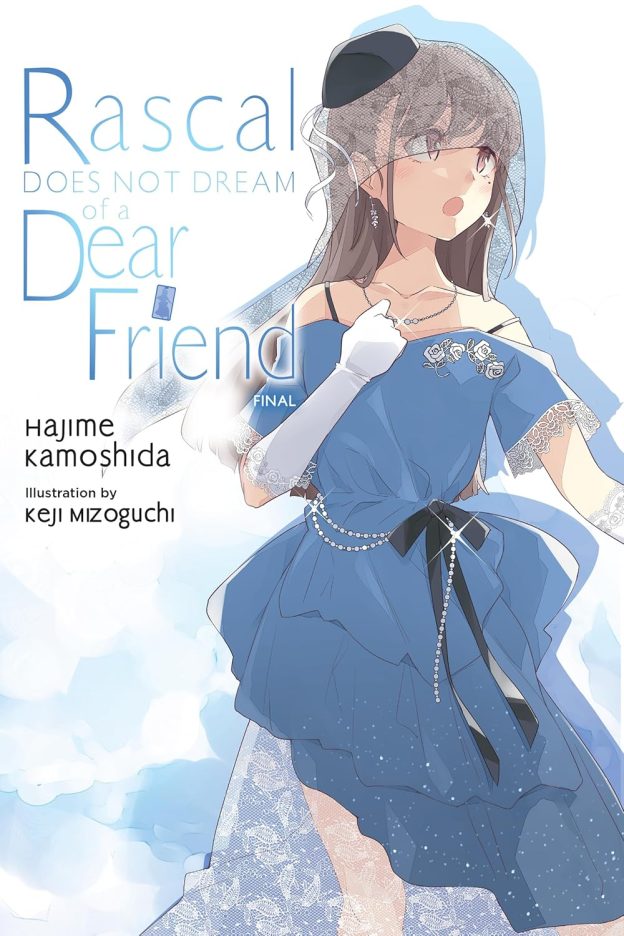
Rascal Does Not Dream of a Dear Friend

By Hajime Kamoshida and Keji Mizoguchi. Released in Japan as “Seishun Buta Yarou wa Dear Friend no Yume wo Minai” by Dengeki Bunko. Released in North America by Yen On. Translated by Andrew Cunningham.

And so the Rascal books come to an end (leaving aside any short story or side story collections) with a volume just as short as the previous one. The main conflict from the last few books gets solved fairly quickly and easily, so much so that we realize that it was a fakeout, and we’re right, as the real conflict is with Sakuta himself. Well, that and maybe the publishers. I’ve talked before about how the series has always felt a little artificially extended after the 9th book, and that Sakuta in college but still dealing with all the Adolescent Syndrome stuff felt tacked on. Turns out Sakuta agrees with me – no, not the Sakuta we’re familiar with, but his alternate-world “perfect” Sakuta, who has come by to let him know that there are many and infinite alternate realities around them, and they all think Sakuta sucks, because he’s managing to break all of them.

When we last saw Sakuta, everything was terrible as Mai announced to the world that she was Touko. Now he has to make things right, which involves getting deep into the heart of Miori’s relationship with Touko and why her repressed feelings are actually making things worse. This is resolved, and thanks to Mai doing a quick “this was all an April Fool” bit, no one believes that she’s Touko anymore (including Mai herself). Unfortunately for Sakuta, all the OTHER reality-altered dreams are still present and correct – there are two Kaedes, Yuuma is dating Rio, etc. As it turns out, Miori is more than just the last in a string of women Sakuta has to help, she’s a dimensional nexus point of sorts. While everyone else has alternate versions of themselves (which we’ve seen with the alt-Sakuta), there is only one Miori. That said, most of this has little to do with Sakuta’s actual problem – how does he fix everything?

Despite the fact that this seems like the 15th book in a row where Sakuta takes a lot of public transportation lovingly described until a solution occurs,. there are things I really enjoyed here. Touko’s final song being a palindrome made it very life affirming, and I wish Miori luck in finding a Touko who isn’t dead. I also liked Sakuta’s discussion with the alt-Kaede, and her own simple solution to his “problem”. His problem is phrased as “grow up”, and the solution is pretty neat, and ties into something we’ve known about Sakuta from the very start – I appreciate how this fixes everything. The biggest issue with the book, and possibly why the last two were so short (well, that and artist illness) is that it’s padded out. Sakuta goes round in circles a lot here, and at one point takes us on a tour of iconic Rascal Does Not Dream locations. Like his alternate self, I wanted Sakuta to get with it and solve everything, not mope around.

The book ends with an epilogue set two years later, with stuff I really liked as well as a few things I’m eeeeh on (why do people love student/teacher relationships? Who are not students?). Sakuta and Mai are still exactly the same as before only with all their issues resolved – sorry, no engagement, marriage, or honeymoon scenes. Basically, everyone has grown up. Rascal went on too long, just like its hero, but I liked it a lot.

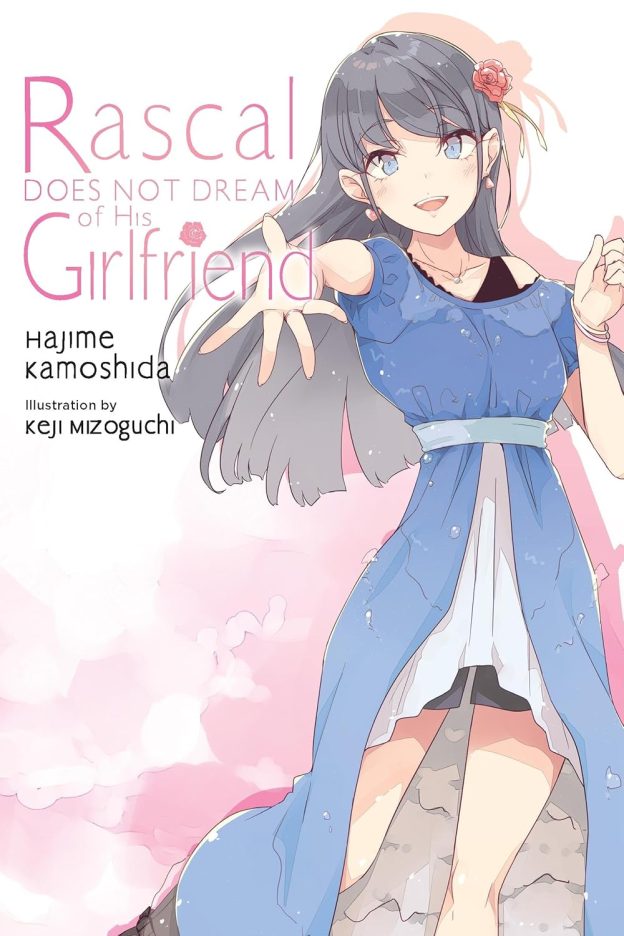
Rascal Does Not Dream of His Girlfriend

By Hajime Kamoshida and Keji Mizoguchi. Released in Japan as “Seishun Buta Yarou wa Girlfriend no Yume wo Minai” by Dengeki Bunko. Released in North America by Yen On. Translated by Andrew Cunningham.

If you remember my reviews of titles like Babel and Unnamed Memory, you may recall that I yelled at the author and the publisher (Dengeki Bunko) for taking what could easily be two books, divided in half neatly, and making them one huge 400-page monster. This book has the exact opposite problem. The digital version is a mere 139 pages long, and that’s counting the table of contents and the (one) color illustration. I wondered if it was a case where the final volume was too long to combine them, but no, the final volume seems to be the same size as this one. This should have been one book, but it is two, with this the first half. I get the sense, judging by the very minimal illustrations, that there were production issues, but it’s still a mostly frustrating volume where Sakuta has his latest crisis happen, wanders around talking for a while, and then has the series’ Deus Ex Machina help him figure out the issue… but not solve it. Yet.

We start this book with Sakuta having done everything possible to ensure that the dream everyone had of Mai announcing that she’s Touko will not come true. Guess what happens. What’s worse, this new reality sees EVERYONE’S dreams come true. Rio is dating Yuuma, Kaede is somehow now two people, both of whom are living a happy fulfilled life, Tomoe is now going to his college next term, etc. And none of them know reality is different, and none of them want to help him fix it. Fortunately, there is one other person who is unaffected by the Touko dream virus, and it’s very thematically appropriate. They manage to take a Sakuta who is at the end of his rope (in a mild-mannered way) and lead him to the main issue, as well as help him see who’s really behind everything we’ve seen in the last five books.

Despite my carping above, this is not a bad volume, just a mostly frustrating one. The revelations, as well as the one who is giving them, are thematically appropriate, and it’s nice to see Sakuta try his usual “walk around and mope at people until he figures things out” and have it not work at all. Turns out when people have their dream come true, they actually are happy and satisfied with it. Hell, some of the dreams might be the readers’ as well. I cannot think that Saki has any fans who are desperately unhappy that she’s broken up with Yuuma, and even Sakuta admits he’s happier with that outcome as well. (We do briefly see Saki, who is NOT happy with that outcome.) Even Kaede, who would be the one most torn by her incompatible dreams, literally becomes two people to fix everything. Mai is still in love with Sakuta and his girlfriend, she’s just also Touko. Everyone is happy and content. Except Sakuta. And the other two people I deliberately waffled around in the second paragraph.

So the next volume is the last, though there’s already an After Story volume out as well, apparently. I assume, this having mostly been all setup, it will be all payoff. This was good. Should have been combined with the next book.