Category Archives: reviews

Strike the Blood, Vol. 3

By Gakuto Mikumo and Manyako. Released in Japan by ASCII Mediaworks. Released in North America by Yen Press.

You’ll pardon me if I find myself saying the same things I said in the first two reviews of this series. I have gotten to the point where I almost wish Strike the Blood was worse than it actually was, as that might actually make it slightly more surprising, even in a horrible way. But no, this is very much a series that fulfills its function. It has a lot of cool, well-written action scenes, the plot advances incrementally, the hero gets a couple of new girls who like him, and the heroine sees this and is cool and frosty to him for reasons he can’t quite figure out. It’s very well colored, but never goes outside the lines. Not once.
strike3

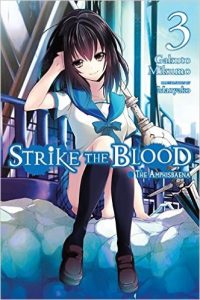
Oddly, you would expect a series like this to have varied covers, usually with the hero and a different girl on each of them. that is one thing Strike the Blood does do differently – each cover is Yukina posing for the reader, reminding readers that she is the main heroine whether they like it or not. And as a main heroine, she’s pretty good. The main reason I’m interested in her is that she seems to get frosty when the hero does something that implies he’s not attracted to her, rather than the usual punchy. Her overly earnest personality balances nicely against the more normal childhood hacker friend, the classic tsundere not-lesbian, and (introduced here) the shy princess and her sister, the teasing princess. Of course, the fact that all those are classic harem series archetypes also says something about what we’re reading here.

As for non-harem plot antics, well, trying to turn your adopted daughter into an Angel in order to make her happy is certainly not something you’ll see every day. I did appreciate that Kensei’s motives were given a bit of depth, showing off the somewhat misplaced love he has for her, even if his solution is appalling. It made a nice contrast with Beatrice, who comes to us right out of sneering female villains 101, and is such a cliche that it begins to verge on parody. Same with the elder princess, La Folia, who is noble and very royal, but also introduced to the reader by being found bathing in a stream, and also becomes the latest girl Kojou has to bite in order to release a beast monster to save the day.

I would ideally like something in this series to horribly offend or appall me, so that I could simply drop it and that would be the end of it. But no, Strike the Blood continues to be quietly competent and eminently enjoyable, provided you hate surprises. The hero is a nice guy, but if it weren’t for the illustrations provided throughout, I’d likely imagine him as looking exactly the same as Touma from A Certain Magical Index, a series which this has some similarities with. Index’s prose can be a bear to read, though, and it does throw the occasional curveball. Strike the Blood is batting practice. Straight down the middle, book after book.

Monthly Girls’ Nozaki-kun, Vol. 3

By Izumi Tsubaki. Released in Japan as “Gekkan Shoujo Nozaki-kun” by Square Enix, serialization ongoing in the online magazine Gangan Online. Released in North America by Yen Press.

There’s not really much in the way of plot or character development in a series like Nozaki-kun (indeed, much of the comedy relies on everyone not growing or learning in any way), so when it comes to reviews such as this, I need to look elsewhere to find things to talk about. This is another great volume, and Chapter 27 is one of my favorites in particular. It’s a pitch-perfect example of how everything is about the gags, but it doesn’t overuse the same gag, and its comedic rhythms are highly suited to the 4-koma style. It bears examining, so let’s do so.

nozaki3

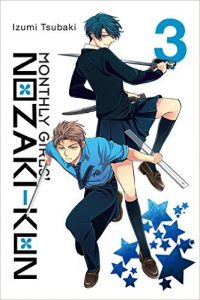
We begin with what is probable the ‘default’ gag in this series, as Nozaki and Mokoshiba show up pretending to be delinquents because Nozaki has to write in a rival character. They’re horrible at it, of course, so this leads to 2-3 pages of them doing something silly or out of place and Sakura giving her best tsukkomi comeback. She fulfills her traditional straight man role. However, we can’t forget that Sakura is in love with Nozaki. And, as we see when he attempts to climb a tree, fails miserably, and her heart skips a beat, she seems to especially be in love with Nozaki being an adorable loser. We then have 3-4 pages devoted to Mikoshiba and his issues, ranging from his embarrassment to simply being unable to climb back down the tree, and both Nozaki and Sakura serve as dual straight men. Finally, they leave and Seo shows up, being a genuine “delinquent”. Now it’s Mikoshiba who’s the straight man, observing Seo’s uncaring, oblivious antics. And Seo ends up getting the final punchline: “I’m late ‘cos a cute guy fell from the sky”.

In non-Chapter 27 news, Seo proves that she can use her obliviousness for good as well as evil when she buys a new exacto knife for Wakamatsu, and they also go on the worst date ever (at last from Wakamatsu’s POV); we see that everything horrible in Ken’s life is a result of Maeno’s very existence; While searching for a flaw that Suzuki could have, Nozaki misses the obvious, which is Kashima’s incredibly horrible singing voice; We find that Hori really is an excellent actor, but has trouble distinguishing between the actors and the characters they play, be it wanting to beat up Kashima or Miko-rin’s resemblance to a shoujo heroine; And Sakura’s attempts to show her affection fail miserably, be it old Valentine’s Day chocolate or someone mistaking her for the third wheel in a love triangle.

If you dislike standard Japanese comedy, this may not be as funny to you – much of the humor still relies on screaming “what the heck?” in disbelief. But for me, this is top drawer humor, and the 4-koma format means it doesn’t have to stop for pesky story development like Oresama Teacher, her other series. I love this series.

Also, though they aren’t as prevalent as before, the tanukis continue onward.

Overlord: The Undead King

By Kugane Maruyama and so-bin. Released in Japan by Enterbrain. Released in North America by Yen On.

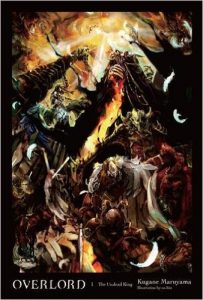
Given the extreme popularity of Sword Art Online, Log Horizon, and similar titles in Japan (and now in North America, where you can’t seen to walk ten feet before hearing about a similar series being licensed), it makes sense that we’d start to see series that play around with the format, or use it as a springboard for something else. Such a series is Overlord, which spends much of its first quarter or so making you think that the main character is going to find himself trapped in the game he loves so much only to end up being somewhere a bit different – he, and all his NPCs, are transported to a different fantasy world. Oh yes, and he played the game as an evil undead skeleton, and his minions are equally evil.

overlord1

With SAO, we saw a brand new game just opening. In Log Horizon, it was a popular game receiving a brand new update. And Overlord has Yggdrasil, which is a popular game whose time has now passed, and it’s getting its servers shut down. Our hero (who has three names throughout the book, but who I’ll call Ainz for convenience) was one of about forty players who had their own guild, which was composed of “monsters”, i.e. non-humanoid characters. Of course, that was a while back. Now he wants to have a party to celebrate the end of the game, and only three other players bother to show, and they all bail early. Right away you get the sense that he is more intensely devoted to the game than the others, but also that he is far more unfulfilled in real life than they are – he admits all he does is work, eat and sleep.

And now he, his group of somewhat cliched NPCs (all of whom have detailed backstories written by the other players, which is how we find out about them), and his giant hellish fortress are bounced into the middle of this fantasy world fighting a battle among three various empires. Luckily, there’s one tiny village that seems to be a focal point for all three, either as “killing everyone in the village will set an example” or “we are heroes, so must save this village no matter the cost”. Into this wanders Ainz, who tries to remain aloof and dispassionate but is still not about to let a cute teenage girl and her sister get run through.

I’ve summarized a lot of plot here, usually a sign that I don’t know what else to write about, but that’s not really true here. There’s a lot to work with after this first book has finished. Ainz is dispassionate because his undead form suppresses emotions – is he even human anymore? He still seems to regard this as a game he’s trapped in – will this change? And then there’s his NPCs, suppliers of most of the humor in the title – Albedo, his main subordinate, has a massive crush on him do to his being stupid before the “server shutdown”, and this leads to typical anime yandere humor. His NPCs also have motivations that go beyond obeying his command, something I don’t think he grasps yet.

So there’s a good many ways this title can go, and I am quite pleased I read it. That said, I do hope that it continues to play with its cliches rather than embracing them – there’s always a danger that this becomes a straight=up male power fantasy sort of title, and I think it could be much more than that.