Category Archives: reviews

Paradise Residence, Vol. 1

By Kosuke Fujishima. Released in Japan by Kodansha, serialized in the magazine Afternoon. Released in North America by Kodansha Comics.

For all that Fujishima’s Oh My Goddess! was a series with angels, devils, and everything in between (that is when it wasn’t just about vehicles and those who love them), there was an awful lot of what is generally termed ‘slice-of-life’ in the series. And before that we had You’re Under Arrest, which also took a basic premise (female cop buddy movie) and used it as a springboard for everyday amusing situations. As a result, it should not come as a surprise that his new series details the rather everyday, slice-of-life adventures of a girls’ dormitory way up a hill, and the eccentric characters therein. Of course, the problem with this is that the series needs to rise and fall on said eccentric characters, and so far we don’t really get a good handle on any except one or two.
parares1

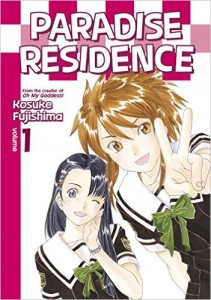
Our two heroines are on the front cover posing for us, and they are very much of the Miyuki and Natsumi school of personalities. Takanashi is brash, sleeps late, loves to eat, is not very good at school but makes up for it with energy and heart. Misawa is her best friend, the straight man of the group who exists mostly to react to Takanashi’s antics and sometimes sigh. The dorm they’re in is old and tends to fall apart easily, but its residents all love it, particularly when defending it against their all-girls’ school’s other dorm, which is modern and state of the art. We get the overly sadistic sempai, the elementary schoolgirl who acts as a dorm mother (she’s the daughter of the REAL, almost never seen, dorm mother), the overseas student, the otaku, the eccentric artist, etcetera.

The volume begins pretty much in media res, showing off the group’s everyday school and dorm life. We see how Takanashi deals with dogs, heat, and typhoons, as well as what appears to be a rivalry with a stuck-up girl from the otehr dorm. After this volume, we get as an extra “Volume 0”, a collection of the initial chapters that ran as one-offs in the spinoff good!Afternoon while Fujishima was still working on Oh My Goddess!. I can see why it was put later, as the characters are not quite in character yet, but it does give a better introduction to everyone than the initial first volume does. There’s also a short story featuring Takanashi’s parents, about the springtime of youth, etc.

This is light and fluffy fun. If there’s a flaw it’s that that’s all it is. There’s not as big a hook to draw people in as there is with Oh My Goddess!, and I doubt we’ll get serious plotlines here. The pacing can be slow, as you’d expect with this genre. And sometimes there’s a gag thrown in that just doesn’t work, such as one girl comedically falling into another girl’s breasts during a blackout, as if Fujishima is reminded that fanservice has moved on since 1985 and tried to imitate it. But if you like Fujishima, and his art is very nice here, this should appeal to you. It’s also over in Japan, so should wrap up pretty soon.

Ranma 1/2, Vols. 25-26

By Rumiko Takahashi. Released in Japan by Shogakukan, serialized in the magazine Shonen Sunday. Released in North America by Viz.

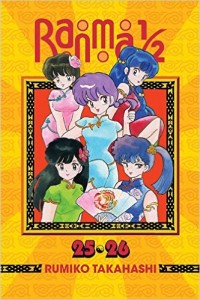
It’s not an ironclad rule, but in general, the longer the story arc in Ranma the better it ends up being. And this is good news for this volume, which wraps up the Herb arc from the previous omnibus, introduces a new character who brings a lot of silliness to the table, and has what may be the strongest arc in the entire series, where Takahashi learns that even though her series desperately need to be static and unchanging, sometimes you have to have the occasional character development. (Admittedly, we haven’t seen her learn that lesson with Rin-Ne just yet, but hey.) The Shinnosuke arc also manages to be strong simply by reversing the usual plotline of many a Ranma story, as this time it’s Akane who meets the stranger with a mysterious connection to her past.

ranma25-26

Indeed, Akane is comparatively calm and peaceful compared to previous situations, possibly as, instead of dealing with a supposed errant fiancee for Ranma, she now has her own love troubles to deal with. Shinnosuke saved her when she was a child, at great cost to his own self, and has grown up to be a handsome young man who looks a bit like Ryouga. (Too much, IMO – especially when the actual Ryouga shows up, it can be difficult to tell them apart.) The trouble is that Akane loves Ranma, and even though she’ll never say it or think it she knows it as well. Thus on her end she feels an obligation to stay and help because of a life debt. Ranma, who is playing the Akane role this time around, can only see her getting cozy with this new guy. He goes through various stages of jealousy, and as ever with Ranma, the worst argument, where you know things are really bad, comes from when Ranma and Akane STOP hitting each other.

There is another half to this volume, of course. We wrap up Herb in a quick but satisfying way, and Ranma once again proves unable to sacrifice even one of his worst villains. We also meet Hinako, who is another character who transforms from one form to another, though for once it’s not due to a cursed spring but rather due to a failed attempt at a good deed by Happosai, of all people. The Hinako storyline is not going to give you the depth and romance that you see in the Shinnosuke arc. Instead we get pure comedy, as Ranma, in order to defeat the teacher, has to essentially grope her pressure points – which are exactly where you’d think they are. Oh yes, and Hinako’s transformation from bratty immature kid to statuesque stunner makes no sense except as comedy. But that’s Ranma for ya.

In short, Ranma has now turned the corner and is entering its twilight years, but can still turn out some classics, and this volume is overall excellent, provided you don’t mind some fanservice. There’s even actual romantic progress at the very end, which I won’t spoil except to again say that the real tsundere in this series is Ranma, not Akane.

No Game No Life, Vol. 4

By Yuu Kamiya. Released in Japan by Media Factory. Released in North America by Yen On.

It’s always dangerous when a title that you enjoy despite its many glaring flaws has a subpar volume. Suddenly there isn’t enough to enjoy to justify wading through everything. It doesn’t help that this volume was delayed two months for unknown reasons (possibly as the translator got burnt out – it did have a 3-month schedule before this). And it’s unfortunate that this is the first volume that wasn’t adapted into an anime, so will presumably have a lot of new readers trying to see what happens next. But yes, there’s no getting around this – this is just not a great volume of No Game No Life.

ngnl4

Everything seems to be just that little bit tired, starting with Sora and Shiro, who in the first volume were hideously broken people who just happened to be crazy otaku, but here the otaku part is in full swing and were it not for a few casual mentions in the text, you’d never even remember how codependent they are on each other’s presence. This is the first of a two-parter again, so it’s possible the next volume will up the ante, but it also has to be said that nothing really seems to threaten our heroes. Sure, they initially refuse to play the datesim simply because it’s just like that anathema, real-life romance, but once they’re in it, merely avoiding any love points seems to be fine with them. Sora and Shiro have been shown to be invincible, and that’s ALL they are here.

The other characters don’t fare much better. There are the usual NGNL levels of perversion, this time around involving the fantasy vampires and mermaids we see here. The fact that the dhampirs can suck bodily fluids other than blood is (pardon me) milked for all it’s worth, and the Sirens are succubuses whose lack of foresight and intelligence had better be undercut when we reach Volume 5 or I’m going to be pissed off. You don’t right an entire race of bimbos anymore just because it’s fun. And then there’s Ino, the old Werebeast grandpa, whose response in regards to winning the datesim was… memorable, but I’m not sure I get the manly part, and he was also used as a sexual gag regarding all the women he’d bedded over the years.

There is one bright spot in this volume, and that was the first scene with Steph, who has been left behind to deal with the kingdom while Sora and Shiro are negotiating with the Shrine Maiden. Having been forced to play against the two for thousands of games, and losing every single time, Steph has actually become scarily good at games, particularly the card games we saw her failing at in the very first volume. Of course, she’s not aware of this – she’s constantly trying to compare herself to Sora and Shiro, rather than, say, the average citizen. We are also reminded why Sora and Shiro left her there in the firt place – she’s really good at running a country, something they would be terrible at. Sadly, she then goes back to being a figure of mockery for most of the book, but that one brief shining moment was excellent.

It’s possible the next volume will turn this around. As I said, it is a two-parter of sorts. But I must admit that after reading this volume of NGNL I just felt tired.