Category Archives: reviews

Soul Eater, Vol. 25

By Atsushi Ohkubo. Released in Japan by Square Enix, serialized in the magazine Shonen Gangan. Released in North America by Yen Press.

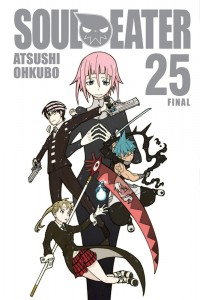
And so here we are at the end of another long-running shonen series. And it’s a good, solid ending, wrapping most plotlines up neatly, giving readers a big battle scene with lots of awesome moves and attacks, and resolving Crona as much as Crona was ever going to get resolved. The cover, as you can see, has Crona looming over our protagonists, and that seems appropriate, as in the end the fight is not so much to defeat Asura as it is to get a chance to try to talk Crona down one last time. And, of course, it would not be long-running shonen without the death of one of the main characters, which is done in such a way that even Excalibur is briefly not annoying. (It’s only briefly though.)
souleater25

It’s also interesting to see the attention paid to Soul and his growth. Soul’s struggles as a weapon have always been closely tied to Soul’s struggles as a musician, and he clearly has a life-or-death performance here. That fact that his music works most effectively when he accepts the madness that roils within himself, and the black blood within, is actually quite well done, even if it makes me wonder if Ohkubo was trying to say something about jazz artists and recreational drugs. But that’s probably just me. More to the point, he and Maka now trust each other completely, which after everything they’ve been through, is a relief. I liked his support when Maka is trying to convince Crona – he says “we believed in what Maka believed in”.

There’s a lot left open after this ending. Kid’s now the new Shinigami, and has already shown that his OCD is not going to magically go away anytime soon. Crona may be rescued someday, but today is not that day, and given all the crimes committed by Crona, it seems appropriate to end with moon sealage. (I have been endeavoring not to gender Crona through these reviews – unlike, say, Hange in Attack on Titan, where an author’s casual joking has spiraled completely out of control, I do believe Crona is quite deliberately not shown to be male or female, and that it works with their character.) As for romance, it was always on the back burner, and remains so – the only couples at the end are Kim and Ox, who get a dance, and Stein and Marie, who are creating new life. You could argue other things might happen in the future (I was rather startled by Maka’s response to Blair’s comment), but for now, things are up in the air.

This wasn’t a perfect ending – the boob jokes at the end fell totally flat with me, even if they do try to justify it in plot as Crona’s subconscious desires, and the “Noah-samas” were just as bad. But it made me happy overall. Eruka Frog was a character I always felt sorry for, so it was nice to see her pardoned and at peace. Rachel had been dropped from the manga the moment she was unpossessed, so it was fantastic to see her with her parents and showing she wasn’t completely broken by what happened to her. And it ends with a party, with everyone singing and dancing in the best One Piece tradition. Well, that and a shot of the city, with its bizarre sun and moon still hovering in the sky. Soul Eater’s world is still strange as hell, and it’s the world that is the main reason I recommend reading every volume of this series.

Sword Art Online: Progressive, Vol. 1

By Reki Kawahara and abec. Released in Japan by ASCII Mediaworks. Released in North America by Yen On.

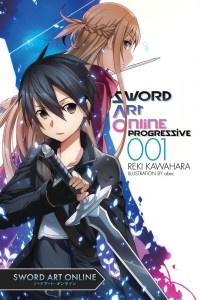
I’ve already discussed some of the ideas behind this concept in my review of the first manga, so I’ll try to skim over that and discuss what I enjoyed about SAO:P as a novel. Again, I don’t think it’s a sort of ‘reboot’ where you can read it in place of the original – I think knowing the characters already adds to the depth. But the main reason to read this is to see how Kawahara develops Aincrad, a world he introduced and essentially abandoned in the first book, sequels and side stories aside. And we also get the addition of Asuna’s POV narration, though sadly only for part of the first arc, after which it’s back to all Kirito all the time.

progressive1

Despite this, Asuna benefits enormously from the added face time. We see her at the start, having essentially decided that she wants to attempt to die with dignity, or at least on her own terms, something that Kirito is able to talk her out of. As the book goes on (and it is a BIG book – at 360 pages, almost as big as Fairy Dance put together) and Asuna starts to actually pay attention to the rules of the game and how to succeed, she becomes just as good if not better than Kirito – the skills she’s used her entire life as a girl who has to be in the top of the class for everything now benefit her in the RPG environment, and she also has more socialization than Kirito, meaning she can see people in a way that he’s unable to – this really becomes apparent in the second half of the book, where Kirito has pegged himself as an evil person, and Asuna has to side-eye him several times and go “really?”. Kirito, meanwhile sees potential in Asuna, and wants her to be the role model for the game world that he feels unworthy of being himself. They’re not a couple here, but you definitely see why they’re perfect for each other – they’re both quite similar, and their differences complement each other.

There’s no Klein, Lisbeth or Silica here, and Agil is mostly just support. The new addition is Argo, though she’ll be familiar to fans of the anime. She doesn’t vanish after the first few pages, however, and actually gets to show off some character depth and an awesome ‘to the rescue’ bit. In addition, the “Interlude” focusing on her and Kirito is hilarious, the second funniest part of the book. (The funniest part of the book involves Asuna’s inventory and Kirito’s complete ignorance of a maiden’s true heart, as well as measuring rage in gravitational units – I’ll leave it at that.)

The most interesting part of the book takes place right at the end, where a scheme is uncovered that led indirectly to the death of a player (or so they hear), and the concept of PKing comes up for the first time, this time as capital punishment. When does justice become vigilante justice? Kirito has definite views on the subject, but he’s already burned so many bridges (or at least he thinks he has) that he doesn’t want to make any rallying speeches. Luckily, things defuse before we can go there, but everyone is now thinking about it. We’re not at Laughing Coffin just yet, but the seed has been planted.

This book covers the first two floors of Aincrad, and the afterword says there should be 2 floors per novel, so things will likely continue to move quite slowly. This is the main goal of this series, of course, and I’m greatly enjoying what it’s trying to do. And of course there’s also an additional bonus – this is 8 years after the author first wrote SAO, and his prose has improved a great deal. Sword Art Online fans will love this. (Also, I appreciate that ‘Kuroko’ was likely impossible to translate without a footnote, but ‘Blackie’? Geh.)

Captain Ken, Vols. 1-2

By Osamu Tezuka. Released in Japan by Shogakukan, serialized in the magazine Shonen Sunday. Released in North America by Digital Manga Publishing.

Say what you will about Osamu Tezuka, he certainly knows how to write for his specified audience. This doesn’t dumb anything down, but it is absolutely 100% for boys around 7-12 years old, and almost every single page is filled with chases, fights, gun battles, etc. The conceit here is that this is a Western on the planet Mars, and indeed if you changes the Martians into Native Americans, little about this book would have to change. There’s a plucky young hero, a hotheaded teenager (usually the same person, but Tezuka generally liked his heroes to be very shiny, so the anger gets offloaded onto Mamoru here), a cute young thing with a mysterious past (well, in this case, that’s not quite true, but I don’t want to spoil). It’s classic boys’ adventure.

captainken1

Tezuka was churning out manga at an incredible pace at this period in his life, and there are times when it shows. I’ve seen Tezuka manga where you can tell he has no idea where things are going from chapter to chapter, or even page to page, but this was the first one where I wondered if he drew one panel at a time and then figured out what would happen next based on that. Sometimes this works to the series’ advantage, though. Apparently Tezuka’s plan had been for Ken and Kenn to be the same person (a la Princess Knight, a series he would revisit two years after this one), but so many people immediately wrote in guessing it that he called that off, and instead made it a competition to see what the real connection between Ken and Kenn was. This works well with the narrative, which starts with it being ‘obvious’ that Kenn is finding excuses to go be Ken, but as the excuses become more outlandish and impossible, we become suspicious along with Mamoru.

Those who enjoy Tezuka’s ‘star system’ of recurring characters will be pleased to see that Mamoru is basically Rock, his young hothead from several other titles. He’s fairly straightforward here, not much like the young man we’ll see in titles such as Alabaster later on. Lamp is also there as a villainous gunslinger. Lamp is actually one of the more interesting characters, not being motivated by greed or power as the other villains are, but simply out of a need to be the best at what he does. Sadly, Captain Ken bests him immediately, and later on it’s shown that he’s actually the worst at the style of fighting he specializes in! Poor Lamp, still no respect.

These two volumes are a lot of fun, and really don’t let a reader catch their breath at all. The message of ‘fighting each other is bad’ is a bit heavy handed at times, but that’s not untypical of Tezuka. There’s also quite a bit of Japanese nationalism tucked in here, which is also not untypical of Tezuka. Still, for the most part this tale of Cowboys ‘n Aliens is on the mark, though those who know Tezuka’s tendencies won’t be too surprised at how it ends. Those who only read his titles for older readers might want to give this one a shot.