Category Archives: reviews

Maria the Virgin Witch, Vol. 1

By Masayuki Ishikawa. Released in Japan as “Junketsu no Maria” by Kodansha, serialized in the magazine good! Afternoon. Released in North America by Kodansha Comics.

There is a scene in the show Arrested Development that has become a meme, where a character finds a bag in the fridge labeled “Dead Dove – Do Not Eat” and, curious, opens it to find… a dead dove. He responds “I don’t know what I expected.” I sort of feel the same way about the first volume of this new fantasy manga. I knew going in it was by the author of Moyashimon. This is a series known for its eccentric humor. And yet somehow the premise led me to expect that it would be a fairly dark and serious piece. Thus, when confronted with a Volume 1 that was quite silly in many places, I felt a bit nonplussed. It’s filled with eccentric humor. I don’t know what I expected.
maria1

The titular witch is in medieval France, trying to stop the English and French killing each other by any means necessary. So far this has involved using a succubus as her familiar to seduce specific people before the battle, making them uselessly aroused. There’s two problems with this: a) Maria is doing this as she has no experience whatsoever, not even being sure what a male looks like; and b) there’s a lot of pederasty in the army and Church as well, leaving an adult-looking succubus high and dry. Maria tries creating a second succubus to seduce other men, but he ends up being sort of like a Ken doll. Add to this that the Archangels are upset with Maria taking a personal interest in the Lord’s work (the Lord taking a very hands off approach to humans all wanting to kill each other) and you have a very angry and frustrated heroine.

While there is a serious battle towards the end, much of this is played for laughs, particularly Maria’s virginity, which she desperately wants to be rid of but is too repressed to really do much about (witness her reaction to her succubus moaning about her “sore jaw”). By the way, the book is rated T for Teen, but I’d have bumped it up a notch, as there’s frank talk of multiple sexual practices and a few of George Carlin’s 7 Words You Can Apparently Say In Manga. It’s not M-for-mature stuff (Maria’s too innocent for that), but I still raised an eyebrow a few times.

I do feel that the author should commit himself one way or the other, as I don’t know that the humor and serious plotline are balanced properly. There is a nice little story here involving how much a “witch”, someone with powers beyond mere humans, should involve herself with God’s creation – indeed, the presence of God’s archangels makes this explicit. But there’s a certain juvenile snickering about Maria’s virginity that made me sigh, and it provided the largest dose of the humor. Things aren’t helped by Maria and her succubus and incubus all looking very similar (they’re all based on her), so that when they’re standing together having a conversation it can be very hard to tell them apart.

If this were a long-running series, I’m not sure whether I’d feel inspired to continue. But there’s apparently only two more volumes, so I think there’s enough interest here to keep going, provided the reader knows what he’s going to get. Don’t be surprised at your dead dove.

Oresama Teacher, Vol. 18

By Izumi Tsubaki. Released in Japan by Hakusensha, serialization ongoing in the magazine Hana to Yume. Released in North America by Viz.

Most of the last several volumes have been seeing each member of the student council try to shut down the Public Morals club, and failing. As to why they’re doing it, well, we’re told that it’s due to Takaomi having a bet with the head of the school, and that his ‘opponent’ is said head’s grandson. But we’ve seen from the very start that this is not really correct. Every time we try to figure out why Hanabusa is doing this, besides “for the lulz”, it’s vanished like smoke. Indeed, as the volumes piled up and each of the Student Council members, by virtue of interacting with Mafuyu and her friends, became better people, you began to get suspicious that this was all a setup and that what Hanabusa is really doing is a form of extreme therapy.

oresama18

And indeed, that’s absolutely correct. It’s made explicit by Hanabusa’s comment to Hayasaka, saying that if Mafuyu had arrived a little later on she’d have seen Hayasaka on the Student Council instead of the Public Morals club. We even get scenes of most of the old members showing how much they’ve grown – Kanon is able to interact with her childhood tormenter again, Komari’s nature is starting to be better understood even by people who aren’t Aki, and as for Momochi…

As yes, Momochi. When a villain turns out to be not a villain after all, there needs to be someone stepping in to take their place. Having Momochi turn out to be shady after all is not exactly a surprise, as her mysterious smirking nature has been played up from the moment we met her – she essentially comes off as an evil Michiru Kaioh from Sailor Moon. Seeing her try to manipulate Mafuyu and Hayasaka is not particularly a surprise. Seeing her drug both of them, and apparently attempting to brainwash Hayasaka into forgetting all his happy memories, is a big surprise. I wasn’t really prepared for this manga to take so serious a turn, even with the mystery of Hayasaka’s past sticking out like a sore thumb. It’s disturbing, and makes a great cliffhanger.

This is not to say that the humor has suddenly vanished from the series – it’s just as funny as ever. Most of it is admittedly packed into the first half, which wraps up Mafuyu going back home for the break with a test of courage. Yui is along for the ride, and ropes others into his own special brand of insanity, leading to some wonderful looks of pity and disgust on Mafuyu and Kangawa’s faces. No one does that flat stare of “wtf? Seriously, wtf?” quite like Tsubaki. And there’s also a beach chapter, with the boys showing off their eccentric (or not) swim trunks, and Okegawa being given a forcible reminded that Mafuyu is a girl by having her wear a bikini. And then we have Mafuyu’s attempts to learn to swim, which would make Rumiko Takahashi proud.

So things aren’t going to get all dark and grim, but I do suspect that Hayasaka will soon be taking a forcible leave of absence from the club soon, and that fixing whatever psychological damage he’s sustained may be the next arc. As for Momochi, is *she* just a simple villain? Or, like Hanabusa, is there something else driving her? She seems focused on Hayasaka, dismissing Mafuyu entirely. Sadly, we’ll have to wait a bit for the next volume (it only came out in Japan 5 months ago), but I’m sure it will be worth it.

Ranma 1/2, Vols. 13 & 14

By Rumiko Takahashi. Released in Japan by Shogakukan, serialized in the magazine Shonen Sunday. Released in North America by Viz.

Having spent most of the last few Ranma reviews talking about how Ranma is essentially filled with shallow unlikeable characters who do funny things, and that the fan might get upset at a perceived lack of serious examination of them, we now get the thirteenth volume, where Takahashi shows off that, when she decides to write a longer, more serious plotline, she can carry it off. The moxibustion storyline is one of the high points of the series, showing off many of the characters at their best. Not their most noble, or most likeable, but a place where we can sympathize with and root for them.

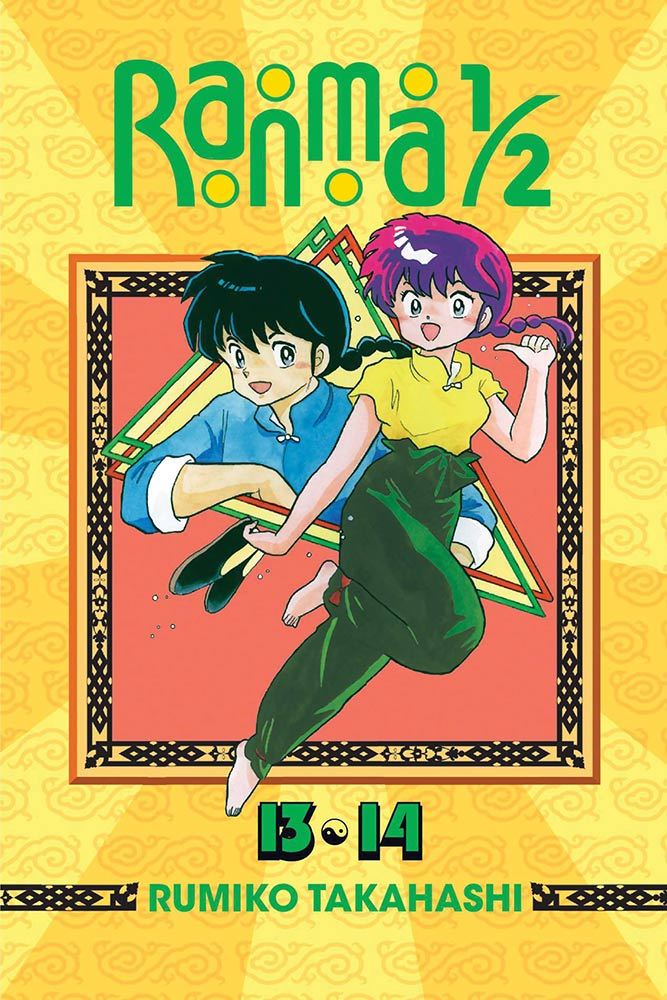
ranma13-14

The basic premise is that Happosai gets really pissed off at Ranma and hits him with an attack that makes him permanently weak – and when asked how to cure it, points out that he’s evil so why should he have bothered to learn the cure? (Note this doesn’t actually answer the question.) Naturally, the now weak Ranma gets attacked by all his past rivals – Kuno, Kuno’s father, Mousse, even Gosunkugi – and can’t do anything about it. You’d think Ryouga would be in here as well… but Ryouga can’t stand anyone who picks on the weak. Which Ranma now is. Ironically, this is what hurts Ranma most of all, and he takes off with his father, Ukyou and Akane to try to figure out how to fix this.

Ranma’s pride and confidence is both his strong and weak point, and having been stripped of his martial artist strength we see how intensely bound up his life is in the Art. It’s especially frustrating because of his burgeoning feelings for Akane – still mostly coming out as deflecting insults – but now that he can’t even take over her dojo he feels unworthy to even speak with her. Notably, he has no compunctions about taking Ukyou along with him rather than Akane – but that’s because Ukyou is providing food, once again he simply doesn’t see her as a romantic interest. Luckily, having heard about the fuss, Cologne comes along as well – Shampoo has returned to China, very conveniently as she’d make this storyline too chaotic – and teaches Ranma a martial arts move that doesn’t require strength in order to succeed.

There were some things in this volume I didn’t care for – getting Ryouga angry enough to attack Ranma by assuming he sexually assaulted Akane made me groan – but for the most part it was excellent, showing off Ranma, Akane, and Ryouga’s strong points. (Ryouga and Ukyou fans take note – when Ukyou sees Ryouga suffering through a nightmare, her first response is to hit him with a mallet so that he’ll sleep harder. Just sayin’.) Of course, there’s also a Vol. 14 in here, and while it’s not terrible, it does suffer by having to follow what comes before it. The strongest story in it is probably the one with Ryouga’s calligraphy martial-arts, which again shows that Takahashi can mine ANYTHING for ridiculous comedy. I also liked that Ranma said Ryouga is the only one he considers his rival – I think he’s serious, too.

We’ve seen Akane unable to swim before, but this is the first major storyline where we see she is heroically, ridiculously unable to swim – even wearing a life preserver is not enough. The two funniest storylines in the volume are also the shortest. In one, Ranma finds his panda-disguised father living it up at a mansion, and has to deal with the “weak, sickly” spoiled brat who has adopted the bear – lots of mocking of shoujo art here. As for Happosai as Santa Claus, teaching two young children how to be just like him, the very premise is horrifying, so much that even Happy realizes he can’t do this, though he ends up making himself ill trying not to be evil. The kids are adorable, and the ending fits perfectly.

So, to sum up: when she tries, Takahashi can make these characters more three-dimensional and realistic, to excellent effect. But most of the time, we see them being jerks to each other for comedic effect, and that’s fine as well.