Category Archives: reviews

Kokoro Connect, Vol. 3

By Sadanatsu Anda and CUTEG. Released in Japan by Enterbrain, serialized in the magazine Famitsu Comic Clear. Released in North America by Seven Seas.

Like many series I review here, I had assumed I’d do a main page review of Vol. 1 and the rest of the series would be consigned to the Bookshelf Briefs column. This despite the fact that the second volume improved on the first. And now the third has improved on the second, taking the cast to surprisingly dark places. It still has a tendency to have people lecture other people to advance the plot, but I’d really like to see how this Heartseed thing resolves now, if it ever does. It’s also very much a manga of two halves, or rather two-thirds and one-third, as the last part of the volume involves Yui wondering if she should date another girl… which is handled awkwardly, but looks like it’s trying.

kokoro3

In the first two volumes, Heartseed was more of a plot mcguffin than any sort of villain, possessing a teacher in order to explain the bodyswapping to the cast, and then making itself scarce to watch the fallout. But the fallout isn’t good enough for them, as Taichi and Iori manage to resolve their issues a lot faster than anyone was expecting. Like Inaba, Iori’s identity crisis ends up having a solution that’s a lot less complicated than one would expect, and I hope she manages to resolve a few more things going forward. But we can’t let all the problems be resolved like that… so Heartseed literally attempts murder, by tossing Iori into the reservoir and swapping Taichi and Yui at the same time, so that he can’t save her.

What follows is a classic sadistic choice. Iori’s near death, and Heartseed says she only has a half hour to love… provided one of the others doesn’t swap out before she dies, dying in her place. Of course, it’d only be their mind dying, their body would live on with Iori in it. And mostly, this is an excuse to show off how Taichi’s ‘selflessness’ is actually a really bad case of selfishness, as seeing anyone hurt makes him feel so bad he’ll do anything to stop it. Luckily, his friends are there to punch sense into them. Also luckily, Iori gets to swap out one last time to point out that she’d never be happy with any of them sacrificing themselves for her. And also also luckily, this was all a test/game, and Iori was never really at risk after all.

After all this, it’s nice to have a lighter story (this appears to be the end of the first novel, and the rest of the volume adapts a short story from “Volume 4.5”) that focuses on nadrophobic Yui. She gets a love letter in her locker, which turns out to be from another girl. Reactions range from Aoki’s, who adamantly says that man/woman relationships are the only natural ones (I know he’s in love with Yui, but still, shut the hell up, dude) to Inaba’s (who wants to leave things up to Yui to decide, but still uses the word ‘lesbo’), to Fujishima’s (we’ve seen her lust for Iori before, so she’s the one who’s best suited to tell Yui to follow her heart. I’m not sure how this will resolve itself in the next volume (though I can guess), but so far it’s a wildly uneven handling of the issue.

Which, to be fair, fits with this series in general. It’s dealing with the emotions and feelings of teenagers in general more than most high school comedies, and kids say stupid things. Awkward emotions are the order of the day, and this volume continues to serve them up. We’ve only got two more to go, so I’m interested to see how the adaptation wraps up.

Servamp, Vol. 1

By Strike Tanaka. Released in Japan by Media Factory, serialization ongoing in the magazine Comic Gene. Released in North America by Seven Seas.

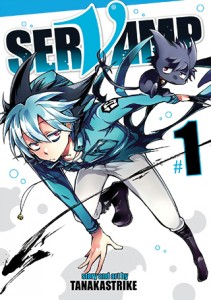
In general, I’m very reluctant to talk about a manga or anime being unoriginal, mostly as many of my absolute favorite titles have been made of of little bundles of cliches. Particularly shoujo titles, and Comic Gene is sort of a shoujo-ish magazine, if you squint. That said, after reading the first volume of Servamp, my general reaction was “that was pretty good, but I feel I’ve read it all before”. It might just be that I am simply vampire’d out – the North American market is absolutely glutted with vampire manga, with more and more coming every month, and Servamp (Vampire Servant, in case you were unaware) is another example of the genre. That said, it’s not actually a bad volume, just a little worn.

servamp1

Our hero Mahiru is a serious young man who tends to get irritated easily (though that gets toned down later in the book when he meets another young man who also gets irritated easily), but is more defined by his inability to stand aside when there are people that need help. He even picks up stray cats on the street, which proves to be his undoing when said cat turns out to actually be the immortal vampire Kuro. Not that Kuro is all that impressive – he’s lazy as hell, not wanting to show off his strength even when it would save lives. Turns out he is one of seven (at least we’re told seven at the start) vampires based on the Seven Deadly Sins, and Kuro happens to be Sloth. But Mahiru won’t let him slack, especially when someone appears to be going on a vampire killing spree in the city.

This description likely makes the title sound more serious than it is. There’s lots of light-heartedness iin this series, particularly in the interaction between Mahiru and Kuro. As you can see from the cover art, Kuro has this sort of sleepy hangdog look that’s funny even when he’s at rest, and his desire for food/drink/sleep just gets even funnier because of it. Later in the series we meet more eccentric vampires, including Love (asks Mahiru to check out his “boobies”, despite being male) and Wrath (the sole female character, who has a pissed-off expression on her face in order to “look cool”). And the one major death we actually see is semi-handwaved away the following day, for reasons as yet unknown.

So it’s put together well, but again, there’s a sense you’ve seen this all before. The use of the Seven Deadly Sins as eccentric weirdos is unfortunate coming after Kodansha’s license of a shonen series with a similar premise. Mahiru’s grumpy straight-man lead reminds me a bit of Devils and Realist, and honestly there’s also a bit of Alice here as well, in terms of his gradually acquiring a bunch of seeming killers around him. (The author has apparently done BL in the past, but there’s no real teasing here, though Love seems very camp.) Even the cliffhanger ending made me say “yeah, I was expecting that surprise.” It’s well told, and fans of manga with lots of handsome young men or supernatural action series might enjoy it. But I hope to be at least startled by a plot or character in the future.

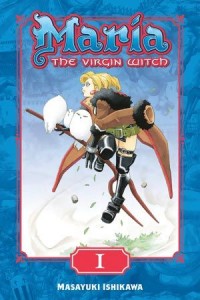
Maria the Virgin Witch, Vol. 1

By Masayuki Ishikawa. Released in Japan as “Junketsu no Maria” by Kodansha, serialized in the magazine good! Afternoon. Released in North America by Kodansha Comics.

There is a scene in the show Arrested Development that has become a meme, where a character finds a bag in the fridge labeled “Dead Dove – Do Not Eat” and, curious, opens it to find… a dead dove. He responds “I don’t know what I expected.” I sort of feel the same way about the first volume of this new fantasy manga. I knew going in it was by the author of Moyashimon. This is a series known for its eccentric humor. And yet somehow the premise led me to expect that it would be a fairly dark and serious piece. Thus, when confronted with a Volume 1 that was quite silly in many places, I felt a bit nonplussed. It’s filled with eccentric humor. I don’t know what I expected.

maria1

The titular witch is in medieval France, trying to stop the English and French killing each other by any means necessary. So far this has involved using a succubus as her familiar to seduce specific people before the battle, making them uselessly aroused. There’s two problems with this: a) Maria is doing this as she has no experience whatsoever, not even being sure what a male looks like; and b) there’s a lot of pederasty in the army and Church as well, leaving an adult-looking succubus high and dry. Maria tries creating a second succubus to seduce other men, but he ends up being sort of like a Ken doll. Add to this that the Archangels are upset with Maria taking a personal interest in the Lord’s work (the Lord taking a very hands off approach to humans all wanting to kill each other) and you have a very angry and frustrated heroine.

While there is a serious battle towards the end, much of this is played for laughs, particularly Maria’s virginity, which she desperately wants to be rid of but is too repressed to really do much about (witness her reaction to her succubus moaning about her “sore jaw”). By the way, the book is rated T for Teen, but I’d have bumped it up a notch, as there’s frank talk of multiple sexual practices and a few of George Carlin’s 7 Words You Can Apparently Say In Manga. It’s not M-for-mature stuff (Maria’s too innocent for that), but I still raised an eyebrow a few times.

I do feel that the author should commit himself one way or the other, as I don’t know that the humor and serious plotline are balanced properly. There is a nice little story here involving how much a “witch”, someone with powers beyond mere humans, should involve herself with God’s creation – indeed, the presence of God’s archangels makes this explicit. But there’s a certain juvenile snickering about Maria’s virginity that made me sigh, and it provided the largest dose of the humor. Things aren’t helped by Maria and her succubus and incubus all looking very similar (they’re all based on her), so that when they’re standing together having a conversation it can be very hard to tell them apart.

If this were a long-running series, I’m not sure whether I’d feel inspired to continue. But there’s apparently only two more volumes, so I think there’s enough interest here to keep going, provided the reader knows what he’s going to get. Don’t be surprised at your dead dove.