Category Archives: reviews

Lucifer and the Biscuit Hammer, Vols. 3-4

By Satoshi Mizukami. Released in Japan by Shonen Gahosha, serialized in the magazine Young King Ours. Released in North America by Seven Seas.

I’ve discussed before how series can sometimes be plotted in “short/medium/long” ways in Japan. The short is if the series is a failure – 2-3 volumes and it’s done. Long is when a series is a huge hit and basically can run as long as the author needs or editors demand. And mid-sized tends to be in the 10-20 volume range, where it’s a big enough hit to get room to grow. Biscuit Hammer falls into the second category, and I am happy that it has its ten volumes (or 5 omnibuses). That said, sometimes you can hear the screeching noises as the author realizes it’s not going to be cancelled and rolls out the rest of the plot. Having spent the first two volumes keeping the focus primarily on three people, these next two add the entire rest of the cast, plus the villain over the space of only a few chapters. It can feel exhausting.
biscuit3

That said, the cast is not without interest. Seeing two middle-school girls as two of the knights is rather jarring, and I liked the determination of the oldest of the knights to keep them out the battles, even as that quickly becomes moot. We get what seems to be the standard ‘childhood friends with secret crushes’ pair, only to realize that the girl is not only odd but a little worrying – given what happened with the Dog Knight, I wonder if she’ll survive the book. There’s not just youngsters, though – a 42-year-old ex-cop is one of the knights, an agent for justice whose cynicism won’t let him believe in it anymore. And the Swordfish Knight, now dead, gets probably the best backstory of the group, though it starts off in a ridiculous manner.

Then there’s our villain, Animus – assuming you aren’t thinking that the villains are our two heroes, who have after all vowed to destroy the Earth as well. He seems the typical smiling villain – he’s already corrupted one of the Knights, and goes after a second, though he’s unsuccessful – but he’s too laid-back to really fall into that stereotype – indeed, that may be a bit more disturbing, as his calm placidity works even better. I liked his intellectual faceoff with the Cat Knight, whose smackdown that gaining knowledge just for the sake of having it is a useless goal.

Overall, though, much of this omnibus feels like setup – lampshaded by Animus, who calls off the attack golems about 1/3 of the way through the book so that the author can show off his new characters and give us their backstories. It’s nice to learn about them, even if some seem a bit underdeveloped still, such as the Snake Knight. But I didn’t enjoy this quite as much as the first omnibus due to the sound of the grinding gears I heard in the background as the author realized he now has room to stretch things out. I’m still very interested in seeing how things go, though, and the next volume looks likely to have more action, if the cliffhanger is anything to go by.

Nurse Hitomi’s Monster Infirmary, Vol. 1

By Shake-O. Released in Japan as “Hitomi-sensei no Hokenshitsu” by Tokuma Shoten, serialization ongoing in the magazine Comic Ryu. Released in North America by Seven Seas.

As longtime readers will know, I pay far more attention to which company is releasing a manga and what magazine it runs in, for good and ill. Sometimes this can give me a feeling of great anticipation (Love at Fourteen is a good example), and sometimes it can inspire a feeling of dread, such as with this title, which runs in Comic Ryu, home of Monster Musume, which is very, very popular in North America and I simply can’t stand. Luckily, even though it does feature a degree of fanservice and boob jokes, Nurse Hitomi is a far more palatable title, mostly as the fanservice is a distant fourth to its other aims: amusing comedy, amusing drawings of weird creatures, and monsters as a metaphor for teenagers.

hitomi1

This actually puts it closer to its other Comic Ryu neighbor, A Centaur’s Life. But whereas that’s more of a slice-of-life title that takes great pains in its worldbuilding, Shake-O is not particularly interested in why the world of Nurse Hitomi is filled with mythological people hybrids, or for that matter how a bear can father a cyclops. This is a manga that wants to have fun and be silly. And it certainly succeeds there. Hitomi is a nice teacher who genuinely wants to help her kids, but she has no depth perception, making her clumsy, and she tends to try to do everything herself, something pointed out by fellow teacher and childhood friend Kenjiro (you’d think they would have some unresolved tension between them, but sadly Ken is a lolicon, the final joke in the volume and a lousy one to go out on).

Rather than Hitomi, probably the best reason to read this title would be the kids who come to her with unusual problems, some of which are couched in subtle metaphor but most of which are as unsubtle as they come. One girl is horrified that as she gets older her tongue is getting longer and longer, and she can’t control when it comes out anymore. Two childhood friends are going in opposite directions – one is now a giant while the other has shrunk to the size of a 5-year-old. And a shy girl who has trouble speaking up has now found herself literally turning invisible. (To comedic effect – if you want Translucent, go bother Dark Horse.) As you can see, monster teens = puberty. Most of these titles try to have a heartwarming lesson in them, but the lesson is secondary to the humor, and that’s just fine.

There’s other things going on here – Hitomi’s assistant, Itsuki, seems to be gender-ambiguous, though Itsuki mostly exists to poke gentle fun at Hitomi. The story of the giant girl and her small friend has an undercurrent of yuri – though only an undercurrent – and I hear future chapters may do the same thing. For the most part, though, despite the occasional ‘this looks like tentacles but it’s really not’ art and ‘why are people staring at my large breasts’ jokes, this is a fairly cute and innocent look at teens and their problems, couched in monster language. It’s not essential, but if you like unusual comedies, give it a try.

Nura: Rise of the Yokai Clan, Vol. 25

By Hiroshi Shiibashi. Released in Japan as “Nurarihyon No Mago” by Shueisha, serialized in the magazine Weekly Shonen Jump. Released in North America by Viz.

We’ve come to the final volume of this Shonen Jump series, and as it turns out I had not done a full review of it since the very first. That first review is sort of retroactively hilarious, talking about what was mostly a high school comedy about Rikuo trying to hide his yokai heritage from his friends while dealing with a minor love triangle. Now here we are at the end, and I don’t think we’ve had a volume that wasn’t basically either a giant battle or preparations for a giant battle since around the early teens. When you have a hero that can transform into a handsome badass, and a large cast filled with eccentric but fascinating supernatural creatures, no one cares about your human childhood friend. Sorry, Kana.

nura25

But of course the tradeoff is that, while I’ve basically enjoyed myself throughout the series, there’s been very little to talk about with each individual volume, hence why I’ve kept my comments to the Bookshelf Briefs. Even here, the first half of the book is basically the climax of the final battle, which is as you’d expect – the villain is convinced he’s won, but with the help of all his yokai companion, as well as a reformed villain or two, our hero pulls it out despite risking death (as does his grandfather, who actually meets his wife in “heaven” before returning as his time is not yet over). With everything won, we return to the (somewhat beat up) clan house, where a giant party proceeds to end the volume. Well, except for several side-stories to pad it out to a proper length – by the end of the series, Nura was running in ‘Jump Next’, a side-magazine, which allowed it to have its 80-page finales but also hinted it was being put out to pasture.

And it’s for the best, really, as I’m not sure how much more Nura had to give. It’s always been one of those series that was good but not great, and you can’t see the ‘Final Volume!’ at the back cover without thinking “Oh good”. As ever with Jump series, we’d had an escalating scale of villains, but with the last one basically being a creation of absolute evil, there’s nowhere else to go after that. As for the romance, it was the typical non-romance you get in Jump titles like these. There’s enough tease to keep Tsurara fans happy, and it’s implied Rikuo returns her feelings, but nothing really happens. In a world where we recently saw Naruto trying to pair people up and fail so miserably (I actually do like Naruto/Hinata, but there’s no denying that rushed ‘epilogue’ was pretty miserable), and where Bleach fans await the end of their series with dread and prepared outrage, this seems quite satisfying.

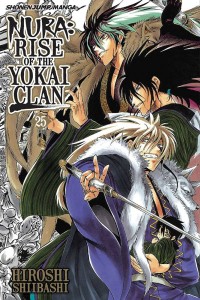
The cover shows us three generations of Nuras, which is good as honestly in black and white I can’t tell them apart, and they’re all smiling and showing off their badass poses. It’s a good cover for a series that has never been amazing or addictive, but more solid and dependable. I enjoyed reading you, Nura. Now… GET OUT!