Category Archives: reviews

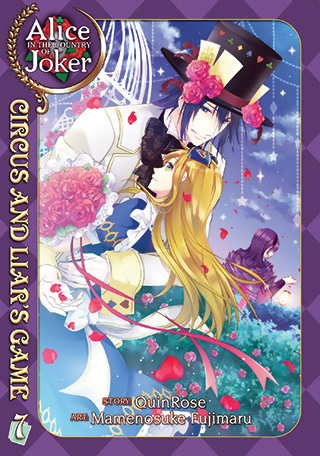
Alice in the Country of Joker: Circus and Liar’s Game, Vol. 7

By Quin Rose and Mamenosuke Fujimaru, based on the game by Quin Rose. Released in Japan as “Joker no Kuni no Alice – Circus to Usotsuki Game” by Ichijinsha, serialized in the magazine Comic Zero-Sum. Released in North America by Seven Seas.

This review contains spoilers for the “Bad End” of the visual novels.

Of all the Alice spinoffs, this one is clearly my favorite, and I’ve said why in previous reviews I did for Bookshelf Briefs. The romance between Alice and Blood doesn’t overwhelm the story. There isn’t as much painful filler the way some of the lower-tier Alice spinoffs have, where you can find yourself in Crimson Empire at the drop of a Hatter subplot. But mostly I think I like it as the main plot is very much dedicated to psychological trauma, Alice’s in particular but also everyone else. Time after time in Circus and Liar’s Game we see her back in the prison, with her sister Lorina sitting in a cell that only Alice can open. Joker is taunting her, trying to get her to face up to the memories of her past that she avoids. And the entire rest of the cast tries to stop her, and get her to stay there and not remember.
alice7

We’re never going to get a ‘bad end’ in these spinoffs, and I think it’s a shame, because the more I read of this series the more I think I really want to see it. Alice remembers that her sister is dead, and wakes up back in the real world, clearly older than the franchise has been portraying her, and having apparently been completely devastated by the loss. Thus staying in Wonderland – kept in that “Sunday Afternoon” that Peter White represents – is denial of reality, and the inability to grieve and move on with her life. And it’s clear that the series, in almost all its endings, really wants you to pick ‘denial’. Throughout Circus and Liar’s Game, Alice is tempted by Joker, and we do cheer when Blood confronts Joker and even takes a wound in order to stop her giving in. In the end, she even marries Blood. But is it really a “happy ending”?

There are two reasons I ask this. The first is the epilogue of this volume, where Alice ends up in the Country of Diamonds after a fight with Blood, and is horrified to find that every relationship she’s had is lost. Blood in particular is not the one she knows, even though he’s still willing to protect her if need be. The best part of this is that it’s not Joker tempting Alice to return to reality in this world, but Ace. Ace has always functioned as the most dangerous protagonist, the one who only loves Alice when she’s upset, fretting or struggling. Here she’s his ideal (and it’s worth noting that we see “adult” Ace here, not the teenage one from the Diamonds VN). That said, the epilogue can’t bring itself to destroy its happy ending, and she chooses to return to her Blood, who she wakes up with.

The other interesting thing is what Alice chooses to become, and how it ties into Blood and Vivaldi. As with the main Alice series, their relationship is a key aspect of the plot here. We get flashback hints (which I suspect I’d understand more if I played the game, but that machine translation drives me up the wall) that they aren’t just brother and sister, but were once like Alice herself. And that’s what makes the ending extra disturbing, as Alice’s ‘Outsider’ status is now considered a Role, one she willingly takes on. Does this mean that she has a clock in her chest now? It’s possible I’m reading too much into this, but I think in the end I’m like Ace. I like the Alice series best when it’s troubled, disturbing, and has nasty implications. Even if Alice is getting great sex with Blood and happy endings. This Circus and Liar’s Game has been a terrific look at the psychology of the series.

(Also, Alice looks fantastic in that Negotiator outfit. She should wear it more often.)

Haganai: I Don’t Have Many Friends, Vol. 10

By Yomi Hirasaka and Itachi. Released in Japan as “Boku wa Tomodachi ga Sukunai” by Media Factory, serialization ongoing in the magazine Comic Alive. Released in North America by Seven Seas.

There is always a certain level of frustration in a harem comedy, which its audience tends to want resolved immediately and its parent company tends to want to have it go on indefinitely. The author is usually caught in the middle somewhere. Harem fans love the romance to a point, but after around 6 or 7 volumes the voices start creeping in, wondering why the hero doesn’t understand that all these girls are all over him, why isn’t he going after (girl who is not the lead girl), why isn’t he manning up and showing all these girls who’s boss? (I will get into the inherent sexism of much of the harem manga fans at a later date.) Haganai has always been a bit meta about such things, and here the face of that fan becomes Rika, as she has finally had enough of Kodaka’s act.

haganai10

There’s actually a nice buildup to this the entire volume. Sena’s attraction to Kodaka has been obvious, as has her frustration, but Kodaka has been very good about hiding his desires for anything to go further with anyone. Now we see that he’s starting to become more obvious – ending up shopping with Sena on what is clearly a date, at least until she presses the issue of whether he wants a girlfriend or not. Later on, when Kate and Maria (look, if I say ‘Zoro’ and ‘Ryouga’ I’m allowed to say ‘Kate’ as well) show up at his house, and we get the inevitable full frontal nudity fanservice that seems to be this titles way of driving away any readers I might lead to it, Kate observes that she’s like to go after him, but it’s no real use – after all, he has Sena. His ‘huh?’ is used as the cliffhanger here, but when it’s followed in the next chapter by ‘I knew what she was trying to say’ we know that he’s started to stop lying to himself, at least.

The Friends Club is, to a degree, inhabited by people who are socially inept and have difficulty communicating in ways that society considers ‘normal’. This manifests itself on Kodaka’s end both by his desire to have the club stay together no matter what, but also his denial that he has any friends, the purpose of the club. Staying in a comfortable place where you can quietly hate yourself and hang out with friends without risking anything. If you admit you’re friends, then why have a club? If you admit you’re falling for Sena, then won’t everything fall apart? And is this club more important to someone like Yozora than it is anyone else?

This culminates in the maid cafe scene, where the girls all do their best to show why a maid cafe is a disastrous idea. For Rika this involves acting like a stereotypical ‘tsundere’ maid, but in reality it’s a way to work off some stress about Kodaka’s dumb act. Earlier in the volume, we heard her say out loud that no one can be that oblivious, and his response was, naturally, “What’s that?’. Readers of this series should know that’s almost a catchphrase by now, and it’s not because he’s hard of hearing. So when Rika ‘serves’ Kodaka as a maid, her service turns into 15 minutes of abuse and torture, which the others observe is a way to get her frustration out of her system. Kodaka admits to himself he knows what she was trying to do. But he still doesn’t say anything.

Can a harem comedy, especially these days, go on forever without making a choice? If Kodaka admits his feelings for Sena, will the readers abandon ship the way Yozora might? It’s a high-wire act that’s really hard to achieve, but a little meta makes it enjoyable.

Assassination Classroom, Vol. 2

By Yusei Matsui. Released in Japan by Shueisha, serialization ongoing in the magazine Weekly Shonen Jump. Released in North America by Viz.

In this second volume, there’s a bit less focus on the actual assassination attempts as Matsui starts to try to expand the cast and show us more of the horrible world they live in. We meet the principal of the school, who exudes pure cynicism and hatred from every pore, and it’s quite apparent that he will not allow Class 3-E to succeed. Scapegoats who learn to better themselves have no value to him, and so he changes the rules to ensure that they are hated and despised. What it’s doing to the kids themselves doesn’t seem to matter to him – I think if they all killed themselves the day after graduation he wouldn’t spare it a second thought – but in my mind, it’s the values he’s placing in the A-D classes that’s far more chilling.

ac2

Of course, this is meant to contrast with Koro-sensei, who may be an alien out to kill us all but is also determined to give these kids self-confidence to be the best they can be, and takes it personally when all his hard work goes wasted during the midterms. This is nicely contrasted with all the moments where Koro-sensei is simply an eccentric idiot – the reasn that we don’t get to bored or irritated with him is that he has so many flaws and bad habits in among his invulnerability – flaws that are dutifully being written down by our narrative voice Nagisa (calling him the protagonist of this series seems oddly wrong), and flaws that are abused, seemingly, by the new teacher and assassin introduced here, Irina Jelavich.

A brief aside. For those who hoped that with the forced addition of ‘Koro-sensei’ we’d see honorifics in this series, sorry, Jump editorial practice will only allow it if it leads to an untranslatable pun. Thus ‘Bitch-neesan’ becoming ‘Bitch-sensei’ is not going to happen, and instead we see ‘Ms. Bitch’ becoming ‘Ms. Vitch’, which also neatly allows Viz to soften things up a bit. Bitch or Vitch, though, Irina certainly makes a horrible first impression, on both the cast and the readers. She’s an omniglot and talented assassin, but it’s clear that she only knows how to assassinate through seduction, and when it comes to actually keeping her cover as a teacher she’s useless. That said, she does seem to be easing up a bit, particularly when she sees how Class 3-E are treated by the rest of the school. I could have done without the tentacle rape joke, though given what Koro-sensei looks like I suppose it was inevitable.

We see the students here as well, but so far they seem to be more of a cast herd rather than having deeply drawn personalities. Nagisa is the strongest, being the keen observer (though he’s weak for busty women, like most teens – and indeed like Koro-sensei). Kaede hasn’t really said much at all (though I did love the ‘my brain is up here’ sign she held up, a wonderful translation choice, as I think the original just had her complaining about Irina’s large breasts). And Karma may be the smartest in the class, but he made far less of an impression here. The end of the volume promises that may change soon, though, and I’m hoping that this is the sort f series where everyone gets some attention paid to them. Though ‘a lot of them are only bit players so I try not to make them too unique’ doesn’t bode well.

Overall, this is still an addictive series, even if I feel it has some issues with character. Irina is an amusing addition to the cast, and I hope we will eventually get jokes about her that don’t involve her being a femme fatale who’s really just a ditz. More to the point, the stakes are raised with the introduction of the principal, as now we really see what Koro-sensei and the class are up against. Go get this.