Category Archives: reviews

My Neighbor Seki, Vol. 1

By Takuma Morishige. Released in Japan by Media Factory, serialization ongoing in the magazine Comic Flapper. Released in North America by Vertical Comics.

By all rights, I shouldn’t really love this title as much as I do. At heart, it’s a variation on a standard Japanese comedic trope: a) person does funny thing; b) Other person says “WAIT ARE THEY DOING FUNNY THING?”; c) person seemingly has explanation for funny thing; d) Ah, OK, so it’s ____; e) Person does even funnier thing; f) Other person says “WAIT ARE THEY DOING EVEN FUNNIER THING?” Rinse and repeat. And yet My Neighbor Seki is a wonderful series, because the things are genuinely funny and strange, the chapters are short enough so that each one is just about the right amount of time devoted to one situation; and there’s a surprising amount of character development given that this is, at its heart, a series about two people at adjoining desks.
seki1

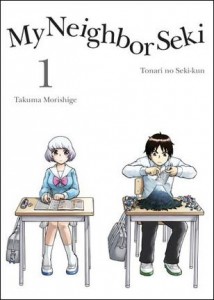
Basically, Yokoi is a “normal” middle-school student attempting each day to pay attention and study what the teacher’s saying, but can’t because the boy next door, Seki, keeps distracting her by doing… odd things. Elaborate domino setups, shogi with trapdoors, knitting cactuses… Seki’s imagination is topped only by the impossible nature of some of the tasks he performs. Seki himself is silent (and honestly Yokoi is much of the time as well)… we only get how elaborate Seki’s imagination is by Yokoi narrating everything he does and filling it in with her own interpretations. Which of course should clue us in that Yokoi is not really all that normal a girl after all.

The majority of this manga consists of Seki’s setups and Yokoi’s reactions, but it’s fun seeing how it occasionally dips its toe outside the box. The rest of the class apparently are fully aware of what Seki is doing; when he sets up his note-passing post office in one chapter, Yokoi is really the only one surprised by it; the rest of the class merely thinks “Cool!”. Of course, they’re not sitting near him, so he’s not the annoyance he can be to Yokoi. During a fire drill, we see (but don’t hear) Seki being normal and outgoing with other male students, and realize how much of his life we have filtered through Yokoi’s perceptions. And when another, clueless, classmates interrupted his Ouija board shenanigans, we see why he HAS to be filtered through her.

The art is fairly simple (just look at that cover), but highly expressive, and the main reason to read this in the end may be Seki and Yokoi’s facial expressions. They’re both so immature, in ways that only teenagers can pull off, even as they show amazing flights of fancy. You wonder at times if this is some demented form of courtship (Yokoi leaving notes in Seki’s locker after school really isn’t helping deny that), but this isn’t a romance. Yokoi gets punished several times through the series – for being distracted, for getting caught doing something Seki was doing, etc. – but it’s always her own fault for getting too involved, so she’s not really a total victim. Seki avoids getting discovered by anyone but Yokoi, but this means she’s the one who punishes him. They’re becoming rather codependent.

Basically, I enjoyed this as a funny comedy, but was surprised at how much depth it had. Of course, like Yokoi, I could be reading too much depth into it. But I’m absolutely buying more to see if I’m right, and you should as well.

One Piece, Vol. 73

By Eiichiro Oda. Released in Japan by Shueisha, serialization ongoing in the magazine Weekly Shonen Jump. Released in North America by Viz.

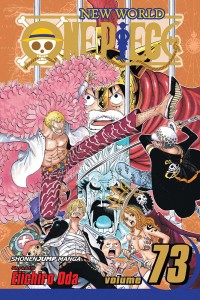
I’ve talked about the disparate chaos going on in this One Piece storyline for a couple of volumes now, and while it doesn’t decrease in this new volume there seems to be a purpose behind it. The Tontatta Army states its intended objective – turn all the toys back into humans, give everyone their memory back – and then point out they realize this could lead to an outcome even worse than what they have, but they want to leave that up to the people – a sort of controlled, directed chaos. That type of chaos is seem throughout here, as we get a lot of explanations about what’s been going on, both here and through the series.

onepiece73

It’s not just order vs. Chaos either – the reveal that the old king of Dressrosa is still alive allows the series to contrast his rule of peace with Doflamingo’s suppressive, violence-led style. Like Crocodile, he comes into the kingdom as its supposed savior, having first set up the circumstances where he can do so. He talks about the heritage of his ancestors, but I’m not sure he actually cares about that, and a more telling speech is seen when he’s yelling at the melee fighters who tried to run away during their match, saying that taking a hit and getting bloody was better than any act of cowardice. It’s not just chaos, Doflamingo loves brutality.

We get a little more revealed about the past of One Piece’s universe, in what for Oda is a giant block of exposition, as the disgraced fighters bring each other up to date. I’m not particularly surprised that it ends up having royalty and aristocracy as the villains – the cruel rule of the powerful over the oppressed has been one of this series’ top themes, with Alabasta being such an exception that they actually had to single it out here as being different so as not to paint Vivi and company with the same brush as the others. In addition to that, there’s a strong anti-terror message here in seeing the reaction of everyone to the King’s demand for ransom money – pacifism is a noble intent, but unless one realizes that there’s a limit to it, it may lead to an even bigger tragedy, because people can be bastards.

Through all this, we have the ongoing adventures of our heroes. Sanji gets a few moments to try to look cool, which I would enjoy more if they weren’t so telegraphed and obvious. Nami has an inspiring speech used as a comedic undercut, which made me facepalm, but she redeems herself a bit with a better rousing speech towards the end. As for Luffy, he mostly spends this volume just watching everyone, but we do get a dramatic revelation as a cliffhanger. It’s presented as a mystery (indeed, Viz’s ‘next volume’ blurb has us wonder who the mystery stranger is), but anyone who recalls the flashbacks to Luffy’s childhood will have guessed it by now. It’s nice to see confirmed what most already expected.

So after as much exposition as I think we’re going to get, I expect Vol. 75 to be a series of giant fights. Should be fun. One Piece: Still Excellent.

Meteor Prince, Vol. 1

By Meca Tanaka. Released in Japan by Hakusensha, serialized in the magazine LaLa. Released in North America by Viz.

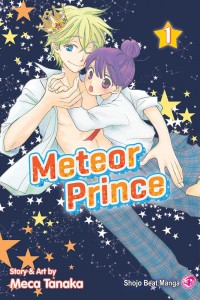
Meca Tanaka was an author I enjoyed back in the old CMX days – I was quite find of Omukae Desu. She has a certain messy style with a lot of words that reminds me a bit of Banri Hidaka, though really many Hakusensha artists have this, as their magazines have a lot more dialogue than the average Shueisha and Shogakukan title. Here we see her writing a short two-volume series about an alien who comes to Earth looking for a soulmate, and the girl with a life of bad luck that he declares is the one.

meteor1

I was a bit worried at the start, what with the jokes about “shall we mate now?”, but it’s made clear right off the bat that consent is required first. Io, the alien, is not particularly adept at human social conventions, but he’s an alien so gets more of a pass than the usual shoujo boyfriends who are just bad at interacting and boundaries. Once Io realizes what Earth requires, he does his best to try to work within its rules, even if they baffle him. He’s also very cheery and friendly (except for one moment where he gets jealous), which actually works against him at the end, as Hako can’t tell if he’s being sincere about his love, especially when he seems to give it up so easily.

Hako also impressed me. Honestly, with the sort of life she’s led, she should be a lot more broken than she is, and it’s definitely a good thing that she’s been taken in by the occult club. That said, she gets a lot more emotional as the title goes on, and it becomes clear that a lot of her open cheerfulness is a mask. She’s also shown to be somewhat stocky (well, by shoujo manga standards), so makes a nice change from the usual tall thin girls. She’s a nice girl. You want good things to happen to her. Io ends up being a good influence.

As for the rest of the cast, I already commented on Twitter about finding Erina fascinating. Unlike Io, there’s no excuse for her – she’s just constantly smiling with closed eyes, all the time. I think the only time she remotely shows another emotion is when Io pretends to be injured and drives Hako away, and even then it’s less anger and more ‘tsk tsk’. I hope we find out something about her in the 2nd volume. As for the club president and Matchan, they make a nicely goofy beta couple – indeed, the president (is he ever named?) seems to be starring in a completely different manga, possibly Nisekoi. Matchan might feel a bit cliched to Western readers, but the girl who shows embarrassing emotions as anger is a classic Japanese trope, and so I just deal with it.

This is over in the 2nd volume, and honestly it almost felt complete in this first one – you could stop right here and have a satisfying ending. Still, I enjoyed it. It wasn’t deeply meaningful or anything, but was good enough for me to seek out the next in the series.