Category Archives: reviews

Sword Art Online: Progressive Manga, Vol. 1

By Reki Kawahara, abec, and Kiseki Himura. Released in Japan by ASCII Mediaworks, serialized in the magazine Dengeki G’s. Released in North America by Yen Press.

These days fandom is used to seeing multiple tie-ins and spinoffs of popular franchises, and SAO is no exception. That said, usually they’re more along the lines of a cute 4-koma thing, or a side story following other characters (such as Girls’ Ops, which we’ll see in May.) This is an odd duck, though: it’s the author rewriting the series after he realizes he wanted to stay in his world a bit longer. SAO was originally a series of online web novels, and the main light novel adaptation is essentially a straight reworking of those. Here, though, Kawahara goes back into Aincrad proper and gives us a closer look at its early days… while also sort of retconning our lead couple into having been meant from each other from the day they met.
saoprog1

Fans of the anime may be very familiar with some of the material seen in this first manga volume, as it was made around the same time and many things were taken from it to use in the adaptations, such as the presence of Argo the informant, and much of Asuna’s somewhat suicidal attitude at the start. The main reason to read this, though, is that it’s mostly from Asuna’s point of view, with Kirito as the mysterious stranger who may have ulterior motives. We see a nightmare where she flashes back to her life in the real world before the game, and also her poor relationship with her mother, things that never really came out in the main series till the seventh book. And the reaction when Asuna speaks up at a strategy meeting from all the guys in the game reminds readers what women in Aincrad have to deal with all the time – and why Asuna is cloaked most of this volume. (The manga, of course, also features a long, lingering nude bath scene for Asuna – this is still a product made for its known market.)

While this is a reboot of sorts, I’d argue that it only works really well if you’re familiar with the source material. Asuna is a LOT more tsundere in this volume, as the creators lampshade, and while we see her obvious skills, she lacks the confidence and poise of the Asuna we know. Likewise, we know what Kirito is likely thinking in these early meetings, with all its discussion of “let’s find the beta testers and get our revenge’, as we saw his thought processes in the original SAO – without that, he would be something of a flat character. This is meant to complement, not replace, the original. It’s not perfect – the leader of the group planning to take out the boss of the first floor is a very flat character, and his death is signposted from the moment we meet him. And some of Kirito and Asuna’s interaction at the start falls into the standard comedy romance tropes – oh no, I just walked in on you in the bath! – which just made me sigh.

I suspect, like the main series, that I’ll be enjoying it even more once I read the light novel in March – note I had to add ‘manga’ to the header to differentiate in advance. For manga readers who enjoy SAO and would like to see a book from Asuna’s POV, this is a deent start, and I look forward to more.

Whispered Words, Vol. 3

By Takashi Ikeda. Released in Japan in three separate volumes as “Sasameki Koto” by Media Factory, serialized in the magazine Comic Alive. Released in North America by One Peace Books.

In this final omnibus of Whispered Words, both Sumika and Ushio have come to terms with their feelings for the other, but Sumika realizes that there’s also other aspects to life besides love, and that staying together forever is not necessarily something easy to achieve. The rest of the cast watches the two of them struggle as they march towards graduation. And their own struggles and successes are also seen throughout, as we watch Mayu’s burgeoning crush and social ineptness come together in a horrible way, Akemiya being clueless about his love life but finding that he enjoys his newfound career, and Kyori being blissfully ignorant of everything.

ww3

As the cover might suggest, everything really does work out in the end. There’s a certain amount of angst on Sumika’s part, though, as she has to content with realizing that Ushio really does love her back, her family’s expectations for her “taking over the dojo” (meaning siring an heir), what she plans to do for a career (sports medicine? she’s not sure), and the fact that they aren’t in school anymore so she may not be seeing Ushio on a regular basis. Last volume we had a major Ushio breakdown, this time it’s Suminka who does the crying, as she realizes that she may have realized everything too late to do something about it. Ushio, meanwhile, has matured after her experiences in the last volume, and really comes into her own here, especially after being voted Student Council President. Admittedly, she and her brother are still playing “I can sacrifice my happiness for my sibling better than you”, but luckily neither of them succeeds.

A lot of this volume is told in a non-straightforward manner, which seems oddly fitting. There are flashbacks and present-day panels mixed together so that you really have to pay attention to the black borders to realize where you are. There’s lots of wordless dialogue, including whole pages where we see the characters dealing with fallout (usually caused by Mayu), but don’t hear them. We get the story of Ushio’s brother and his ex-girlfriend, who still have feelings for each other, mostly in the one-page ‘extras’ after each chapter. Oh yes, and Cooking Papa shows up towards the end, for reasons I can’t quite figure out.

In the end, the happiness outweighs the angst, and we get an unabashedly happy ending. Sumika and Ushio are openly together, and while some of the school mutters about it most seem to accept it. Akemiya becomes a famous model, and seems to be friends with Lotte, who has gained about 3 feet in height and 3 cup sizes as she hits puberty like a truck. Kyori finally finds out what’s been going on, and after some brief worry that she was in the way (which she totally was), she gets over it. Food helps. Mayu and Koi finally finish their ‘we are Sumika and Ushio two grades lower’ dance around each other. And our main couple is happily holding hands, as their brother, at his wedding, suggests they can’t get married now but maybe someday?

That someday is now, actually, and I’d like to think Sumika and Ushio are taking a trip to Tokyo Disneyland in their future. In the meantime, this was a great end to an excellent yuri story, and I think it worked very well in the omnibus format. A fantastic release from One Peace Books.

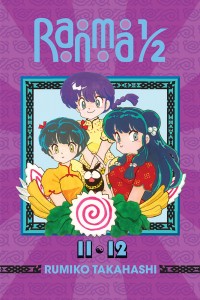
Ranma 1/2, Vols. 11 & 12

By Rumiko Takahashi. Released in Japan by Shogakukan, serialized in the magazine Shonen Sunday. Released in North America by Viz.

My resolve to do full reviews of the whole Ranma series as it comes out can sometimes give me pause, as this is not only a series that fights against a deeper analysis but which actively becomes worse when you treat it too seriously. Treating Ranma as shallow entertainment is something people have to do to get enjoyment out of it, due to the vast cast of unlikeable people in it. And it’s also a lot less serialized than even I remembered it being, with plots and people coming and going as Takahashi saw fit. For example, remember I was talking about Ukyou being such an important major character last time? She’s not even in this. Also, I knew Nabiki didn’t appear much in these early days, but I’d forgotten HOW little.

ranma11-12

Ryouga is still a major player here, of course. We get a few plots involving him in this omnibus. The first, where he finally manages to go to his house and invites Akane there (with a jealous Ranma following behind) shows off all of what makes Ryouga who he is: his basic sweetness and shy nature around Akane, his stubborn pigheadedness and anger (which can verge on stupidity), his poor sense of direction (which we discover is a family trait in this story, allowing Ranma to pretend to be his “sister” and get away with it), and his plain old bad luck. In the second story, a soap that Shampoo bought as a Jusenkyo cure is used by Ryouga instead, and his attempts to take advantage of not being cursed anymore show a frightening turn, as he almost becomes a berserk stalker. Best line, after we find the “cure” is temporary like all the other ones, and Akane is reflecting on Ryouga’s unthinking brute strength: “Whoever ends up being Ryouga’s girlfriend will have to be made of sterner stuff than me.” Well, does raising sumo pigs count?

Ranma and Akane appear throughout, of course, and the volume shows off why fans of the couple love them and those who hate them (and by them I mean Akane) can’t stand it. Akane jumps to conclusions all the time (albeit in situations that simply would not happen to normal people), punches Ranma into next week when she’s angry or jealous, and refuses to admit any affection. Ranma, meanwhile, jumps to slightly more reasonable conclusions but makes up for it by having his jealousy be more obvious. And of course he refuses to admit affection even more, even when he thinks Akane is being particularly cute (The end of the “whiskers ramen” story is the first of several that show off Ranma’s handsome face smiling at Akane with genuine affection.) And of course together they make a very effective team. They’re held back by their hot bloodedness and insecurities, but if this weren’t Nerima they’d be dating by now.

There is a new character introduced in this volume, thought he turns out to be related to two old friends. I’d forgotten how long the Principal Returns storyline ran before it was finally revealed that he was Kuno’s father, but it makes sense, given he seems to be just as divorced from reality as his children are. He went to Hawaii to study discipline techniques, and much of his behavior is stereotypical Hawaiian, but the teachers point out that he was always over the top even before this. And on his return, he’s obsessed with giving everyone old-fashioned school haircuts – shaved heads for boys, “pudding bowl” for girls. This leads to a giant melee battle, a frequent appearance in this series, as everyone searches for the coconut that can free them from this fate. (Nice lampshading when a man-eating tiger is set upon the students: “What part of this is Hawaiian?”

Of course, no one should be thinking about whether Kuno and Kodachi’s mental trauma is a result of their father’s upbringing, any more than they should worry about Genma being a horrible father, Akane punching Ranma so hard he flies several blocks, etc. Don’t analyze the series, just laugh along with it. It’s a lot of shallow, shallow fun. That said, join us next time for a plotline that is at least a little more serious, and takes over half the omnibus to resolve.