Category Archives: reviews

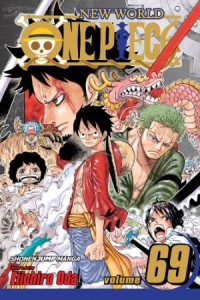
One Piece, Vol. 69

By Eiichiro Oda. Released in Japan by Shueisha, serialization ongoing in the magazine Weekly Shonen Jump. Released in North America by Viz.

The majority of this volume of One Piece is composed of running around and fighting, as we tend to get when we’re 2/3 of the way through most story arcs in this series. Everyone is coming together from various disparate points (or, in the case of Luffy, getting dumped way the hell away from everyone) to try to stop Caesar Clown, who is upset that he has to kill them all in his secret base rather than out on Punk Hazard’s surface. We also get to see more of the fighting styles of minor villains Monet and Vergo. And thankfully we also get lots and lots of silliness.
op69

One thing that gets a bit more attention this volume is the way that trust works in the world of One Piece. Luffy is, let’s face it, a man who inspires devotion and loyalty in his crew, but he’s not the only one. Most of the pirates, marines and mooks we see here are all fiercely proud and supportive of their leader, to the point almost of mindlessness. This is where Luffy’s crew stands out, of course – being real characters, they’re allowed to disagree with him or tell him he’s being stupid. The nameless marines and villains, however, don’t have that option, so they remain trusting and gullible to an extreme. When it’s someone like Tashigi who inspires them, that’s fine – she would never tell them to do something stupid, and indeed tries to protect them by stating that their foe is not the real Vergo. When it comes to Caesar, though…

Let’s face it, Caesar is a terrible, terrible liar. His “I am a good guy trying to help you all” act is pathetic, and it doesn’t say much for his mooks that they buy into it wholeheartedly. At least the little kids have the excuse of being too young to really understand. (though kudos to the one kid who sacrifices herself for the others, after Chopper finally convinces her what’s really happening). Caesar is not quite as scummy as, say, Spandam, but it’s still very satisfying to see Luffy beat the ever-loving snot out of him here.

There’s also Zoro and Tashigi, who get a lot of spotlight here. Tashigi’s character has always been fairly problematic, and it doesn’t really get any better here, as her compassion wars with her fierce competitiveness and her belief that Zoro is holding back whenever he’s near her because she’s a woman. Zoro, of course, is not about to tell her the real reason, and in any case is so far beyond her skill level now that he can take out Money, let her get in the final blow, and then agree to have her take the credit for it. Makes no difference to him, as that sort of thing is irrelevant when you’re on the level he is. In short, their relationship is still just as amusing yet awkward to read about as ever. (I did love her nerding out about his new sword as he carries her away from the gas, though.)

So overall another solid volume. The crew get chances to show off (Even Nami, whose weather control works well briefly against someone like Monet), and the collective treatment of Brownbeard is a comedic masterpiece. I am, however, looking forward to this arc being done in a volume or two.

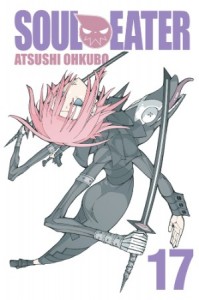
Soul Eater, Vol. 17

By Atsushi Ohkubo. Released in Japan by Square Enix, serialization ongoing in the magazine Shonen Gangan. Released in North America by Yen Press.

One of the most enjoyable things about Soul Eater is the way that the author balances out the seriousness and humor throughout the story. A lot of shonen fighting series tend to have long serious parts, then chapters that are pure goofy. Ohkubo, though, simply lets the humor come in anytime he feels like it, even if it’s in the middle of a pitched battle for everyone’s life. This is not to say that there aren’t pure comedy bits here (the middle chapter, which features Maka’s dad trying to be sympathetic and failing spectacularly – again) but the fact that you can find a goofy face or a silly moment anywhere actually helps add to the mood of the overall work. Soul Eater has always thrived on being one step off the edge, leaning slightly into madness.

souleater17

The converse of this, of course, is that any silly moment can turn on a dime to become serious. Thus Black*Star’s self-aggrandizing has a serious point – the reason why he can push back Crona so easily is due to his own self-confidence and ego, while Crona is simply filled with hatred and loathing. Crona’s “I DON’T KNOW WHO MAKA IS!” is a cry of anguish that once again makes you realize that Crona’s entire life (the manga may choose to say he, but I prefer to be awkward – Crona is genderless on purpose) has been mental torture and abuse by Medusa. Speaking of Medusa, she’s back to being a mad scientist, and is perfectly content to justify her actions by noting she is a witch – not that all witches automatically stand against our heroes, but as Kim has shown us, they are generally assumed to be evil until proven otherwise.

As for Kid, once again we get the goofy stuff – his obsessive-compulsive disorder comes to the fore in a very funny way, as you realize that the one who’s really best at torturing Kid is Kid himself – followed by an unnerving scene where Kid meets another one of the Great Old Ones whose presence has made this world what it is – and is seemingly taken over by it, as the cliffhanger shows. Soul Eater does star Maka and Soul, but has been excellent at giving Black*Star and Kid enough character arcs and development that they also feel like co-stars.

And then there’s the gender-bending. Rule 63 has been around the Internet forever, but has appeared in actual canonical works less so. As such, it’s highly amusing to see the cast transformed into their opposite-gendered selves (though I do have a little niggle with the explanation why – it makes it sound like gays and lesbians don’t exist), particularly as Maka and Soul have to deal with the thing that most annoys them about the other – Maka’s male body is tempted by the succubus, and Soul bemoans the fact that it’s “just big boobs” that turn men on. Judging by the previous, this swap won’t take up too much time, but it’s fun to see.

In the end, this is why Soul Eater is one of the best shonen titles coming out here. It’s fun, but with a tinge of madness that never quite goes away. It skitters at the back of your brain.

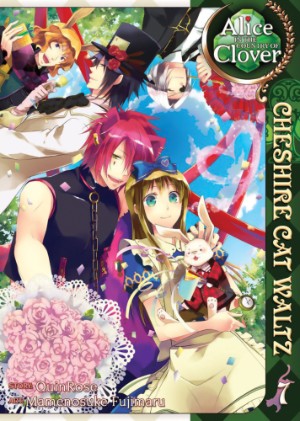
Alice in the Country of Clover: Cheshire Cat Waltz, Vol. 7

By Quin Rose and Mamenosuke Fujimaru, based on the game by Quin Rose. Released in Japan as “Clover no Kuni no Alice – Cheshire Neko to Waltz” by Ichijinsha. Released in North America by Seven Seas.

(Note: this reviews mentions THAT Alice spoiler later on. You know the one.)

Now that this series has finally come to an end, I think it’s a good time to take a look at it in a larger context. Volume-wise, it’s the longest Alice series to date. However, many of these volumes were bloated up with side stories – some featuring Alice and Boris, some not – to the point where I suspect the actual content would struggle to make it to 5 volumes if put together on its own. Overall, I think the series was successful, but its tendency to meander and focus on the romance over the darker themes make it perhaps midrange in overall quality. Let’s see if we can pin down what it did best.

cheshire7

First off, the premise of the Clover world spinoffs (as opposed to Hearts) is that Alice has been there longer and is finding love with someone she already has a friendship with, as opposed to a sudden passionate love. I think it does a pretty good job of that here – much as I’m not a fan of the romance part of this series in general, the author does a good job of showing us Alice and Boris’ friendship, and how that’s affected by their growing love. It also shows off dealing with Boris’ cat-like tendencies – he can wander off, or seem aloof, and is quite changeable – as well as Alice’s mood swings and anger issues. And, of course, jealousy. It didn’t really knock me out, but as a romance it’s perfectly sweet.

The other thing I think this manga did very well is the attention that it gave to the ‘faceless’ inhabitants of Wonderland. Our view of this world has almost entirely come from Alice and the 12 ‘role-holders’, all of whom are naturally drawn to her by their very existence. The faceless are meant to be bodies filling out the story, so unimportant they don’t even get eyes. And yet Alice can tell then apart, something that mildly astounds everyone else. What’s more, here they are shown to have goals and lives beyond support of the heroes and heroine. Some are plotting a takeover against the hatter, some are jealous of Alice’s ability to get someone to love her whether she likes it or not, and some are just doing a job, even if it means their death. I’m still not certain about the faceless overall, but I have a much greater understanding of them after reading this.

And then there’s Lorina. This is the second book we’ve seen recently where Alice is shown abandoning the real world and staying in Wonderland with her love. I’ve discussed how this makes me slightly uncomfortable, something I think is entirely intentional on the author’s part. Cheshire Cat Waltz is not as dark and twisted as, say, Joker and Liar’s Game, however, so we see Alice, who’s having another post-traumatic breakdown, visited by Lorina’s spirit, who reassures her that it’s OK to forget and move on, and that her death (looks, it’s been 15+ books, I am now prepared to reveal the horrible secret of the Alice books) was not Alice’s fault. So her stay in Wonderland is couched in terms that make it look less like escaping from reality and more like accepting this is her new reality. How you feel about that depends on how you view the Alice series as a whole, I think.

As for the major drawback of the series, well, it meanders. It meanders even more than my reviews do. And just when each volume seems to be leading up to an exciting bit, the story ends halfway through so that we can get either side-stories of Alice and Boris in the Hearts world, or even worse, Crimson Empire side-stories that have nothing to do with this world at all. Read all at once, it must be more tolerable. Read over the course of a year, it’s a mess.

Still, overall, I’m pleased to have read this. Alice and Boris are cute, and it fleshed out the personalities of the non-Hatter cast a lot more. (The Hatter cast got a lot to do as well, but they always do.) It’s a good read for fans of the series. Just be prepared for the story to start and stop a lot.