Category Archives: reviews

Bunny Drop, Vol. 9

By Yumi Unita. Released in Japan as “Usagi Drop” by Shodensha, serialized in the magazine Feel Young. Released in North America by Yen Press.

You may finally discuss Bunny Drop in the comments. But be polite.

And so here we are. I’d mentioned when reviewing the previous volume of Bunny Drop that there was a certain discomfort with where it was going, even if there wasn’t really anything objectionable besides the basic concept. That feeling continues and is magnified in this volume, which could almost be described as “Yeah, it went there.” It does its best to try to show the thought patterns of the people this decision impacts – though Rin, as always, is harder to read and understand than the others. But in the end, was this trip really necessary? Let’s find out.
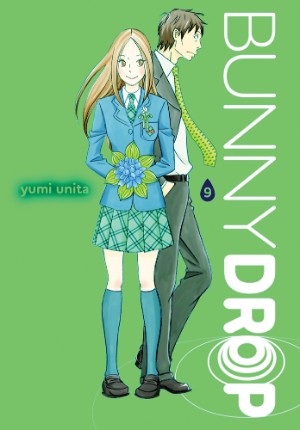
bunnydrop9

For most of the volume, the basic conflict is not so much “Rin is in love with Daikichi” – that was dealt with by Vol. 8, mostly. The conflict is that Rin seems to be perfectly content to never deal with this and live in her happy family cocoon forever, denying her own feelings so that things can be the same. And big props to Kouki for pointing out how selfish this is. Honestly, Kouki’s development has probably been written better than Rin’s as this series has gone along – he’s still very much in love with her, and knows that love can’t happen, but is determined to be sure that Rin is happy. What she’s doing now isn’t getting her that way. So, because he’s that sort of person, he simply tells Daikichi everything.

Yumi Unita’s art has always been best when showing feelings of awkward discomfort, and really excels here in the middle part of the book, as Daikichi has to deal with Rin’s feelings, and Rin has to deal with Daikichi knowing about it, and – inevitably – the destruction of their cozy parent-child relationship. I liked that she ended up going to her mother – whose character development has also been good but is mostly off-screen. The mother, of course, is there to provide the “”out” the story needs – Rin isn’t really Soichiro’s daughter, she’s an adopted daughter. Meaning she and Daikichi aren’t related by blood. Which is fine, except, y’know, he’s still raised her as a parent since she was six. Sigh.

Daikichi says to Rin he’s going to wait two years, possibly thinking that Rin might get over this. But of course she does not. Through most of the post-timeskip series we’ve had trouble reading Rin, but right at the end it’s Daikichi who becomes difficult, as his acceptance of Rin’s love and agreement to marry her seems to come less from romantic feelings and more “well, a father can’t say no to his daughter”. Which provides all sorts of deeply wrong reactions. Particularly when Rin brings up children right at the end.

There is a certain odd dilemma with this series. When it began, everyone was enchanted by its warm and loving take on parenting and adopted families, and recommending it to libraries and such. Then the spoiler hit, and suddenly the entire fandom took a darker turn. The anime solved this problem by simply ignoring the timeskip altogether. The difficulty is that if readers had known the manga was going to go down this direction, I don’t think any of them would have bought the series. Most people still reading have a sense of “Well, better see this through to the end, since I’ve invested so much time in it.” Which is not what one really wants from a heartwarming manga series. Bunny Drop could be very well-written, and thoughtful, and have nice art, and I’ve analyzed it more than most other series. But I don’t think I’ve ever felt quite as uncomfortable with an ending as I am with this one.

Of course, there’s Vol. 10 in April of next year. But I hear that’s mostly side-stories from when Rin was a kid. We shall see. (What, drop the series? Nah.)

Excel Saga, Vol. 26

By Rikdo Koshi. Released in Japan by Shonen Gahosha, serialized in the magazine Young King OURS. Released in North America by Viz.

In between all the body swaps, and personality wipes, and past lives, and pure hostile mind takeovers, it’s become increasingly apparent that one of the core themes of Excel Saga (the manga) has been identity. What is it that makes us who we are? Is it the bag of meat we currently inhabit? Is it that we think, therefore we are? What if we have amnesia? What if we’re put into a robot body? What if we are a reincarnation of someone else with similar memories? Lately it seems that our cast, especially Excel, need to have this question answered. And while I’m not sure this volume gives us anything definitive, it is one of the best at showing just how complicated this can actually be.

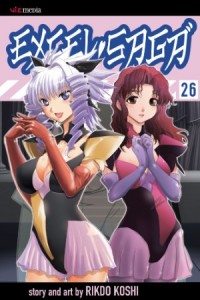
excel26

Let’s start with Excel, who is now back in her regular old human body after a couple volumes as a Ropponmatsu. Of course, ‘regular old human body’ has never quite applied to Excel, given she is capable of lifting several hundred pounds if she doesn’t think too hard about it, can open doors to ancient civilizations, and clearly has a past which Doctor Kabapu is trying hard to deny. (Kabapu and Shiouji’s greek chorus is one of the more frustrating things going on in this volume, mainly as Kabapu clearly has the answers but doesn’t want to say them out loud, and Shiouji doesn’t care enough.) Unfortunately, Excel, newly invigorated and with Hyatt and Elgala by her side, runs into Il Palazzo, and the shock causes her to have a mental breakdown for the last half of the volume.

Because of course that isn’t really Il Palazzo. Oh, it’s his body, all right. This is actually a major reason why Excel breaks down, as she can’t get over how Il Palazzo-ish he really is… until he speaks. And we finally get to see the truth about Shiouji’s father, Tenmangu. I’ve gotta say, we’ve been expecting him to be possessing Miwa’s body since about Vol. 13, which is… sort of true, only not. No, he’s now in control of Il Palazzo, and Miwa is a Ropponmatsu – one far more powerful than anything Shiouji could ever invent. Of course, this may not really matter all that much, as we’ve never really delved too deeply into who Il Palazzo really is. Excel figures out something is wrong purely due to the ideals she holds so dear – Il Palazzo talks about this “wonderful world”, and she knows her real love believes that this world is truly corrupt. (Given Excel Saga’s plotline, I really have to lean more towards Il Palazzo than Tenmangu here.)

Even if you can understand who someone really is, there’s always the chance of them disappointing you. Both Umi and Hyatt seem to hold Teriha/Excel on an impossible pedestal, one that she’s never really going to live up to. Elgala is more realistic about her expectations of Excel, but gets too lost in her own la-la land to be of any help. Misaki still has trouble rationalizing her love for Iwata, given what a giant doofus he is 90% of the time. Sumiyoshi always found Ropponmatsu 2 to be a loli pain, but is rather surprised by how angry her destruction makes him. And Watanabe disappoints EVERYONE, as his love for Hyatt has clearly not lessened (or ind3eed deepened) one iota.

The next volume of Excel Saga is the final one, and I’m fairly certain that we won’t be getting everything answered. But we should at least clear up a few things, and hope that at least some of these people can live happily ever after. Or at least get a good night’s sleep. God knows they need it.

(Also, Excel’s face when she realizes that’s not Il Palazzo is beautiful yet achingly sad at the same time. This series can still hit the heartstrings when it wants to.)

Happy Marriage?!, Vol. 1

By Maki Enjoji. Released in Japan as “Hapi Mari” by Shogakukan, serialized in the magazine Petit Comic. Released in North America by Viz.

Viz has started to slowly dip its toe into the waters of josei, first a few years back with Butterflies, Flowers, and now with two new series, of which this is the first. They’re all being put under the Shojo Beat imprint, because a) it’s a brand people look for, which a Signature title isn’t necessarily; and b) honestly, most of these titles hit the same beats as their shoujo titles, it’s just that the protagonists are adults and there is sexual content. It wouldn’t be hard to see something like Happy Marriage?! reimagined to high school and Sho-Comi, with Hokuto as the hot new transfer student or something.

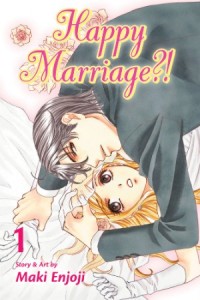
hapimari1

The basic premise isn’t too hard. Chiwa is an office lady whose father is a bit of a naive idiot, so their family is in heavy debt. She’s trying to deal with it by taking extra jobs, but that’s not going so well. Then the company chairman has the brilliant idea of marrying her to the company president, a smooth yet vaguely jerk-like guy naked Hokuto. Neither of them are really enthused about the idea, particularly Chiwa, who is a twitchy virgin who has no idea how to handle anything like this. Will they gradually grow to love each other as husband and wife and find true love and sexual satisfaction?

It’s hard not to compare this title with Butterflies, Flowers, Viz’s first foray into the world of Petit Comic. Both have the same types of hero and heroine, both involve company power issues (he has far more power than she does), and both heroines tend to freak out when bad or confusing things happen to them. Happy Marriage?!, though, is a far more natural and mellow title than Butterflies, Flowers ever was. There’s no real exaggeration for comedic effect here. No superdeformed heroines, no over-the-top sexist behavior as of yet, and zero Gundam references. Hokuto seems a bit standoffish, and like many shoujo/josei heroes likes to smirk smugly on occasion, but compared to other types I’ve seen he’s not too bad. Likewise we see Chiyo standing up for herself on occasion, though her lack of life experience and self-confidence is no doubt going to be one of the issues this manga deals with through its 10-volume run.

Of course, the problem with not having the appalling lows of Butterflies, Flowers is it doesn’t have the amazing highs either. The comedy and gratuitous appallingness of the latter title was what kept audiences reading, as they wanted to see what outrageousness would happen next. There’s not as much outrageousness in Happy Marriage?!, so what you’re left with is just a bit duller. It feels like one of many other shoujo titles, just grown up. Which is something you could say for a lot of josei, really. Chiwa in particular hasn’t really done much to separate herself from other blushing blonde heroines. Hokuto at least is more reserved than this type usually is, and I liked that we see he doesn’t really understand his new wife any more than she understands him, he’s just better at hiding it.

This is a good start to a romantic series, and I look forward to seeing if it avoids other ‘smutty shoujo’ traps once our heroes get hot and heavy (which they don’t here). I’ll check out another volume. But it’s not making my jaw drop the way its predecessor at Viz did.