Category Archives: reviews

Kitaro

By Shigeru Mizuki. Released in Japan as “Gegege no Kitaro” by Kodansha, serialized in the magazine Weekly Shonen Magazine. Released in North America by Drawn & Quarterly.

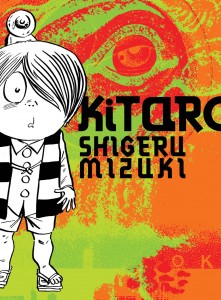
This is another of those titles manga fans have been waiting for years to see, and now Drawn & Quarterly are finally releasing what I hope is the first of multiple volumes devoted to it. Shigeru Mizuki’s most famous and influential series, about the adventures of a young yokai and his various supernatural friends, who spends much of his time investigating creepy happenings and trying to stop them. Almost all yokai manga on the market owe a debt to Kitaro, even if, on the surface, this manga is not really all that much like Kamisama Kiss or Natsume’s Book of Friends.
kitaro

It starts off fairly slowly, with a few short one-shots involving Kitaro being mysterious, and a large amount of human involvement. There are some very nice scares, though, such as the story about the drunken salarymen who insult yokai at a bar and then get taught a lesson on the train ride home. These stories have Kitaro mostly on his own, which is fine for a while, but he’s pretty much a stoic straight man, so the series needs some spicing up after it gets going. Enter Nezumi Otoko (Rat Man), a yokai who is always out for himself above any other. His appearance adds a lunatic joy to the proceedings, as you’re never quite sure if he’s been possessed by evil, is changing sides merely to save his own skin, or is genuinely being a complete ass. Usually it’s all three.

As the collection goes on, the stories get longer and more complex. One tale has Kitaro and several of the stronger yokai (including future series regulars Konnaki Jiji, Sunakabe Baba, and Ittamomen) headed to an island that has been taken over by Western monsters such as Dracula and Frankenstein. At first I was expecting this to be a fairly lighthearted romp, but things got surprisingly dark and serious for our heroes. Even more impressive is the largest story in the book, which shows Kitaro joining an expedition to track down an immortal yokai monster, but being hindered (and later completely betrayed) by an egotistical young scientist who wants the credit and glory of single-handedly discovering it. What eventually happens is a giant kaiju battle, a la Godzilla. This gives us some of the best art of the series, and also has Nezumi Otoko bitchslapping the villain over and over again, something I will never get tired of reading.

Contrary to today’s hipper, sexier Shonen Magazine, the stories that ran in the 1960s version are totally child-friendly, and I think that still applies today. Younger kids may get freaked out a bit by some of the scarier things, particularly Kitaro and his father, who is an eyeball that lives in Kitaro’s own empty socket, and pops out grotesquely from time to time. For the most part, however, these are great, fast-paced ghost stories with action and laughs that any child can enjoy.

And it goes without saying that adult manga fans should enjoy this as well. It’s fairly episodic – there really aren’t any ongoing plot threads beyond ‘Kitaro discovers new yokai threat’ – but that’s mostly irrelevant. You’re here to see a good story well told, some really creepy yokai, and the work of a master craftsman in what has proven to be his greatest work. Highly recommended.
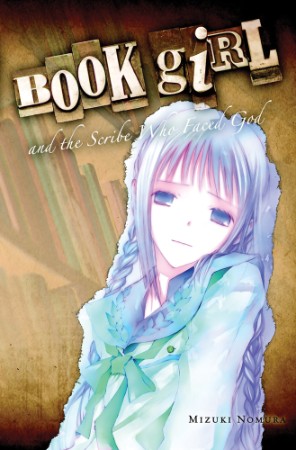
Book Girl and the Scribe Who Faced God, Part 1

By Mizuki Nomura. Released in Japan by Enterbrain. Released in North America by Yen Press.

It is not uncommon in the world of fiction – and indeed in the world of manga – for the main character to be the most difficult, the most problematic, and sometimes the least satisfying. This is particularly true when the goal of your book or series of books is to have that character achieve catharsis, to rise above mental and emotional blocks and become a better person who can move past the past that may be causing them suffering. There’s a fine line here, particularly in a series. Their faults and trauma drive the plot, but at the same time the goal is to heal them. This can lead to an unfortunate tendency to ‘forget’ past lessons learned in time for the new book to roll around, so the character always starts two steps backward from where he was before.

bookgirl7

As you can guess, I’m talking about Konoha Inoue, the first-persona narrator and hero of these books. The last events in this series chronologically, Book Girl And The Wayfarer’s Lamentation, showed Konoha finally confronting directly the girl most associated with his past trauma – Asakura Miu – and dealing with exactly what led to that point, both his actions and those of Miu. At the end, both have moved to a point where they can start to repair their psyches. So you can imagine my frustration where, at several times during this new volumes, Konoha is still consumed by the same demons that haunted him before, particularly in regards to his writing.

It’s especially frustrating because we even see Miu, who is brought in in a short scene to attempt to smack some sense into Konoha, and we can see for ourselves that the same thing has not happened to her. Miu is changing, has grown and started to mature, even though we see that it’s hard for her, and she may still be regretting a few things. We thought this is what Konoha was doing as well. He was moving in the right direction, had started to opemn up to others, and had (we thought) made peace with Tohko, his mentor/friend, moving on to college. Of course, the main problem with this is that the series didn’t end with Book 5, and there’s one more backstory we haven’t really focused on, and that’s Tohko’s.

Konoha and Tohko have what amounts to a very codependent relationship in this book, far more than what we appeared to see in the prior books in the series. There had been small hints in the past, but nothing that quite led us to expect what was going on with Tohko and Ryuto here. It thus feels overwrought and emotionally draining, and worse, it feels like those emotions haven’t really been earned yet. This is in contrast with the scenes with Miu, and also Nanase, where you can buy into the tension and dissonance that flows between their characters and Konoha. Tohko seems to have made a leap here I wasn’t prepared for.

Speaking of Nanase, she really needs to move to another series ASAP. K-On!, or Sunshine Sketch, or something cute and fluffy that is absolutely not filled with broken people who think nothing of throwing each other to the wolves. While Ryuto’s frustration with Konoha is absolutely understandable – we feel the same way, honestly – his handling of Konoha is brutal and horrible, and made me lose all sympathy for him, mostly as he’s risking Konoha having a complete mental breakdown. Given the cliffhanger shows that he’s determined to ‘break’ Nanase, I can only look forward to that part of Vol. 8 with dread. I never had any illusions that Konoha and Nanase were going to remain a couple – his affection for her has never quite seemed like genuine romantic love – but this isn’t how I want to see them break up.

Lastly, there’s the question of what Book Girl as a series thinks of writing and authors in general. Ryuto’s mother points out that Konoha shouldn’t be an author, and Konoha through this book seems to regard writing as suffering. Except, of course, that he’s been writing short stories for Tohko the entire time. He just doesn’t think of that as coming from the same place. What he fears more than writing is notoriety – someone reading his work, holding it up to others, and judging it. Tohko notably never does that – his snacks are pretty much immediately eaten by her, and never see anyone else’s eyes. But given how screwed up Kohona is at this point, and the fact that Tohko’s mask may have been in place more than any of the other masked characters in this series, can we really resolve this in just one volume?

Well, no, that’s why there’s a Part 1 up there. This came out in Japan in 2 parts, and unlike the Haruhi 2-parter coming out in November, Yen has chosen to release it separately as two volumes. This means we have to wait till January to find out how this will all end. And despite all my complaints, I still want very much to see the resolution. After all, any series that can make me go on at this length about its faults is one that’s worthy enough to read. Even if Konoha does make me grind my teeth. A lot.

Last of the Mohicans

By Shigeru Suguira. Released in Japan initially by Shueisha; this updated edition was released by Shobunsha. Released in North America by PictureBox.

Wow. I had heard that this author was a bit surreal, so I went into this thinking I was prepared, but I was not remotely prepared. I’m not entirely sure that this manga can be read, per se. It’s an experience, almost like going to an interactive art show or something. Each page led to a new expression on my face: awe, bewilderment, sometimes staring blankly while saying “Really?” There is a story to tell, and it flows pretty well, but I’ll be honest, there’s nothing here regarding plot and characterization to talk about. Not that this is a bad thing. I found reading this to be very sensory, and absolutely would recommend it to other hardcore manga fans.

Mohicans

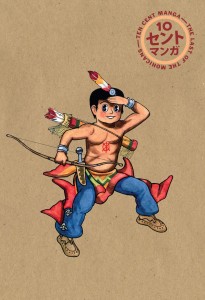
Technically, this is an adaptation of James Fenimore Cooper’s Leatherstocking Tale, and the basic framework does sort of follow the plot. This doesn’t take place in a realistic world, however. This is the world of Wild West movies, where the East Coast can have huge mesa and rocky cliffs. It’s also very much the world of 50s comic books and strips. Photorealistic serious-minded Indians stand together with some of the goofiest faces you’ve seen this side of Doraemon. And it’s in your face the whole time – there’s no way you can try to work around it. Because this is also very comedic, despite its presence. There’s lots of fourth-wall breaking, and silly gags, and dumb Indians doing dumb things. It’s fun, but loose – one feels that if you take one wrong step along the way, you’ll end up in a place no reader has gone before.

According to the very welcome essays at the end of this book by translator Ryan Holmberg, this is how Sugiura’s style worked in general, particularly in the 60s and 70s. This edition dates from 1973-74, and is an update of the original 1953 edition. Reading the essays made me realize what my mind had been struggling with the entire time I read the manga – it felt like a collage. Pastiche isn’t quite right, because it doesn’t explain the way that the work gives a sense that anything can be pasted in from anywhere as you go. And so the two military daughters who need to be rescued are straight out of a romance comic-book and the villain of the piece is drawn completely straight, yet one of the guards is Oliver Hardy, and Wimpy from Popeye is the chef. The band Negativland once called this kind of approach culture jamming, and that’s what we see here – American and Japanese influence all thrown into one glorious canvas.

This is not the sort of manga I would recommend to any casual manga reader, nor do I think it would be a good present for kids, even if it was meant for young children in Japan. The content pretty much deals with the old, slightly racist way that Hollywood and comic books dealt with Indians, though honestly it’s much better than other contemporary works could be. But for those who really love something different in their manga, or for scholars, this is a real treat. It’s just about the right length – I’m not sure I could have taken more than the 114 pages it turned out to be, mostly as reading it can be a bit exhausting. For those who like a challenge, or art lovers, or even folks who enjoy slapstick comedy, give Last of the Mohicans a try. It’s like a yaminabe – you never quite know what ingredient will come out next.