Category Archives: reviews

Sankarea: Undying Love, Vol. 1

By Mitsuru Hattori. Released in Japan as “Sankarea” by Kodansha, serialized in the magazine Bessatsu Shonen Magazine. Released in North America by Kodansha Comics.

I have been running into the same sort of problem lately with many new manga, even though most of them are completely different on the face of it. They all seem to boil down to the same thing when I review them, which is “quite readable and even better than I expected, the big downside being crushing unoriginality”. This probably does the title a disservice, as originality, particularly in recent Japanese manga, is what DOESN’T sell. In general, what readers want is “something familiar with a slightly new spin on it”. And Sankarea provides that in a perfectly readable way.
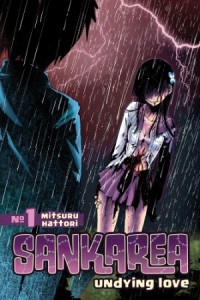
sankarea1

I should note that the cover you’re seeing is one created by the artist especially for the North American market. The original Japanese cover just has Rea staring at the reader in that sort of cute seductive ‘girl posing’ way, with absolutely nothing to suggest what the content within is like. Except, of course, the title, which is a play on words based off of a very popular zombie movie (seen over here as Zombi 2, and one of the most terrifying movies of the late 70s, if I recall.) Kodansha decided that they’d need more than ‘generic cute girl staring at reader’ to sell this, so asked for the more… gruesome shot. I approve. It’s a better cover.

As for the content, it’s mostly a fairly standard romantic comedy. Nice if somewhat weird hero, who has a cousin who’s busty and secretly likes him, as well as a younger sister who’s an emotionless stoic. At his all-boys school, we see him with his two friends, one of whom is girl-crazy and overdramatic, the other pleasant and unmemorable. They are most impressed by the perfect Japanese princess girl who’s going to the all-girls’ school across the river, who is gorgeous and popular. Except that it turns out she has a secret, which our hero quickly finds out.

So far so boring, but it’s the nature of the secret, and the nature of our hero’s weirdness, that perks things up. Rea’s father is not so much possessive as disturbing. We don’t see a lot of him in this volume, but given she’s talking about him taking nude pictures of her and his increasing paranoia at Rea being touched by other men, I think Daddy’s shaping up to be our main villain here, with a side of incestuous creeper. (To the book’s credit, this ISN’T played for laughs at all – after all, he’s not an older brother.) As for Chihiro, he’s trying to resurrect his dead cat using a magic potion that turns things into zombies. Which is presented as mildly eccentric – he’s a normal guy at heart, he just wants to bring back his cat. From there, things start to go desperately wrong.

Rea is probably the best part of the title – she’s written very well. Her sheltered upbringing is warring with her desperate Attempts to get away from her father’s smothering. Her immediate attraction to Chihiro could be read as romantic, but could also be read as a little bit unnerving – fitting for a title like this. Her zombification (yeah, sorry if I spoiled that for you, as if the cover didn’t) reads almost like a rite of passage – she demands Chihiro “accept responsibility” in a seductive voice, equating death/resurrection with loss of virginity.

The question is which direction this goes in. If it continues to do fanservice and comedy (and there is quite a bit of fanservice – particularly from Chihiro’s cousin Ranko), I’m not sure it would keep my attention. But there’s a lot of potential for both depth and darkness here. If it manages to mine those two veins, Sankarea could be a real winner.

Pretty Guardian Sailor Moon, Vol. 11

By Naoko Takeuchi. Released in Japan as “Bishoujo Senshi Sailor Moon” by Kodansha, serialized in the magazine Nakayoshi. Released in North America by Kodansha Comics.

First off, this review has spoilers for the volume, as it’s kind of hard to discuss it without them. Second, this volume is a first for me. I’d never seen the dubbed Sailor Moon anime, and for the most part always read the manga before I saw the subbed anime – probably one reason I like the manga so much. Stars is the one exception, and I worried that I would inevitably find the manga wanting, as I seemed to when I first read it years ago. And to be fair, there is a bit of ‘let’s drag this out for one more apocalypse’ to the story. I also found it hideously rushed, even more so than usual for Takeuchi, but am putting that down to seeing the anime first. All that said, there’s still piles of stuff I want to talk about.

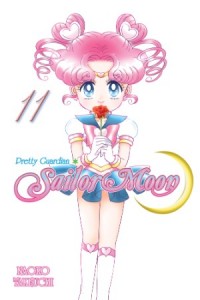
sailormoon11

I always recalled this being the most depressing arc, and there is certainly a lot of bleakness and death. But I liked how the volume began with everyone happy and content. Minako has now joined the others in high school (Rei is still at her private school), and everyone’s getting involved in club activities and various things that aren’t being senshi. It’s peaceful days, folks. Also, the introduction of the Three Lights leaves room for humor, particularly Yaten’s catty remarks to Michiru, leaving her in a rare instance of losing her cool. And much as I find Chibi-Chibi as puzzling as the rest of the cast, I was amused at everyone’s attempts to figure out who the hell she was.

And now on to the trauma. This is a vicious volume of Sailor Moon, probably the worst to date. By the end of the volume, all the senshi bar Sailor Moon are either dead or presumed dead. Indeed, Mercury and Jupiter get taken out so early they barely get a chance to appear. What’s more, these deaths look deadly, if you’ll pardon the expression. Takeuchi uses the same “flesh melting off” death mask she’s used before when minor villains are dispatched, and having it happen to folks like Mars or Venus seems wrong. Worst of all is Mamoru, who’s killed in front of Usagi at the airport, something so trauma-inducing that she blocked it out for months afterwards. And while Seiya and the others do note that if the Senshi Star Seeds survive, they can be reborn, it honestly feels like he’s talking about reincarnation. Or heaven.

Mars and Venus do get a few cool things to do before they’re dispatched. Rei infiltrates Minako’s school, a nice mirror to the short story where Minako did the reverse – or at least it would be if the re-release didn’t shuffle the short stories off to the end. They draw out the Three Lights, amusingly, by Minako going over the top about finding herself a man. Yaten calls her on this, noting that their duties to Usagi mean there will never be room for love in their lives (Minako in particular has heard this before – see Code Name: Sailor V). Minako smirks, and admits that this is true. She then leans into Rei and notes that the two of them have no use for men. It’s meant to be “duty over love” and threatening the Lights, but can easily be read as homoerotic if one chooses. And many do.

Speaking of senshi in general, one interesting thing going on here is the use of innocents from other planets as a sort of “failed Senshi” – their planets were destroyed by Galaxia and they’re being brainwashed/forced into attacking Earth. It’s interesting because of the Lights’ insistence that they’re all just as genuine as our heroines – on another planet, for example, Iron Mouse was Sailor Chu (yes, yes – it’s Nakayoshi, folks). Tying Lead Crow into Phobos and Deimos and Tin Nyanko into the cats thus works even better – I loved Luna’s accusation to Tin Nyanko that she’s defiling Planet Mau’s ‘One True Hero”, Sailor Mau. The Sailor Moons of other worlds are being used to kill off the cast of Sailor Moon. Which is really horrible if you think about it.

Even more than previous volumes, I find this one works best when you immerse yourself in it rather than try to understand each nuance. There’s too much going on here. But for the Sailor Moon fan, there are always so many rewards that the experience is never dull. It all ends next volume (except for the short stories).

The Disappearance of Nagato Yuki-chan, Vol. 4

By Nagaru Tanigawa and Puyo. Released in Japan as “Nagato Yuki-chan no Shoushitsu” by Kadokawa Shoten, serialization ongoing in the magazine Young Ace. Released in North America by Yen Press.

This volume of Nagato Yuki-chan is pretty much impossible to review without spoiling the major plot twist that happens in the first chapter, be warned.

So, when we last left Yuki, she was about to be hit by a car, ending our cute little AU spinoff before it really began. Luckily, it doesn’t do major physical damage. That said, there’s something… odd about Yuki after the accident, which Ryouko, being the perfect best friend and oneesama, figures out right off the bat. Yuki seems more serious, speaks more precisely, isn’t a giant goofball, and acts more like another Nagato Yuki that readers may be far more familiar with. Yes, that’s right, this series that is an AU spinoff of a movie where Kyon crossed over into a world where Yuki was a shy adorable human is now crossing back over with the canon and dealing with a very different Nagato.

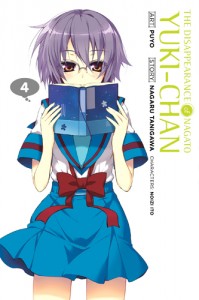
Tanigawa_YukiChanV4_TP

Please note that nowhere in the actual text does it say this. Indeed, there’s very little ‘explanation’ given at all. Yuki has an alternate personality due to the accident, which acts much like Nagato from the main Haruhi series, and everything resolves at the end of the volume with a similar lack of explanation – her mind re-orients itself and Nagato essentially says goodbye. Indeed, some may argue it’s not the canon Nagato due to the amount of emotions shown by this version – ranging from embarrassment at her stomach growling to a full-on body blush when Ryouko suggests that she may be in love with Kyon. But then again, Nagato in canon is an alien whose emotional growth is deliberately stunted by her masters. Here, she’s in a real human body and has no such tethers. So dealing with these feelings makes sense.

More to the point, Ryouko and Kyon’s reactions to this new Nagato are pitch perfect (Haruhi and Koizumi are conveniently absent for tests, so this book is pretty much just Kyon, Nagato and Ryouko). They’re both worried about what’s happened to Yuki, but both instinctively realize – even if Kyon’s much better at expressing it – that this Nagato is also her own person and shouldn’t just be treated as a clone or as if she’s “taken over” Yuki’s body. (Ryouko worries even more than usual here – also, great meta-joke about her saying she’ll just stab Kyon to relieve her stress.) There is a lack of conflict here that in most series would serve to make things rather boring – but this is the light and fluffy Suzumiya Haruhi spinoff, so it makes sense that there’s no accusations or attempts to return Yuki to her head – just calm acceptance, patience, and watching Nagato grow as a character of her own – to the point that she also falls head over heels for Kyon.

I’m not sure what the fallout from all this will be – whether Yuki will have memories of the time she spent as Nagato (it seems unlikely from what little we see) or whether Kyon will be able to deal with a love confession that wasn’t really – but I will admit that this volume really is a major step forward by Puyo, and the best in the series. Which is still light and frothy, but now deals with its characters on a level equal to its source.