Category Archives: reviews

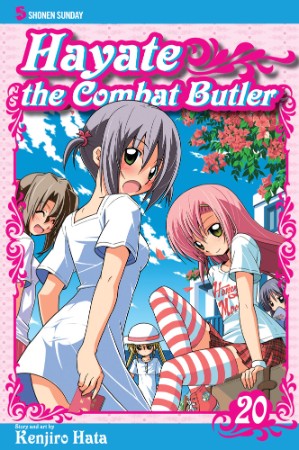
Hayate the Combat Butler, Vol. 20

By Kenjiro Hata. Released in Japan as “Hayate no Gotoku!” by Shogakukan, serialization ongoing in the magazine Shonen Sunday. Released in North America by Viz.

In general, you find two types of Hayate fans when you look at your average message board discussing the series. Those who appreciate that this is, at heart, a comedic gag manga, and those who do not. To be fair, Hata does not make this easy for us. Indeed, Volumes 23-24 will be almost entirely gagless, as was Vol. 18. Hata brought this on himself by creating, as part of his comedy manga, a classic harem manga where you genuinely *don’t* have a clue which way it will eventually resolve. And the interaction of the girls with Hayate can be adorable, heartwarming, and fluffy. Thus, when Hata decides after a particularly shippy chapter to suddenly do something incredibly silly with Fumi, or a fanservicey plot that goes nowhere with Izumi and company, fans who want harem resolution (i.e., more Hinagiku and Maria) tend to get irritated.

Fortunately for the romance fans, Volume 20 should keep them very happy indeed. There are no real pointless gag chapters (though there is much humor), and lots of character development – well, the closest one gets in a title where nothing can be resolved. We open with the resolution of the Las Vegas story, as Wataru and Saki manage to finally get one over on his mother and escape. Wataru’s ambivalent feelings towards her are nicely portrayed – he acknowledges that she’s a horrible, immature person who is not ready to raise her son even though he’s a teenager – but she is still his mother, and should she show up at his door one day, he’d likely take her in.

Parents in Hayate tend to get a raw deal – there are no less than three different characters whose parents have saddled them with a huge amount of debt and run off, Nagi’s grandfather seems to be the main villain of the series, and Mikoto is happy to use and abuse even her own son. Interestingly, we also see far more of Nagi’s late mother (in flashbacks) in this volume than in any of the previous ones. She is the one exception – she’s allowed to be, as she is dead – and seems to be a kind and loving, if flakey, mother. I sometimes wonder if all the parents of our current gang knew each other growing up (it’s clear some of them did), and are taking it out on the next generation. Luckily, Hayate and company seem to be a bit more with it.

On the love front, Ayumu has drawn Hina out to where she can admit her love for Hayate openly as long as there’s no one else around. Progress! Of course, actual conversation with Hayate is still awkward – they both tend to put their foot in their mouth a lot – and she’s annoyed when she realizes that, because she’s strong and Hayate trusts her to take care of herself, he may not see her as feminine. As for Ayumu, she’s still the most mature of the cast, and gets to think what most North American harem fans don’t want to hear – that Nagi is the most important person in his life right now. (If Hayate resolves with a Nagi ending, by the way, watch this fandom crash and burn even faster than School Rumble and Negima did. This is why so many harems are unresolved…)

So now everyone’s in Greece, having fun and accidentally ending up in underground tunnels. You know, the usual vacation antics. If I recall correctly, we still have a ways to go before we get back to the serious Athena scenes (and yes, there are also folks who primarily read Hayate, a gag manga, for the serious parts), so when Vol. 21 comes out the usual six months from now, expect hijinks! Meanwhile, this is a great volume for fans of the series – though obviously a bad place for newcomers to jump in.

One Piece, Vol. 64

By Eiichiro Oda. Released in Japan by Shueisha, serialization ongoing in the magazine Weekly Shonen Jump. Released in North America by Viz.

The Fishman Island arc, considering that we spent such a long time waiting for it to finally arrive, has been n unfortunate mixed bag so far. And that doesn’t really change with this volume, as while there are a lot of cool things going on, some good dialogue and humor, and some interesting bad guys, for once I wish that Oda would try pacing a little more like Bleach and let things slow down a bit.

The Straw Hat Pirates (plus Jimbei) are on the cover of this particular volume, and they do all get to show off their respective skills, in Oda’s standard shonen “see how I have grown stronger!” montage. Indeed, Zoro is captured and put into a cage (along with Usopp and Brook), but you get the sense that he barely treats it as something more than a minor inconvenience – he’s faced off against worse than this. Robin, meanwhile, can seemingly not only duplicate body parts but also herself now (let’s see Usopp try to imitate that!), and Nami gets to steal something for the first time in what seems like forever.

Speaking of Nami, given that we were at Fishman Island we were always going to touch on her past at some point. After the long flashback, Jimbei apologizes to her for not stopping Arlong, but this is an older, more mature Nami, and she can mourn the past while still looking forward to the future, and realizes that she’s met her crew and had grand adventures because of all this as well. It’s very heartwarming (as the rest of the cast seems to note, as several tear up in a “this is so heartwarming!!!” moment).

You would think Oda would have his hands full dealing with the prejudice moral that’s running through this arc, but apparently that wasn’t quite enough, so we also have some drug abuse going on, with the bad guys taking the Fishman equivalent of stimulants to keep going. As for the bad guys themselves, we meet Hody’s four lieutenants here, who are basically all variations on ‘goofy Fish guy Oda thought up to be funny’. There’s the one who adds sound effects to his sentences, the one whose camouflage is so good he gets run over, and the Drunken Master, just for a nice Hong Kong reference. Like Vander Decken, they are there to be bad guys you want to see beaten down but also enjoy reading about.

And so we finally start getting into the big fight about 2/3 through this book. It took longer than I thought – Luffy’s brief battle with Jimbei was particularly pointless filler but it’s here at last. So I’m hoping for some really good fights to take my mind off the fact that this arc is, for Oda, pretty mediocre. I mean, it’s still worth picking up – this is One Piece, and I don’t think Oda is capable of making anything not entertaining – but it’s not as fulfilling as what has come before it.

Pretty Guardian Sailor Moon, Vol. 7

By Naoko Takeuchi. Released in Japan as “Bishoujo Senshi Sailor Moon” by Kodansha, serialized in the magazine Nakayoshi. Released in North America by Kodansha Comics.

Sailor Moon continues to introduce us to the Outer Senshi and their way of dealing with things in this volume. It can be a bit hard to take, and the anime was never quite sure when to quit with the whole ‘no, we are right and you are wrong’ schtick. To be fair, one can argue that it’s all that the Outers know. We see, in their flashback (and note that their memories of past lives seem MUCH clearer than the Inner Senshi pasts have ever been) that they basically patrol their solitary planets looking for distant threats. They don’t even have cute animal companions to keep them company. And the one time they were able to do something, it was pushing the big red ‘PRESS THIS TO DESTROY UNIVERSE’ button of summoning Sailor Saturn. So it stands to reason they’d regard this as something that’s their job, and has to be done their way. Plus they’re two years older than Usagi and company. For a teenager, that’s, like, FOREVER.

That said, it’s Sailor Moon’s manga, and you know she’s going to be right in the end, so it can be a bit aggravating to see them try to do the whole ‘go away and let us handle this’ thing. Luckily, there are several moments that endear them to us. For one, I loved that, immediately after Setsuna’s memories awaken and she reclaims her powers as Pluto, she rushes to embrace Chibi-Moon. From a story perspective, Pluto’s death was devastating to Chibi-Moon the most, so it stands to reason that if you’re going to retcon it (and I don’t remotely understand how Pluto gets reincarnated in the past, but hey, timey-wimey ball and all that) you’d better reclaim that emotional moment. Pluto’s joy at seeing Chibi-Moon is equally fantastic. Of course, once that’s over she joins the Outers in their aloofness, but hey, can’t have everything.

I know that it’s a common theme throughout all 12 volumes of the manga, but it always seemed to me that S really ramped up the idea of possession as an attack to an insane degree. Here the Inners and Outers get pitted against each other by pumping up their negative emotions, we see Kaolinite (back when she was just Kaori, presumably) getting possessed by Pharaoh 90, and of course there’s Hotaru, whose success at fighting off the Evil Mistress Nine within her is even more admirable in this context, given that nobody else seems to have any luck fighting anything off at all. Speaking of Hotaru, her father in the manga is a really evil bastard, who it’s made clear seems to have been off the rails even BEFORE turning evil, so no redemption for him as you may have seen in the anime. That said, Hotaru’s reaction to all this is sweet and loving, even as a disembodied spirit.

Lastly, while bonds of friendship, love and respect are all very well and good, there’s a lovely reminder that being a senshi is a calling rather than a cute little fantasy. Most magical girl manga tend to have their heroines thinking of romance first and foremost – and indeed Usagi is fairly typical in that regard – but we’ve seen over and over again that this is a lifetime profession for Sailor Moon and the others – and that the lifetime is going to last MUCH LONGER than most. The Witches Five (brought back to life again, in one of the poorer plot choices in the entire series – don’t kill off minions if you need them again!) each taunt the Inners with the idea that there are other careers they could be doing – doctor, fortune-teller, florist, idol – that they’re sacrificing by choosing to be a senshi and help Sailor Moon instead. This is not a one-time theme, and will become even more important in the SuperS arc that follows this.

This isn’t a perfect volume of Sailor Moon – it’s a bit more messy and chaotic than it’s been in the past, and there’s more shouting at everyone else than I’d like (most of it designed to fill up pages while we wait for Mistress Nine to be powerful enough to break out). But, as noted above, it’s filled with food for thought, and now that we have all our ducks in a row we’re ready for a powerful climax. Will the Outers have to kill Hotaru to save the world? (Note: if you want this to remain secret, try not to look at the color pages for this volume.)