Category Archives: reviews

Bunny Drop, Vol. 6

By Yumi Unita. Released in Japan as “Usagi Drop” by Shodensha, serialized in the magazine Feel Young. Released in North America by Yen Press.

Please do not discuss Bunny Drop beyond Vol. 6 in the comments. At all.

When I reviewed Vol. 5, I noted that I couldn’t wait to see what direction Unita would take things, even though I thought it would make me cringe. And I was 100% correct – this entire volume is like a giant train wreck, where both of the main ‘ships’ we could be rooting for are faced with tortured reality.

Last time around, we had been told about Kouki’s ‘bad boy’ period in middle school, and now we get to see it in the form of an extended flashback. Which is good, as it really gives us insight as to why Rin has decided that she’s no longer ‘romantically’ inclined towards him. The two of them walked that fine line between ‘like brother and sister’ and small crush last time, but seeing Akari’s wholehearted efforts to drive Rin away, you can’t help but feel horrible for her. Cyber-bullying isn’t just an American thing.

This is paralleled with the ongoing not-relationship between Daikichi and Kouki’s mother, who still doesn’t have a first name (and likely never will, sadly). Their conversation at the end of the volume is all about wishing things could be different but having to move forward anyway, and it almost feels like Nitani-san cares about Daikichi too much to get involved with him. They’ve been there for each other in order to raise their children, but this has perhaps led both of them to be too self-sacrificing – Nitani-san is marrying someone else so that Daikichi can move on and find anotehr as well. The whole scene is heartbreaking.

Rin and Kouki aren’t as sad, but they’re equally hemmed in by feelings that things have moved beyond a point where everyone can go back to how it was before. This is helped, of course, by Akari, who Rin confronts when she tricks Kouki into thinking she’s pregnant. There’s a nice effort to show Akari’s side of things, which isn’t sympathetic at all, but it’s quite understandable – and mercenary. Akari wants to be her own woman, and if that means abusing the love of a gullible high schooler for money, well hey. Unfortunately, all this seems to have done is shown Rin that she needs to get over Kouki, and she tells him so – though notably getting over him is not as simple as she thinks, judging by her red-eyed face the next day.

We all make bad choices in life, and wish that we could turn back the clock and do things better. But we can’t, and that’s what this volume is all about. There’s no going back in time so Nitani could meet Daikichi when she was younger. There’s no do-overs so Kouki isn’t sucked in by Akari’s schemes. And sometimes you can’t fix things, and you have to accept it and move on. Which is where we are now in this series that, while it still has a lot of quiet and cute moments, has come an awful long way from the saga of a young guy raising an adorable daughter.

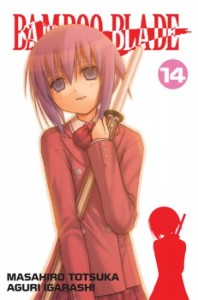
Bamboo Blade, Vol. 14

By Masahiro Totsuka and Aguri Igarashi. Released in Japan by Square Enix, serialized in the magazine Young Gangan. Released in North America by Yen Press.

Throughout the 14 volumes of Bamboo Blade, we’ve seen its heroine, Tamaki Kawazoe, grow and evolve. She’s always been an amazing kendo student, but that’s not her goal, or her passion, or even her hobby – it’s just what she does. Meeting with Kirino and the others has helped bring her out of her shell, and she’s learned the value or true friendship, but they aren’t able to challenge her enough in regards to kendo. Now, after her defeat by Erina in Vol. 13, we come to the final volume, where Tama-chan spends half of it asking: why do people do kendo?

Everyone’s answer is slightly different, but they all end the same. Azuma uses kendo to improve herself (and make up for her hopeless study habits); Miya-Miya, in addition to finding beating the hell out of everyone fun, wants to see how strong she can be and how far she can go. Saya, who’s suffered from being the ‘comedy character’ in a manga filled with them, finally admits that kendo gives her discipline she needs to grow up. Kirino, of course, simply lives and breathes kendo. It’s surprising to realize that, like Tama, she hasn’t had a real reason for doing kendo beyond “I love it!”, but given her simple and direct personality, this fits. Yuuji and Kojiro-sensei both chime in briefly, but are savvy enough to note that Tama-chan has to find this answer by herself.

Everyone’s final ‘real reason’ for doing kendo is elided out at first, and we only hear it once Tama-chan is back in her bedroom, watching a tape provided for her of her mother on a kendo TV show years ago. Her mother is asked the exact same question, and notes that she wants to make everyone feel the same joy and satisfaction in kendo that she does – its ideals, it’s disciplines, its purity – and that she teaches to to this. And then we flash to the end of everyone’s answer, the one thing all the other girls said. They want to be like Tama-chan. She is their goal, what they are pushing themselves to. And as she breaks down in cathartic tears (part grief over her mother’s death, part simply feeling the weight of everything, and part because she now has that goal), she knows what it is she wants to do kendo for. To be a teacher.

And this ties back in with Kojiro-sensei. I’ll admit, when the series began I had little time for him, putting up with his waffling and goofball tendencies because I liked the rest of the cast so much. But he’s grown just as much as Tama-chan has, and it’s also due to kendo. Seeing him strive to teach the girls how to use kendo to further themselves, and realizing what he can and cannot do in that regard (much of the series has been his angsting about not finding the right way to teach something), he knows he wants to keep doing this – but not with these girls, who he feels have learned all they can from him. He’s leaving for a different school to start with a new class of beginners. We only see Kirino’s reaction to this (and she outright says she’s refraining from saying what she thinks…), but I think they’ll understand his reasoning, just like they did with Tama-chan.

Despite the comedy throughout (even the last climactic battle features Saya (of course) getting herself in trouble by not having eaten for 48 hours prior out of nerves), Bamboo Blade has been almost the pinnacle of idealistic sports manga. If someone is at a loose end in life, or trying to make a change, or needing to find something within themselves… all this can be found through kendo. It’s a trend we see in a lot of sports manga, be it baseball, soccer, or what have you. but despite the idealism (or because of it), this is a manga that really makes you feel good about yourself, and have confidence in the lives of its cast. And it’s not just our 5 heroines – even the ‘rival’ characters such as Sakaki and Erina find strength and fulfillment in kendo, and in bringing kendo to others. Filled with emotional moments, goofy comedy, and of course awesome sports battles, anyone who likes to see humanity striving for a goal should read Bamboo Blade, where kendo will have the answers.

A Certain Scientific Railgun, Vol. 5

By Kazuma Kamachi and Motoi Fuyukawa. Released in Japan as “Toaru Kagaku no Railgun” by ASCII Media Works, serialization ongoing in the magazine Dengeki Daioh. Released in North America by Seven Seas.

As we get into Vol. 5 of Railgun, it strikes me how many sociopathic killers are really in this series. It’s a whole lot. Misaka has found out about the experiment where 20,000 of her clones are killed off in order to force a Level 5 to get even higher, but that’s just the tip of the iceberg. Academy City and its dedication to science clearly continues to have a dark and sordid underbelly, and I doubt that the enemies this time will be as misguided but ultimately likeable as in the Level Upper arc.

First we have Accelerator, this arc’s “Big Bad”, who just finished brutally murdering Misaka 9982 at the end of last volume. The real Misaka is understandably upset by this, and does her best to try to make Accelerator see reason, or at least beat the shit out of him. This is especially true when she hears his motives are simply power, thus making the killings even more appalling. There’s a short battle, but a) it becomes clear that Misaka is severely outclassed by her enemy, and b) the clones stop things fairly quickly, pointing out that if he defeats the real Railgun now, that sort of ruins the experiment.

So now Misaka knows about the experiment, and has to stop it. The clones are of no help at all, as they don’t value their own lives so can only point out how easy it 9is to build new ones. She briefly has the help of Shinobu, a scientist who is trying to fix things after realizing that the clones are more than just lab rats. But for the most part it’s just Misaka straightforwardly trying to destroy the experiment by destroying every single site where it takes place – all 10 of them, supposedly used to combat muscular dystrophy. Yes, it’s Misaka the terrorist. Given that the hero of the main series, Touma, tends to solve problems by simply punching them very hard, it’s somehow fitting that our heroine is cut from the same cloth – if there are no more labs, there will be no more experiment.

Of course, things aren’t made that easy, as we also meet ITEM, the anti-terrorist group sent off to take Misaka out. These are basically child soldiers, with a slightly older leader, and are, like Accelerator, rather blase about all the people they have killed. The team is actually balanced nicely between two hotheads who glory in killing and torture, and two cool stoics who seem more blase about the whole thing. Naturally, it’s the hotheads who get most of the focus, and as we see a 10-year-old girl brag about the number of people she’s killed, we are reminded again what kind of environment this is.

And so in the end Misaka thinks she’s won, but somehow I doubt it. Blow up 10 labs, and 10 more will spring up. This is about defeating an entire scientific culture, and that will take far more than electroshock therapy. Luckily, we have an exciting cliffhanger, where… she sees Touma at a vending machine! Gasp! (This is actually more exciting to those who have read or seen A Certain Magical Index, as the two stories now join up, all of the past two volumes having been prelude.) Will she ask Touma for help? Or just be tsundere at him? It’s been a while since we’ve seen that side of her…