Category Archives: reviews

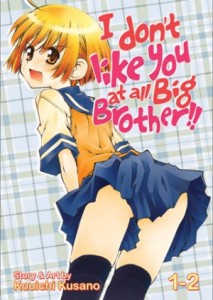
I Don’t Like You At All, Big Brother!!, Vol. 1-2

By Kouichi Kusano. Released in Japan as “Oniichan no Koto Nanka Zenzen Suki ja Nai n da kara ne!!” by Futabasha, serialization ongoing in the online magazine Web Comic High!. Released in North America by Seven Seas.

People follow trends. It’s just a way of life. When something is popular, the first instinct of a business looking for profit, or writer looking for a surefire seller, is ‘what did it do and how can I use that to replicate it?’ And this is fine sometimes. I’ve known many derivative works that have been very good and sometimes even surpassed the original. But too often someone goes too far. Either they miss the original point that was being made, or they deviate in an unacceptable manner, or they add too many other, equally trendy things to make a giant stew of trends that all cancel each other out.
And incest as a sexual thrill is, god help us, popular these days. Especially in Japan. Naturally, *genuine* incest seems to be saved for the actual porn magazines, but there’s no end of manga and (more importantly) anime that feature guys crushing on their sisters, and girls worshiping their brothers. Usually at some point they find out they aren’t related after all. Other popular trends in anime these days include the tsundere type who says mean things and hits the object of her affection as she’s too embarrassed. And let’s not forget the pretty, reserved princess type who secretly turns out to be a stalker and pervert.

If all this sounds like a lot of moe animes seen in the past five years, it’s by design. I’ll be honest, I had initially confused this title with ‘My Little Sister Can’t Be This Cute’, which comes out next month by Dark Horse, and has a somewhat better reputation. IDLYAA,BB!! features Nao, who loves her older brother a lot (the title may have given that away), despite his being a somewhat perverse non-entity in these two volumes. She goes to wake him up every day by hitting him (and giving him calculated panty flashes) and throws out anything in his porn doujinshi that it’s brother/sister incest. In fact, when told that she’s actually not related to him after all, this *depresses* her briefly, as it ruins the incest fantasy she’s been going for for so long.

This may seem rather hardcore for what’s meant to be a typical seinen title for horny guys, but rest assured there’s no actual sex, merely piles and piles of suggestion (though I note this is the author’s first ‘mainstream’ work after years of drawing adult titles). And to be fair, Nao’s obsession is treated in-story as immature and wrong. Then we meet our second heroine, Iroha, a long-lost childhood friend who meets Nao’s brother after all these years and proceeds to sexually assault him. This is actually one of the few interesting scenes in the book – it’s presented as incredibly disturbing (after all, we’re meant to root for Nao), and her brother’s horrified reaction to it, and realization that he may have led to her turning out this way, is a brief moment of soul searching that could be interesting… if it weren’t undone by Nao and Iroha’s determination to make sure that their man stays perverted and does not ‘turn over a new leaf’.

There’s a couple more things to like here – Nao’s two female friends are meant to function as a Greek chorus of sorts, and their reactions towards the end of the book at all the slapstick are well done – but to be honest, I have rarely seen a manga that seemed to calculated to hit as many fetishes as possible as this one. If you enjoy perverse moe harem comedies, well, I think you’ll get a big kick out of this, though even the most hardcore fan might finish the volume and say, “Erm, isn’t this a bit over the top?”

Sakuran

By Moyoco Anno. Released in Japan by Kodansha, serialized in the magazine Evening. Released in North America by Vertical.

The oiran, or high-ranking courtesan, is a very popular character in manga of the Edo period. We’ve seen them solving crimes, manipulating high level politicians, and craftily playing one side against another. We have even, occasionally, seen them entertaining clients. However, a lot of those plots have been typical manga fodder, and the life of a typical Edo brothel worker is far more painful, degrading and tortuous. Sakuran shows us the story of Kiyoha, a strong-willed and rebellious girl who must be broken (but not completely) into the role of a courtesan.

We meet Kiyoha when she’s a child, and a good deal of the book is witnessing her grow up. Well, to a certain degree. One good thing about Anno’s characterization of her heroine is that Kiyoha can be quite unlikeable at times – willful, stubborn, quick to violence. They’re qualities that *also* make for a good oiran – the job is so grinding and will-breaking – this is forced prostitution we’re talking about – that only the strong can hope to survive. (Note that Kiyoha makes friends at one point with another cute and lively girl, and briefly bonds with her… before the other girl dies (the dialogue makes it unclear if she killed herself or was beaten to death). And indeed, once Kiyoha comes of age and rises to the level of oiran, she is noted for both her young beauty and her cynical smile.

We see Kiyoha try to escape quite a few times, but it’s made clear that the ideal way to escape is to have a man take so much notice of you that he proposes – buys out your contract. We see this with Kiyoha’s mentor Shohi, who I think comes off the best out of everyone in this manga. She’s certainly cruel and sadistic to Kiyoha, but it’s that sort of ‘it’s in order to make you stronger’ mentoring that always seems to pay off in the end. There’s nothing Shohi can *do* for Kiyoha in this environment except that. Notably, Kiyoha’s own love affair, which is made out to be more ‘illicit’, does not end nearly as well.

The ending of Sakuran can be seen as a bit bleak. After her most successful escape attempt yet, Kiyoha realizes that things on the outside are not any better for her than life in the brothel. She says in dialogue that she returned on her own, and in her inner monologue (showing us scenes of her being punished and tortured) that she feels better now that she knows there’s no ‘better world’ to go to. Kiyoha, unlike Shohi, does not seem to be the sort who can simply gain the favor of a rich man in a way that would get her out of there – I think she’d sabotage it. At least in the way she is now. The manga is open ended in that you question how broken she really is. I like to think that she still has a lot of strength in her.

The tension between what is needed to be a good oiran and the fact that it also makes a person realize how awful their life is and yearn for freedom is the core of Sakuran. Combined with Anno’s stunningly gorgeous artwork (you can argue everyone looks too similar, but that’s more a function of the time period than the artist), you have a manga whose images and ideas will stay with you long after you read it.

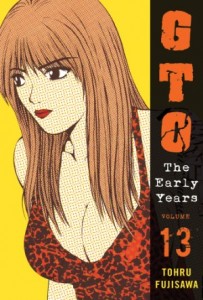
GTO: The Early Years, Vol. 13

By Toru Fujisawa. Released in Japan as “Shonan Jun’ai Gumi” by Kodansha, serialized in the magazine Weekly Shonen Magazine. Released in North America by Vertical.

It always seems as though there’s more dumb comedy in the Early Years manga than comes up in its sequels featuring Onizuka. Now, I’m sure if I went back and checked all of GTO this would not be the case – GTO has some monumentally silly things going on, and I’ve noted just last week how much dumb fun is in 14 Days in Shonan – but here Onizuka has the better excuse of actually being an immature high schooler, meaning that he and his friends lend themselves even well to situations that make one cry with laughter and weep at the stupidity of all involved.

First, though, we get some more epic fighting, as Onizuka still has to resolve his rivalry with Mafuyu, who is determined to take on Eileen, the one that killed his brother. Now, I figured out that Eileen was actually the name of a tropical event right off the bat, meaning it can be grating seeing everyone going around just NOT GETTING that Eileen isn’t a woman. But it leads to some interesting situations, as well as some epic surfing. We also get a very shonen moment where Onizuka is taking on a group of washed-out ex-military Americans, as he notes that saying ‘dreams will die’ and ‘know your limits’ is something that happens to other people. Oh, and showing them the wrath of a true Japanese person, of course. (It almost reads like the U.S. and Japan are rival gangs here, probably deliberately.)

After this, which takes half the volume, the other half is devoted to far shorter and sillier situations. We are reminded that this manga takes place in the late 80s/early 90s with Onizuka’s obsession with bootleg video porn. We see a chapter devoted to Onizuka’s mother, and realize just how horrible it must be trying to deal with a kid like him. There’s an amusing parody of Kindaichi Case Files where Onizuka and friends try to solve the murder of one of their own (spoiler: he’s not really dead). And after his mother finally throws him out, we see Onizuka and Danma moving into a roach-infested rathole of an apartment, which brings its own levels of disgusting humor.

And then there’s the Russian night vision goggles. First off, I really like how Onizuka and Danma are shown here as the leaders of their gang. Even though everything spiraled out of control because of their underlings being stupid and not getting the point, they still don’t back down from a fight, because, well, they’re leaders. Secondly, the idea of a shonen title spending this long discussing night vision goggles being used to masturbate while watching a neighbor strip through a peephole is simply mind-numbing. I’ve noted before that Shonen Magazine seems more ‘mature’ than its rivals Jump and Sunday, and apparently that was the case 20 years ago as well. This leads to an amazing finale, which for once features Danma as the stupider one. He likes to pretend he’s the more mature, especially given he actually has a girlfriend and has gotten lucky, unlike Onizuka, but the peephole situation (which I don’t care spoil) shows he can be even more perverse when it gets right down to it.

I can see why this was such a big success for teenage boys in Japan. Even though I doubt that’s the market for it here, fans of Onizuka should really pick up this prequel, which features less teaching but just as much badassery.