Category Archives: reviews

GTO: 14 Days in Shonan, Vol. 4

By Toru Fujisawa. Released in Japan by Kodansha, serialized in the magazine Weekly Shonen Magazine. Released in North America by Vertical.

It may come as a surprise to those reading GTO 14 Days, and noting its onging bevy of nudity and sexual situations (without any actual sex, of course), that it runs in Weekly Shonen Magazine, a title that supposedly has the same age 10-13 dynamic as its competitors Shonen Jump and Shonen Sunday. But Shonen Magazine skews much older than those two in reality, as readers of Akamatsu’s love comedies and the romantic hijinks of GE Good Ending could tell you. That said, talk to any 10-13 year old boy and I think you’ll find ‘boobies!’ is high on their list of priorities. And it’s not just the nudity: some of the pasts revealed in 14 Days are dark and definitely seem not for kids, but kids their age *do* deal with abuse and abandonment. Best not to sugarcoat it… or at least sugarcoat it with Onizuka’s brand of goofy humor.

It’s all about keeping a balance, and knowing when it’s OK to do action-adventure suspense stuff and when perversion is needed. Onizuka’s own life is balanced this way, as we’ve seen him use toilet humor and lechery as a mask to hide behind when he wants to avoid discussing serious situations. In the case of this volume, however, it’s Ayame and her shattered illusions that provide the humor. She’s gotten a biased sense of Onizuka through Fuyutsuki’s image of him, and was rather taken aback at Shinomi’s violent reaction last time. But here, seeing him ogling her in the bath, running around with his “tackle out”, and seemingly unable to take on assassins in a desperate emergency simply as they’re dressed like strippers, Ayame realizes that Onizuka really is just a horny guy after all.

Which is for the best, as now she can appreciate his better sides even more. It’s not as if knowing the ‘real’ Onizuka stopped Shinomi from falling in love with him, and seeing the brief instance in the hospital when she thinks he’s dead is rather touching, even if it quickly leads back to humor of the “how dare you make me reveal my emotions” variety. And his dogged persistence in helping these kids no matter what, getting them to see that they don’t have to turn out bad, and sheer nigh-invulnerability to physical attacks are also on display here, for those who love it when Onizuka gets badass.

Likewise, the situations these kids are in have to be deepened, or else their lives will be seen by the manga reader as a checklist. “Well, he’s solved Seiya’s problems, so who’s next?” But he hasn’t solved Seiya’s problems. He’s gotten him to think seriously about them, but there’s been pressure Onizuka doesn’t know about (not just twins, but evil twins!) and the end of this volume seems to have come full circle in that we see Seiya ready to confront his stepfather with violence. It’s also a good thing that we not only see a flashback showing the abuse that he suffered at his mom’s boyfriends hands, but also another showing his mother’s abandonment, and how it affected him just as hard. These are complex situations that Onizuka can’t just solve by punching people and giving inspirational speeches. Well, not ENTIRELY by that, at least.

Another cliffhanger for this volume, but I expect that nxt time we’ll move on to the twins Riko and Miko, who look to be even harder to get through to. (The twins are apparently popular in Japan – they got their own spinoff after 14 Days ended.) But for manga about inspirational, never say die teachers who nevertheless cannot resist looking at naked women, there’s no better than GTO.
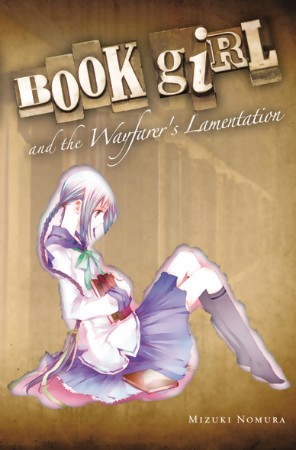
Book Girl and the Wayfarer’s Lamentation

By Mizuki Nomura. Released in Japan by Enterbrain. Released in North America by Yen Press.

This volume of Book Girl does not introduce a new situation of tragic consequences that resonate with our hero’s own past and causes him to grow and change a little more. We’re done with that. Instead, we tie the previous four books together and bring things full circle, as Konoha must confront his past head on, deal with the return of his objectified girl, and realize that despite all the growth he’s made in this last year, he still has quite a ways to go.

These books are all told from Konoha’s point of view, and thus sometimes things can happen around him that he is unaware of. This is especially true of this volume, but Nomura-san is very skilled at letting the reader in on things that Konoha either doesn’t know or is deliberately deluding himself about. Those who have been frustrated by Konoha’s attitude in the past are not going to find this book any easier to delve into. Indeed, as a reader I found myself identifying more with Akutagawa, who is clearly sympathetic to Konoha, but also can’t stand what he’s doing to Kotobuki (and himself). There’s a wonderful scene where Akutagawa lays everything out for Konoha to see, with an expression on his face that says “you aren’t going to believe this or care but I am doing it anyway, dammit.” When his frustration boils over into violence, it’s very cathartic.

Speaking of Kotobuki, I think I’m finally coming to like her. It’s taken a while – she was very stereotypical to start with – but as she’s opened up we’ve seen more of her inner turmoil, and here we see her risking everything in order to protect Konoha. It’s inspiring, but also rather sad, as I think by the end of the book, despite what he may say, he’s no closer to Kotobuki than he was when the book began.

And then there’s Takeda. I’d mentioned in my review of the third volume that it was rather refreshing seeing how in this series, people’s issues aren’t magically fixed by page 235. And indeed, we see that sometimes they aren’t fixed at all. Takeda still puts on a mask of happiness to hide her confusion and sorrow, and now has even taken to self-harm. It’s quite interesting how she actually takes up with Ryuto, a boy who seems to delight in girls with issues, so to speak. Even by the end of the book, after another cathartic moment, we’re not sure if she’ll be OK.

And then there’s Miu. I was predisposed to liking her because of my nature (I find myself drawn to and supporting unlikeable characters), and felt that I was correct when I read the scene with a young Miu meeting Konoha, and telling him a story. Konoha’s narration of it is beautiful, and you believe that it shows you the real Asakura beneath all the anger, hatred and manipulation we’ve seen. And then, later on, that beautiful scene is thrown back at us, as we get it from Miu’s point of view and see the horrible pedestal Konoha has placed her on, leading to writer’s block and her desperate cribbing of stories from other sources. I’m not sure it makes up for everything she’s done, but at least I look forward to seeing if she can finally move on and begin to heal.

I haven’t talked all that much about the book as a book, but that’s mostly as I’m so drawn into the character’s lives. It’s a good book. Frustrating at times, but that’s the frustration of a reader towards the characters doing dumb things, not the author. I do wish we’d had more of Maki – she’s the only supporting character whose story didn’t tie into the others, and her presence at the end seems to be nothing more than ‘I need the whole cast here’ – but she apparently features heavily in Book 6, so I’ll let it go. I also haven’t mentioned Tohko, the titular Book Girl, but that’s because Tohko’s story is still so diffuse. Yes, she’s studying to get into university – barely – but she’s the one who helps others, the detective who puts everything together. We haven’t had her own story yet – clearly that will be Books 7 and 8, the finale. For now, all we get are suggestions and small tastes.

Jiu Jiu, Vol. 1

By Touya Tobina. Released in Japan by Hakusensha, serialized in the magazines Hana to Yume and The Hana to Yume. Released in North America by Viz.

Those who follow my reviews know that I tend to be very fond of shoujo manga published by Hakusensha, despite the fact that most of my favorites were put out by companies which them folded. Astute readers may also recall my #1 complaint with said Hakusensha manga, which is that the artists need more editing than they are really given, and that much of their work, especially in early volumes, tends to be messy, unfocused, and uneven. Unfortunately, Jiu Jiu is a classic example of this sort of manga.

The author, Touya Tobina, has been seen here briefly before – her story Clean Freak: Fully Equipped had one of its two volumes put out by Tokyopop before they shuttered down. That story was more grounded in the real world. Jiu Jiu is a full blown fantasy, featuring a girl who aspires to be a demon hunter and her two wolf pets/bodyguards/whatevers, who can assume human form when they want to. It ran for two volumes in Hana to Yume, then for reasons unknown moved to the quarterly publication The Hana To Yume, where it recently ended last month with Volume 5. The premise involves a young woman who’s trying to block herself off from emotions in order to deal with her tragic past, and the two wolf boys, who want to be helpful and discover these new feelings of love within them, but are foiled by their playful natures.

I think I make that sound better than it actually it, unfortunately. Takamichi ends up being more of an emotional wreck than a stoic hunter. While this makes sense given she’s a teen who’s undergone a traumatic experience (which we still don’t get all the details about in this volume), it is a bit of a disappointment seeing her fall into the traits that I’ve associated with the basic ‘tsundere’ type. As for the two wolves/wolf boys, this falls more into the sort of shoujo romance tropes that were cliched 15 years ago. She constantly wakes up with them naked in her bed, they continue to act like wolves (well, OK, dogs really) even when in human form, etc.

The biggest problem, I think, is that this ends up being far more comedic than I’d assumed given its premise, and the comedy just isn’t all that funny. When it turns to serious matters, its quality improves significantly. Snow and Night, the two wolf boys, have a tough job, given their mistress is trying to shut out anyone close to her but they need to protect her (and make her understand why they want to). My favorite scene in the volume is where the three have to track down a werewolf (an evil one, let’s make that clear) who has been killing people during full moons. After reaffirming their devotion to their mistress, who seems to want them to remain innocent puppies, we cut back to the now defeated and transformed werewolf, who is a salaryman type. He begs for mercy, but Takamichi coldly informs him that her family are killers, and orders the man executed. It’s chilling stuff.

Unfortunately, there was more ‘wacky high school comedy with hot guys behaving like dogs’ and less ‘family of demon slayers’ here. Now, given that I am a big proponent of ‘never judge a series by its Volume 1’, I am hoping that things improve down the road. For the moment, Jiu Jiu is an excellent example of average Hakusensha shoujo – good plot, interesting ideas, but desperately needs an editor to take a firm hand.