Category Archives: reviews

One Piece, Vol. 63

By Eiichiro Oda. Released in Japan by Shueisha, serialization ongoing in the magazine Weekly Shonen Jump. Released in North America by Viz.

There’s always a risk that Oda runs because he puts everything into his manga. This is not a title like Bleach, where a 5-minute fight can take three months of real time. There’s always at least ten different things going on. The difficulty is in trying to keep all that happening and not confuse or alienate the audience with too much information all at once. And in this volume, I’m afraid a lot of the time Oda doesn’t quite manage it. He’s simply trying to do too much too fast here, using too many characters that we haven’t grown to care about yet.
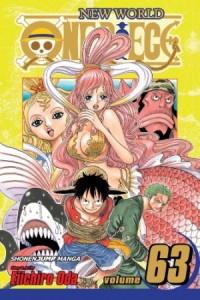
This is basically a volume in two halves. The first continues the melee battle on Fishman Island, as the Straw Hats get in between a civil war/coup started by Hody Jones and his brand of outlaw scum. Of course, they’re powerful outlaw scum, so King Neptune and his good guys are getting pounded. Meanwhile, Luffy has succeeded in getting Princess Shiratori outside, but this quickly leads to even more chaos. And then there’s Jimbei, who is down by the grave of the princess’ mother, feeling guilt and sadness. There are some nifty fights (Zoro is, as usual, badass) and the odd goofy comedic moment (Sanji seems to finally get better here, after briefly turning to stone (which I’m sure isn’t meant to be metaphorical at ALL.) But mostly the chaos is what’s driving everything, and this does make things incoherent at times.

Some things to note: Nami’s subplot is actually quite interesting. She’s recognized, sort of, as being an ex-member of Arlong’s crew, and certainly Jimbei’s guilt is directed quite a bit in her direction. But we don’t really see her reacting much beyond faraway looks and the occasional sweatdrop. I like to think that it’s Oda showing that Nami is finally starting to move on from her past (we get a nice page-long flashback from Nami for those readers who may have forgotten it), but also we see that she can also see things from the other side now, and is more aware of the prejudice and persecution that fish-people have suffered. Not that she’s forgiving Arlong anytime soon.

Which leads us into the big flashback. This is an unusual flashback in that it doesn’t seemingly stem from a crewmember’s past and end with them joining Luffy – unless that’s meant to be Jimbei. Instead, we meet Fisher Tiger and Queen Otohime, two characters whose dreams and ideals for their people are contrasted against each other. Fisher Tiger knows what’s right and tries to follow that, but the constant abuse of humanity against his people has ground him down. As for Queen Otohime, her naivete is contrasted with her nobility and pure stubbornness, and we learn that even if fishmen and humanity can try to move closer together, it only seems to take one person with different ideas to screw everything up. As you might guess, prejudice is not an easy fix, especially when it involves slavery.

The aftermath of the queen’s death will have to wait for the next volume, as she dies on the last page (Oda even notes there’s no room for extras this time). But it’s not going to be pretty. Oda is showing us that the world is a complex, contrasting, and sometimes horrible place. Even if he’s trying to jam it into a narrative already overstuffed with political battles and revolutions. Next volume should have a lot of fights, which will actually come as a relief after all this buildup, I think.

(Also, Oda’s response to the reader asking who the father of Makino’s child is is classic Odatroll. He clearly knows all about the Shanks/Makino shippers, and is baiting them mercilessly.)

Alice in the Country of Clover: Cheshire Cat Waltz, Vol. 1

By Quin Rose and Mamenosuke Fujimaru, based on the game by Quin Rose. Released in Japan as “Clover no Kuni no Alice – Cheshire Neko to Waltz” by Ichijinsha. Released in North America by Seven Seas.

I was less than impressed with the first spinoff from the Alice books, Bloody Twins. This second one promises a much longer and more involved plotline – it’s 7+ volumes in Japan – and like the heart volumes has Alice bonding with a lot of people while clearly being romantically paired off with only one of them. Here it’s Boris, the Cheshire Cat of Alice’s dream world.

The premise, supposedly, of the ‘Clover’ world is that the player, playing Alice, did not actually pick anyone while playing the ‘Hearts’ game – which involved a love based on passion. So the world changes to the ‘Clover’ country, where Alice once again interacts with most of the cast she knows (Julius is gone, and I missed him), along with a few new characters, and tries to see if she can find a love based on ‘companionship’. The manga thus fairly unapologetically plots out one of the ‘routes’ you can take as Alice in the game.

What this means in terms of an actual manga plotline is that Alice is uprooted from her comfortable life at the amusement park (as I said, different world from the Hearts manga) and dumped into a lonely forest. Much of this first volume involves her fear and uncertainty at having her life turned upside down right after she decided to stay there and not return home to her sister. Luckily, she eventually finds Boris, and through a series of wacky situations, ends up staying at the Hatter’s place and getting a new job.

Like Bloody Twins, this manga is focused far more on the romance than the Hearts manga. Alice’s sister is mentioned once or twice, but the implication we get at the end of Hearts is never brought up. Instead, we get the Hatter, and the Twins, and above all Boris, all trying to get into Alice’s pants. I’d mentioned in Bloody Twins that there was a far more sexually suggestive air to the book, and that continues here – at one point the Hatter says ‘So maybe you’ll *stay* if I make you *come*’ and his implication is clear. Of course, this manga series – and the original games – were written for female fans, not male ones. As a result, the tendency to try to keep all the harem characters virgins so as not to offend male otaku is absent. Nothing actually happens here, but I would not be terribly surprised if Alice and Boris come together – so to speak – in the future.

This volume does tend to get a little aimless at times, and risks being as light and frothy as Bloody Twins was. The good thing, though, is that it’s not afraid to show how emotionally damaged all its cast is. Alice and Boris are both filled with doubts and unfulfilled needs, and can’t communicate well at all – part of Alice’s worries are that Boris doesn’t love her as much because he’s a cat deep down. Meanwhile, thankfully Peter White and Ace are both in this universe as well, and they’re as insane as ever – Peter is the worst stalker ever, and Ace always seems to be one step away from a mass murder spree. If the title can balance its romantic comedy elements with the discomfort at its heart, it should prove just as fun as the original.

Olympos

By Aki. Released in Japan by Ichijinsha, serialized in the magazine Comic Zero-Sum. Released in North America by Yen Press.

Yen Press has occasionally taken a flyer on short series that they can release as omnibuses, things that are somewhat off the beaten path. Sometimes this works out well (Dragon Girl), sometimes not so well (Sasameke). Olympos, a josei series about a petulant god and his captive human, seems to fall somewhat between those two camps, though I am ultimately pleased to have read it.

After a very well-handled fakeout of an opening, where we get teased about who the actual protagonist is supposed to be, things settle down. Ganymede, who people may recall from mythology, has been taken from his life and brought to a beautiful yet empty ruin, where he lives in stasis and occasionally has cross words with the god who has orchestrated all this, Apollo. The rest of the omnibus features Ganymede’s interaction with these gods, and Apollo’s attempts to amuse himself, which ultimately end up telling us more about the latter than the former.

The art style used here is very pretty and shoujo-esque. Deliberately meant to evoke androgyny, I found myself throughout the series forgetting that I wasn’t dealing with two women here. Even Poseidon, who is supposed to be big, burly and the masculine ideal, has a face that is very female. Of course, gender doesn’t really matter here – there’s no actual romance, except for the false start with Heinz and his doomed love. Still, the feminine faces are another way of showing that we’re dealing mostly with gods rather than man.

Easily my favorite part of the story was one that did not involve Ganymede at all. Instead, we flashback to a time when Apollo saw a temple being built in his honor, and began to interact with the sacrifice that had been offered to him. He refused to accept her, so she essentially hung around until he did. Iris, the sacrifice, is portrayed as a bit of a bubblehead, but her sweet and earnest devotion is rather cute, and you enjoy seeing Apollo open up to her, even if this leads to an inevitable conclusion.

By contrast, the weak point in the volume is Ganymede, who at the time we meet him has mostly grown rather resigned and bitter about his fate. There’s nothing particularly wrong with his conversations with Apollo, which tend towards the philosophical in regarding the nature of man and gods, but he does not stand out the way that the other gods (and Iris) do. Ganymede may be the focus of the book, but the show is clearly Apollo’s to steal.

I always enjoy seeing Japan dealing with Western mythology, and this is pretty well done. There’s a lot to think about here, involving Apollo’s relationship with Artemis, Poseidon’s desperate attempts at social climbing, and Zeus hovering above all, as unknowable to the other gods as they are to mankind. I do wish that the author had found a better way to go about conveying these ideas besides having everyone sit around and blithely discuss it. Don’t get me wrong, the discussions can be fascinating, but the utter lack of forward movement – even in the end, the manga simply stops rather than reaching a climax – makes the whole thing rather dry and dull, a bit like a textbook of Ancient Greece.