Category Archives: reviews

Hetalia Axis Powers, Vol. 3

By Hidekaz Himaruya. Released in Japan by Gentosha, originally serialized as an online webcomic. Released in North America by Tokyopop in association with Right Stuf, Inc.

For the first time in over a year, I get to review a new Tokyopop book. And naturally, it’s the third volume of Hetalia Axis Powers. It was a runaway bestseller, so it makes sense that it should come back. The translation for it had already been done, given it was scheduled to ship a mere month after TP initially went under. And, being one of the company’s few Gentosha books, I imagine the renegotiations were easier than with a company like Kadokawa or Akita, who might inquire about the 7-8 other abandoned titles that there is little interest in reviving.

The quality of the book itself is a huge improvement over the first two, at least production-wise. The paper is thicker and more durable, there are color pages, and it simply feels more ‘quality’ than the almost xeroxed feel of the first two volumes. As for Himaruya’s art, it’s always going to look a bit dashed off, as that’s just what he does, but it does look a bit clearer here than in prior books.

The series is less about World War II than ever before, but that’s absolutely fine. History buffs may like Hetalia, but in the end it’s not particularly written for them. It’s a goofy comedy starring a bunch of (mostly) guys who do dumb things around each other, and happen to be nations of the world. There’s a bit less reliance on stereotype here (though still a lot – don’t think it vanishes) as we have grown to know the characters and therefore the author can rely on simple character-based gags, such as tomboy Hungary not realizing that she’s a girl, or Japan’s crushing disappointment that Switzerland does not look like Heidi at all.

This is not to say that there aren’t plenty of historical strips, they’re just used as setup for the most part. Probably the best in the book is the analysis of the alliance between Poland and Lithuania in the 15th and 16th century, which also gives us a chance to see some actual action in the series, however brief, as the two nations battle against Prussia and Sweden (what an odd pairing. Are their fanfics? … yes, of course there are.) At times the history/gag comic balance can be upset a bit, but it’s mostly unintentional. When Prussia comes across an older Hungary lying beaten against a tree with clothes torn open, the unpleasant implication is that she was just raped by Turkey. While this is not entirely out of place given the actual history that happened between the two, it jars in a comic that mostly has a light touch with catastrophic world events.

There are a few new nations introduced here (including another rare female, Belgium), and some get a bit more development, such as the Nordics. But for the most part the main cast of 3 Axis and 5 Allies remain the focus, and they have lots of goofy times. Several of the gags fall flat, but the book reads quickly, and in the end you read it with a smile on your face more often than not. That said, this is only recommended to those very familiar with the series, and would be a wretched starting point for newbies. Let’s hope it sells well enough to get a Vol. 4… and perhaps inspire some other license rescues?

Attack on Titan, Vol. 1

By Hajime Isayama. Released in Japan by Kodansha, serialization ongoing in the magazine Bessatsu Shonen Magazine. Released in North America by Kodansha Comics.

When the buzz for this series first started coming out, right about when it got the Kodansha manga award last year, I recall many people mocking Shueisha for turning it down. The author had shown the series to the editors of Weekly Shonen Jump, and was promptly told that the series was not Jump enough. So he turned around and sold it to Kodansha, and now it’s a bestseller. But they were absolutely right. This isn’t a Jump series at all. Leaving aside the basic horror of the premise, modern Jump simply isn’t this grim. Even Kodansha thought it was more suited to their monthly magazine than the flagship.

The series immediately knows that its strength are the titans themselves. They are huge, grotesque, and unknowable, even as the humans in the city desperately try to discover their weak points and flaws. Seeing likeable characters literally getting eaten by these things not only gives a feeling of desperation to the series, but helps you to side even more with our band of heroes who have vowed to destroy them – particularly the brother-sister team who keep the viewpoint.

Speaking of that, and this is a bit of a spoiler, apologies. I’m not at all sure, at the end of Vol. 1, how I feel about Eren. So-called decoy protagonists are nothing new in manga, and we’ve certainly seen folks we thought would be the hero getting mercilessly killed off right away before. But he doesn’t quite have the right *feel* of one of these, and I’m not sure the manga is ready to follow Mikasa and Armin for the rest of the series. I came out of the closing moments of the cliffhanger thinking along the lines of “…really? How are they going to walk back from that one?” Of course, if I prove to be wrong, it’s quite an impressive step to take. Especially given that the seemingly emotionless Mikasa seems more likely the sort to launch a roaring rampage of revenge after this.

If the series does have a downside, it’s the art when titans are *not* on the screen. There’s a fairly large cast filled with military types here, many of whom I presume will form our core cast. It’s a shame I had so much trouble telling them apart, then, and kept flicking to the montage introduction in the middle of the book to try to get them straight. There’s also some basic siege cliches in here – Eren’s fight with Jean is right out of the big book of war movies.

More to the point, I’d like a few more signs that there’s light at the end of the tunnel. This series is still ongoing, at 7+ volumes in Japan, and I really hope that we get a few more bright spots ahead. As if it ends up being the story of how a ragtag bunch of misfits go up against the enemy and slowly die one by one, the story will be fascinating, but far too downbeat for my taste. I hope the 2nd book can show a bit more optimism.

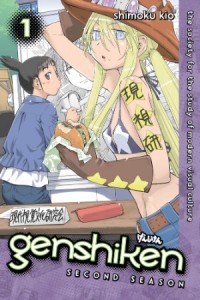
Genshiken: Second Season, Vol. 1

By Shimoku Kio. Released in Japan by Kodansha, serialization ongoing in the magazine Afternoon. Released in North America by Kodansha Comics.

This review is based on an advance uncorrected proof provided by the publisher, and does not reflect a review of a finished product.

It’s not all that much of a surprise that the Genshiken series has returned for more adventures of everyone’s favorite otaku club. The original series also slowly evolved over its nine volumes, seeing the club shed members and switch club presidents, even though the basic cast stayed the same. But now almost all that cast has graduated, so this sequel also has the challenge of introducing a whole bunch of new people and hoping that the reader will appreciate them in the same way they did when Ogiue joined.

Speaking of Ogiue, as the series starts she’s the new club president, not that there’s much of a club. It only has three people, partly as it seemingly duplicates other club’s interests, but mostly as it still has Kukichi. I have to say that while I appreciate his value as a comic foil, Kukichi’s utter creeptasticness still rubs me the wrong way, even in this new series. Luckily, as in the original series, he is used sparingly. This is partly because Kio-san also has another comic relief character to balance things out, Suzanna. Who is also creeptastic, particularly in her inability to speak in anything but old anime phrases, but at least doesn’t make me want to wash afterwards.

As for the new folks, there are two characters who get the bulk of the screen time, and I suspect they will start to force out Ogiue and Ohno just as those two slowly took over from Sasahara and company. Yajima is a poor artist but wants to be better at it, and seems to be filling the ‘we need at least one normal person in the club’ function that used to be Kasukabe’s, though Yajima at least is also an otaku. More interesting is Kenjiro Hata (I thought this might be a Hayate the Combat Butler joke, but it seems to be a coincidence), a character who I can’t really discuss without spoiling the first volume. It’s Hata I expect most Japanese fans will be glomming onto, though I’m not sure about Western fans.

For those wondering if this will resolve anything from the prior series, such as Madarame’s unrequited love… well, Madarame does show up throughout, despite having graduated, and he still seems to be hung up on Kasukabe. Whether that goes anywhere I suspect depends on how fast the new group of characters catches on. I am reminded of the K-On! series, which tried to have its came and eat it too by introducing some new girls for Asuka’s high school band while also following the four others to college. In the end, neither one caught on with readers. Genshiken has been doing this from the start, but we now have a bit more of a tonal shift. As the cast has gotten more and more female, the otaku obsessions have grown more and more BL. The series still runs in Afternoon, a magazine for young men, but I do suspect that the sequel over here may find a larger crossover BL-audience than the original did. (Though the original also had its female fans, of course.)

In the end, I enjoyed getting back to this series. It’s like visiting an old hangout and seeing what’s changed. Thankfully, there’s little melancholic ‘good old days’ here: things are the same as ever, just with a new cast. I look forward to seeing their awkward fits and starts of growing up. Which is, of course, the real plot of Genshiken: Awkwardness Is Magic.