Category Archives: reviews

Puella Magi Madoka Magica, Vol. 1

By Magica Quartet and Hanokage. Released in Japan by Houbunsha, serialized in the magazine Manga Time Kirara Forward. Released in North America by Yen Press.

This is another in a series of media tie-in manga where I have not actually seen the original medium. With Haruhi Suzumiya’s manga I can at least tell you how the manga falls down when compared to the anime and light novels. And Higurashi is the interesting case where most fans agree the manga *is* better than the anime. Madoka Magica, though, is a big phenomenon, one I know through cultural osmosis more than anything else. And while this manga adaptation was perfectly pleasant and didn’t have anything hideously wrong with it (except maybe the usual art style problems), I came away from it with the desire to see the anime and see how it improved on the story. Which, admittedly, may be the reason for many media tie-in adaptations – to get you to seek out the anime/game/novel/toy.
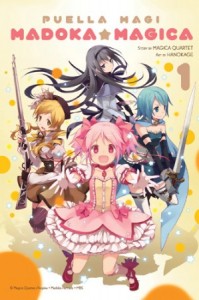
The manga adaptation of this series ran in a seinen magazine for young men, Manga Time Kirara Forward (one of Houbunsha’s many ‘Manga Time’ variations, though unlike most other series that run there Madoka Magica is not a 4-koma). And indeed, despite the cute magical girl plot, young men seems to very much be its target audience. Not that there’s a huge amount of fanservice or adult situations – there isn’t, really. But a lot of this reads like how a male anime fan would want magical girl shows to work. Darker, more weaponized, with a lot less shining optimism. As for me, a person who loves his shining optimism, I’m not sure how I feel about it. Forming a contract to become a magical girl is presented as something you can’t turn back from, and the cliffhanger for this volume fills you with dread rather than inspiring you.

And then there’s Kyubey. As I said, cultural osmosis has led me to know several things about this work without actually seeing it, and Number One With A Bullet was that everyone hates Kyubey. Kyubey looks cute and adorable, like many mascots in similar shows, but his lack of real expression and determination to make magical girls give the whole thing an ominous undertone. Even if I didn’t know about him, I suspect I’d find him creepy.

Our heroine is a bright and shiny optimist in the Usagi mode, and she’s contrasted here with Homura, who is cynical, grumpy, and clearly has a horrific past we don’t know about yet. There’s a yuri fandom associated with this series, and it’s no surprise that these two are a big part of it. Homura is a girl with a mission, and that mission seems to be to stop Madoka becoming a magical girl. Well, so far so good… but with her best friend giving in, I’m not sure how long that’s going to hold up. As for Mami, well, she fills her function. And she does have one of the better lines in the book when she notes that “magical girls don’t always have to be allies”. That line more than anything else shows this is not a shoujo magical girl manga.

As I said at the start, this is pretty solid for the most part. The art is a bit generic (I really couldn’t tell they were designed by Ume Aoki of Sunshine Sketch fame, which I could when I saw the odd anime screencap), but the beats all seem to be there. If you are like me, and can deal with emotional wreckage better on the printed page than on the screen, then this may be the Madoka Magica for you. Anime fans, though, I suspect won’t find much here that’s new.

Alice in the Country of Clover: Bloody Twins

By Quin Rose and Mamenosuke Fujimaru, based on the game by Quin Rose. Released in Japan as “Clover no Kuni no Alice – Bloody Twins” by Ichijinsha, serialized in the magazine Comic Zero-Sum. Released in North America by Seven Seas.

I never did finish Alice in the Country of Hearts, for obvious reasons. Hopefully that will be remedied later this month by Yen Press. That said, it sold pretty well, so I was not surprised that various spinoffs were licensed. There’s certainly twenty million or so of them coming out in Japan right now. This first volume is complete in one, and focuses on the two cute twins, Tweedledee and Tweedledum. The manga (based on the game once more) posits that Alice did not choose a boyfriend in the “Hearts” game, so instead of a love via “passion” it goes for a love via “friendship.”

Unfortunately, there are a few problems with this approach. First of all, the Dee & Dum story takes up barely half the book, so it’s padded out with a few other short stories based on ‘what if Alice chose xxxxx?’ plotlines. Some of these could be interesting (the Vivaldi plotline in particular), but they’re too short to go anywhere. And since most Western readers will have only read the manga rather than played the game, some seem completely out of left field. Gowland? Really? He was barely in the original manga! The purpose of this is straight up ‘give a nice bone to fans of the game who won’t get to see their path animated’.

As for the main plotline, I was never really a big fan of the twins to begin with, but the main reason to read Alice and enjoy it, at least for me, was that this was a twisted, disturbing variation on an otome game. The reason Alice hadn’t chosen a boyfriend is that they all seemed to be psychotic. You can tell that they’re attempting the same thing here (the twins certainly butcher a lot of people), but whether it’s the different artist or something else the fact is it all comes off as too cute and light-hearted. And Alice falters as well, as requiring her to be in love reduces her to the usual shoujo cliches “he cannot love me the way I love him”, “how can I possibly choose between them”, etc. You know it’s bad when the ancillary character bio describes Ace as ‘more unstable’ in Clover World, but he actually seems genteel by comparison.

This ran in a magazine with a slightly older demographic than the original Hearts manga, and the situations are slightly more adult in nature, though mostly in the way of implication. Throughout the Dee & Dum story, everyone is joking about Alice loving both twins being “tough on a girl’s body”, and the Blood Dupre story has similar implications. It’s not actually too bad, but worth noting given that I think the original manga when released by Tokyopop may have had a younger audience.

There are a large number of sequels/side-stories still to go, but this wasn’t exactly a great place to start. At least it’s only one volume. Hopefully better things will come with Cheshire Cat Waltz, a 3-volume sequel featuring Boris.

Ouran High School Host Club, Vol. 18

By Bisco Hatori. Released in Japan as “Ouran Koukou Host Club” by Hakusensha, serialized in the magazine LaLa. Released in North America by Viz.

At long last, one of Viz’s most beloved shoujo series is coming to an end. We’ve had all the drama, we’ve had the love confession, so all that’s left is wrapping things up. Luckily, for the most part that means a return to the comedy that was one of the main reasons that fans loved this series. From Tamaki’s over-the-top reactions, to Haruhi’s deadpan remarks, to Kyoya’s smiling nastiness, there’s something for everyone here. And it’s all topped with a layer of sweetness that will give you cavities – but in a good way.

I should probably mention right now, though, that some BL fans of the series may end up being annoyed. Ouran has a huge BL fandom, as many reverse harem series tend to, and the artist enjoyed playing up to it – though always in a silly way. However, now that it’s the end of the series, she does little panels devoted to what happens to the cast when they grow up. A note to authors of books or manga with romantic entanglements – fans HATE this. Telling folks who love to write fanfiction that all of their romantic avenues are blocked by canon just grates. So when Ouran fans started off Vol. 18 by having Hunny married off to Reiko, I suspect the reaction was less “awww, so cute!” and more “Noooooo, he’s Mori’s!”. Be prepared for this throughout the book.

As for the book itself, I had wondered what Tamaki’s reaction to Haruhi’s confession would be like. It’s pretty much exactly as I predicted – which is what makes it fun, of course. Tamaki’s tendency to overdo everything, his naivete at basic day-to-day living and yet his mastery of reading other people are all on display here, and I think after 18 volumes we no longer worry about how he’ll function as an actual responsible adult. The same goes for Haruhi – the change in her over the course of the series has been astounding, and here we see her actually being openly affectionate with Tamaki.

The series proper ends about 2/3 through the volume, so we get two ‘side stories’ taking place after the series. The second is just 6 pages of our main couple being adorable, but the first is full-length, and focuses on Kyoya and his family issues. The author notes in comments that she wanted to leave Kyoya’s story open-ended as it would be very difficult to realistically wrap it up that fast – it will take years. So instead we have Kyoya being clever, but still not quite clever enough to think ahead of his father, which is his main goal. He also clashes with a woman from another family who’s being engaged to one of his brothers. Seeing their sharp, nasty barbs towards each other – all delivered, of course, with bright and happy smiles – made me happy. And of course the rest of the Host Club is there as well, making this probably the funniest chapter of the volume.

As with all harem series that deliver an actual ending, this is going to upset a few people. But I suspect the majority will be delighted. Ouran has been an over-the-top romantic comedy which, even if it got a bit melodramatic towards the end, never stopped delivering entertainment. It’s been worth the wait to have it fully come out here. v(I do wonder if Viz will license Hatori’s new work, The Bullshit Delusional Opera, when it comes out in Japan. It may need a title change.) Congratulations to Haruhi, Tamaki and the cast!