Category Archives: reviews

Until Death Do Us Part, Vol. 1

By Hiroshi Takashige and DOUBLE-S. Released in Japan as “Shi ga Futari wo Wakatsu made” in 2 separate volumes by Square Enix, serialization ongoing in the magazine Young Gangan. Released in North America by Yen Press.

It feels rather refreshing, after reading this first omnibus, to know that I will not have to be thinking of ways to praise the author’s fresh, original ideas. There’s nothing like that here. Not that this is a bad manga – it’s quite good – but it is an action-packed thriller with spectacle and excitement, not a densely plotted opaque mystery. Well, unless it surprises me later. That said, as I indicated, it’s startling how well this works anyway. This manga is a compulsive page-turner, with likeable, cool characters and lots of good action scenes that are (for once) relatively easy to follow.

The premise reads like the author stared surfing TV Tropes and writing stuff down. Our hero, Mamoru, a blind swordsman who is testing new technology that lets him a) see folks as wire frame-type contours, and b) cut them with a monofilament sword, is interrupted one day by a girl, Haruka, who can predict the future under the right conditions and has a lot of bad guys hoping to catch and dissect her to figure out why. He reluctantly helps her, and along the way they meet the organization he belongs to, a special task force composed of victims of terrorism who are not getting revenge. Together they will bring down an insane global conspiracy!

Again, if I read that synopsis of fanfiction.net, I’d be moving on without a second thought. But the creators make it work, mostly by not really giving anyone time to think about anything. This is an action manga, and things rarely stop for more than 5-10 pages without another firefight or sword battle breaking out. The lead is cool, handsome, morally ambiguous, and has a tortured past – winning qualities, every one. (I am unsurprised that this manga has a large female following.) His colleague Ryotaro is refreshingly normal, aside from his amazing tech savvy, and seems to handle the dual role of Mr. Exposition and Straight Man fairly well.

As for Haruka, well, so far she is the typical waif. I have the most misgivings about her, mostly due to the way this role has been handled in the past. I hope that she gets stronger and starts taking her own initiative (although props to her for escaping and seeking out Mamoru at the start). There’s also the whole “one day I’ll marry him” thing, which gets wrapped up in the actual title of the manga. Given she seems to be about 12, let’s hope that it continues to stay hypothetical. The artist doesn’t seem to draw in a very ‘moe’ style, which is a plus. On the other hand, he avoids panty shots and then points out in the afterword how he avoided panty shots, which is a minus. Sort of a ‘Don’t show, don’t tell’.

So despite being a collection of action cliches, this is a lot of fun. There’s a fair amount of violence, as you’d expect from a manga about terrorists who fight other terrorists, but it’s not overwhelming. It also has a good head on its shoulders, and even an occasional sense of humor. I think the word I’m looking for is solid. Yen has found good, solid entertainment here. Check it out.

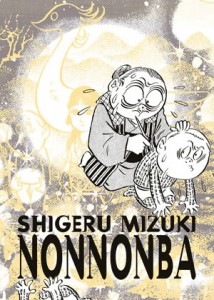
Nonnonba

By Shigeru Mizuki. Released in Japan as “Nonnonba to Ore” by Chikuma Shobo. Released in North America by Drawn & Quarterly.

It feels somewhat odd that after reading Nonnonba, a semi-autobiographic epic by the creator of Gegege no Kitaro, the man who is known worldwide for his amazing yokai tales and characterizations, that I found the yokai in it the least engaging part. Oh, don’t get me wrong, there are some spectacular spooks here. My favorite was probably Azuki-Haraki, who looks as if he had been drawn by guest artist Robert Crumb. But though there are yokai and supernatural elements throughout, the reason this is such a famous title – it’s gotten many accolades ever since its first publication in 1977 – has been its human characters, in particular Shigeru himself.

There are several main plotlines that flit through Shigeru’s life as he grows older in this volume. His flighty father’s continued schemes to chase his dream – and unemployment that inevitably follows. The young child gangs that roam the streets, which seem to be undecided as to how serious they are – especially after their new leader has Shigeru ostracized. His grandmother – the titular Nonnonba – moves back in with them after the death of her husband and is very much what you’d expect, dispensing good advice, acting as a nanny/doctor, and occasionally dealing out exposition on yokai.

One of the main things I noticed, though, was the series of girls approximately Shigeru’s age who arrive, seeming to be potential love interests, and then move on. At first this is sudden – “Oh, she died of the measles a week ago”, and you accept it as part of what being a child in 1930s Japan was like. Then we meet a sickly girl who enjoys Shigeru’s drawings, and given she has ‘doomed’ written all over her (if this were a Western comic she’d be dying of consumption), one can briefly raise an eyebrow. Then, in the last third of the book, we meet Miu, a young girl who is part of a ‘family’ moving into a haunted house – and can also sense nature and the supernatural in an almost psychic way. I was fairly sure she would die as well – the color pages at the start made me think they were all going to the land of the dead – but her fate is far more realistic, fitting in with the darker tone of the 2nd half of the book.

Still, the book itself is not depressing. Life is something that has to be accepted, in all its facets. Mizuki is an expert at capturing his childhood in a way unfettered by preciousness or overanalysis. There’s also a bit of eerie prescience here – Shigeru reforming the teen gangs to ‘pacifism’ is all very well and good, but I kept being reminded that this group of kids would be going off to war in a scant few years. This is probably why Shigeru the child has an emphasis on pacifism – and why the ostracized gang eventually joins him over the dictatorial leadership of the stronger Kappa (Kappa being a nickname, he’s not a yokai).

I wasn’t as blown away by this as I thought I would be – Gegege no Kitaro remains the title I want to see here the most – but it was a nice, solid autobiography, mixing reality and fantasy in such a way that each complements the other. There’s a lot of extremely flawed human beings here, including Shigeru, but the overall mood is one of nostalgia and remembrance.

GTO: 14 Days in Shonan, Vol. 3

By Toru Fujisawa. Released in Japan by Kodansha, serialized in the magazine Weekly Shonen Magazine. Released in North America by Vertical.

After an action-packed 2nd volume of GTO, it’s time to take a breather and get back to some lighter stuff before we gear up for the next broken teen who Onizuka has to save. And hey, didn’t Shiratori-san say that there was someone else who worked at the White Swan? Who was even prettier than her? Could this possibly be the overture to… some romance?

Well, no. This is Eikichi Onizuka, so whenever romance rears its ugly head, he turns into the immature idiot that he is. (Yes, he’s also a heartwarming badass, but hey, facets.) First he tries his hand at seducing Shiratori-san via some red wine, which is a little creepy but it becomes clear that he’s not really going to follow through on it unless she’s awake and willing… okay, no, it’s creepy no matter what. Then when she falls asleep, he falls back on peeping on the other caretaker in the house, who we haven’t met before… or so we think. Much to his surprise and ours, the other caretaker turns out to be his old not-girlfriend Shinomi Fujisaki, who is, as you might imagine, displeased at Onizuka ogling her nude.

It’s great seeing Shinomi back in the storyline, as she makes a good love-interest contrast to Azusa Fuyutsuki from the GTO series proper. Whereas Azusa tends to be ‘he’s sort of a weirdo, but I can see the good heart inside of him’, Shinomi is very much in the ‘I’ve always seen the good heart, but WHY IS HE SUCH A FREAK’ school of lovers. As you might expect, Onizuka walking back into her life after disappearing years ago confuses the hell out of her, and she responds via violence in the best tsundere way. (Onizuka, who is very similar to her, responds by changing the subject and being over the top goofy, which we’ve already seen tends to be his way of avoiding serious issues.) I don’t expect much to be resolved here – this takes place during GTO proper, which didn’t resolve any romances – but it’s sweet to see them reunite.

As for the rest of the manga, we’ve resolved the parental problems that Miki had, and now that we know that she was merely the easiest ‘villain’ to take down, we know it’s only going to get worse. So we get a flashback to another resident of the White Swan, Ikuko, and her abusive mother, who was so bad social services had to step in. This is probably one of the best written parts of the entire volume, as it really gets into the ambiguous feelings kids have when their loved ones abuse them – and the stoic acceptance that it’s their fault for not being “good enough”. I’m not sure we’ll see more of Ikuko’s life later on, but I do hope that she manages to come to terms with her upbringing.

Then there’s Seiya, who would appear to be the next ‘project’ for Onizuka to fix. And once again, we see how Onizuka works – forcing the kids to ‘go too far’ in order to show them that deep down they really don’t want to take the final steps towards darkness. All of these manga – GTO, Shonan Jun’ai Gumi, and this spinoff – stem from the same genre of Japanese manga, which are about teenagers and family, and how much they feel abandoned and helpless. If Onizuka can help these kids reconnect emotionally, on any level, he’s going to do it. And it would appear that the fourth volume will be another action-filled one.