Category Archives: reviews

Oresama Teacher, Vol. 4

By Izumi Tsubaki. Released in Japan by Hakusensha, serialization ongoing in the magazine Hana to Yume. Released in North America by Viz.

We are perhaps in a golden age of strong, spunky shoujo heroines. Minako from Sailor Moon is back in the spotlight. Iku from Library Wars is beating up those who would dare censor books. And now we have Mafuyu from Oresama teacher, who may have to dress up like a guy due to circumstance, but has shown that she is the one to bet on in a fight over anyone. Heck, I think she could take out Ichigo from Bleach if she tried.

It is entirely possible that this is not someone’s brand of humor, but it just happens to be mine. Mafuyu is wonderful. The way that she finds herself thinking like a thug in order to solve problems. And even better, the fact that she’s still learning as she goes, where she finds for the first time what it means to have someone you like injured because of you. And then, of course, there’s pretending to be a gay boy rather than a girl in order to fool the easily fooled Hayasaka. And any interactions she has with Takaomi are fantastic, if only as he can still wrap her around his finger without even trying.

There’s an awful lot of fighting in this manga, so much so that I wonder if it might be better marketed to Jump fans. Even better, as with last volume we see that Tsubaki is actually training her readers on the mechanics of being in a fight. Last time it was escaping from being tied up, here it’s how to dodge and parry, something that poor Hayasaka and his straight-ahead mind have simply never learned to do. Mafuyu’s actually quite a good teacher, but she’s up against a formidable opponent here, and I hope Hayasaka starts taking her lessons to heart before he dies.

I particularly enjoy seeing all the characters that you think are there to be goofball and comic show their inner badass. Maizono, Mafuyu’s masochistic third in command from her old gang, shows up to bring her a present. He never finds her (a given, since he asks the two guys who don’t know she’s a fighter), but we get a good chance to see that while he’s a goofball in front of her, he can fight like a demon when pressed. In fact, it’s notable how Mafuyu’s big problem in her new school is that she DOESN’T have a gang yet. Her old friends were trained fighters who all knew each other’s best strengths and weaknesses. Here she only has Hayasaka, who refuses to duck.

And lest we think that Mafuyu has it all together and isn’t an idiot as well, there’s that final chapter, where she completely forgets that she can’t swim. There’s a bit of romantic tease in it (really the only tease in the whole volume), but it’s second to simply laughing at everyone. There are no subtle characters here. Oresama Teacher is in-your-face gags about a girl who simply cannot stop being a delinquent fighter. And that’s why we love it.
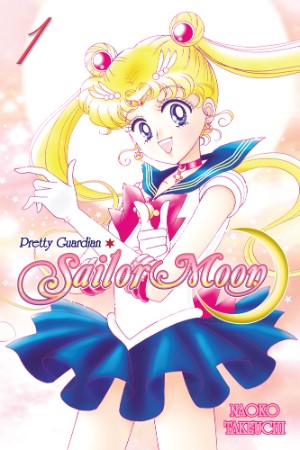
Pretty Guardian Sailor Moon, Vol. 1

By Naoko Takeuchi. Released in Japan by Kodansha, serialized in the magazine Nakayoshi. Released in North America by Kodansha Comics.

I will try my best, but don’t expect me to be unbiased here. This is one of the most anticipated re-releases in the last 10 years, and I have been waiting for what seems like FOREVER. And now, it seems, it’s finally here. Sailor Moon is back, and she is Usagi Tsukino again, and the series, as reprinted in Japan with updated art (and a few rewrites of dialogue) from Takeuchi herself, is ours once again.

I can’t really summarize, so I’ll just try to give my thoughts. I really liked this volume. Takeuchi is clearly taking the time to develop a very different heroine from Minako’s Sailor Venus, one better suited for the long haul of character development, like the best shoujo heroines. As a result, Usagi may grate on some in this volume, especially if they’re reading it in conjunction with Code Name Sailor V. She doesn’t want to be a hero. She finds lethal danger terrifying, strangely enough. Luckily, she has various weapons and allies at her disposal, and (leaving aside the poses for the reader) does a good job despite her faults. What we really notice her is her ability to make friends, and get even the hardest of hearts to open up to her. Even Rei, who’s the coolest (and grumpiest) of the cast, is worried about her instantly.

Speaking of the other senshi, I like how they’re all different yet share a similar background of feeling as though they don’t belong. Ami is looked on as a prodigy, with all the good and bad that this implies, and seems to have taken it a bit too much to heart. “All that I’m good for is studying”, she says at one point, making one wonder if she has the typical “education mama” behind her. Rei, in contrast to her anime counterpart, gives off a cool and frosty aura, and has those who visit the shrine wonder if she uses supernatural miko powers for evil purposes. As for Makoto, well, she’s dressed like your standard 80s shoujo manga girl gang member. She’s huge, left her school for ‘unknown’ reasons, and no doubt has knives under that skirt. Scary girls, all of them.

Except, of course, they’re all nice as pie. (Well, OK, Rei is nice as sour cherry pie. But give her time.) What’s more, being a senshi gives them all a new purpose, and all three seem to feel as if this is the destiny they’ve been waiting for. It’s actually spelled out by Makoto, in her speech towards the end of her chapter. Fate brought them together. Now, Usagi’s backstory doesn’t match theirs – she’s well-liked and has no issues with lacking a purpose. So Sailor Moon isn’t quite as defining for her. It’s almost as if she has yet to discover her true role…

I had forgotten how fast things move in the manga. Most of Western fandom is more familiar with the anime plotlines and pacing, where it’s a good 8 episodes before we even meet Ami. Here we’ve already got 4 of the 5 main senshi before the book is out, and the entirety of the first ‘arc’ will be finished by Volume 3. This is a pacey series, which does not have patience for long protracted battles the way shonen manga does. Sailor Moon’s battles are fairly perfunctory and noticeably lacking in awesome moves. How the villains die is not quite the issue here. However, this does allow the main plotline to become relevant, and there are no monsters of the week. The search for the Silver Crystal (and the Princess) are what everyone is concentrating on, and Jadeite and Nephrite don’t get many second chances before they are dispatched. (By the way, the senshi kill off the bad guys here. Get used to that, much more than the anime.)

There’s some great humor here, but unlike the action comedy that is Sailor V, this is pegging itself as an epic romance. That Mamoru is Tuxedo Mask surprises no one, as clearly he and Usagi have that ‘destined’ look when they first meet in Chapter 1. After all, they bicker with each other. (By the way, the whole ‘secret identity’ thing gets kind of tossed aside right away here. Sailor Moon calls out the real names of her fellow senshi right off the bat, and there seems to be no issue of ‘why don’t they get that it’s the girls they know?’ here, as no one really sees them closely unless they’re unconscious or a villain.) The climax to this volume is actually more effective than the original Volume 1, which ended one chapter earlier. It makes you want to get more right away.

The presentation here is fine. I’m sure there are some translation issues, but I didn’t bother to get out my old Tokyopop editions and do a line-by-line compare. Nothing jarred enough that it made me want to verify anything, which is just fine. I particularly enjoyed Sailor Moon comparing Tuxedo Mask to Lupin III. (Usagi, you’re no Fujiko-chan.) This is the reprint edition from Japan, meaning we get nice new pretty covers (no stickers, though), and Kodansha’s usual liner notes. I do miss Takeuchi’s author’s notes in the originals, but she removed them from the reprint, so what are you going to do? They are basically more variations on ‘I am a busy and fluffy shoujo writer!’ in any case.

If you’re a big Sailor Moon fan, you’re going to be buying this anyway. If you’re not, well, Usagi may grate on you a bit at first, but give her time. The series is worth it. And the women in it kick eight kinds of ass. (Usagi, OK, does not kick as much ass. At least physically. But she gets to be the emotional core.) As we get further into the series, everyone will get even better. Highly recommended.

Ekiben Hitoritabi, Vol. 1

By Kan Sakurai and Jun Hayase. Released in Japan by Futabasha, serialization ongoing in the magazine Manga Action. Released in the United States by Futabasha on the JManga website.

Given that JManga is trying to release various types of manga that would not normally be licensed in North America, it was inevitable that we would get a manga devoted to food. Yes, we’ve seen over the top titles such as Yakitate!! Japan and Iron Wok Jan, and Viz even managed to punch out a few volumes of Oishinbo, but that’s just the tip of the iceberg. Japan loves its food, and loves to read manga about people talking about it. And with Ekiben Hitoritabi, we get cross-pollination with another Japanese obsession… trains.

Our hero, Daisuke, has just celebrated his 10th anniversary, and is quite happy running a bento shop with his wife Yuko. She has noticed, however, that he gets a wanderlust in his eyes when he reads train magazines. And so for an anniversary present, she buys him a railway journey – a trip around Japan, on various slow trains (many of which don’t exist anymore, which shows how fast Japan is modernizing, as this manga began in 2006) which will allow him to see the countryside, obsess about trains, and eat various specialty bentos made by the locals.

Train bentos are genuinely famous in Japan, and each station stop tries to make theirs unique and appealing for the weary traveler. Of course, Yuko is not going with him on this trip – someone has to stay behind and run the business. So we see Daisuke set off alone to marvel at scenery, engines and food. About three chapters in, the author recalls what magazine this runs in, and adds a cute girl reporter, Nana, who is tracking down a story and runs into Daisuke on the train. Coincidentally, she also runs into him later in the volume, and serves the purpose of being the designated female in this manga – as well as being equally obsessed with food. She’s not as obsessed with trains, which allows Daisuke to spout the odd bit of history throughout.

Most manga like this run the risk of being dry, and indeed there were several times in this volume that I wanted something to happen other than talking about trains and food. There’s not really a plot here beyond seeing Daisuke going from station to station. And though he occasionally eyes Nana while sweating slightly, or begs forgiveness of his wife in his head for doing so, there’s honestly no indication that he and Nana are destined to have an affair – a good thing given he’s on an anniversary trip given to him by his wife! No, we aren’t heading forward, we’re meandering.

On the other hand, if you are interested in trains or Japanese train bentos, this is a treasure trove. The food is lovingly depicted and described, and you can tell that the authors had a ball researching this. Enthusiasm for the food is tempered by a melancholy nostalgia when discussing the trains, as invariably they start talking about various trains and lines which are defunct, or have been replaced solely by high speed rail. When we do see a unique train car, it’s drawn with the same attention to detail as the food – there’s honestly quite a good balance between the two obsessions here.

Artwise, aside from the food and the trains, things are fairly stiff. The faces aren’t quite as hard to get used to as Oishinbo, to be fair. Daisuke is a stocky, bearded guy, very appropriate for his profession and love of food. (Another manga by the author in the 1990s, about fishing, also featured a stocky bearded guy with a hot wife – methinks I can guess what the author looks like.) Nana is cute rather than sultry, and I’m hoping in future volumes the two develop a brother-sister type bond – though this does run in Manga Action, which features at least three series I know of with lovingly depicted adultery in them, so who knows?

I enjoyed this manga, but let’s be honest – unless you’re really interested in bentos or trains, you won’t find much here. It’s a narrow market, but plays to that market with all the strength it’s got. And yes, after reading it, you WILL be hungry.