Category Archives: reviews

My Stepmom’s Daughter Is My Ex: “Time to Get Serious”

By Kyosuke Kamishiro and TakayaKi. Released in Japan as “Mamahaha no Tsurego ga Motokano datta” by Kadokawa Sneaker Bunko. Released in North America by J-Novel Club. Translated by Gierrlon Dunn.

The subtitle of this volume serves as an accurate description of what’s inside. Of course, that’s not to say there still isn’t a great deal of broad humor in the book. I mean, Isana exists, for one. There’s also Yume deciding that the best way to seduce Mizuto is by wearing a miniskirt and cat ears, and (ça va sans dire) endless discussions of breasts, with much groping of the larger girls happening from the other girls. (Isana even notes this is the sort of thing she though only happened in light novels, implying that she’s read her own series.) That said, this is about a trip that all the main and supporting cast take, and the girls decide to use it to confess, seduce, or otherwise make things clearer to the object of their affection. Does it work out? Well, sort of. Some of the pairings are actually becoming pairings. It won’t surprise you,l though, that the main pairing remains up in the air.
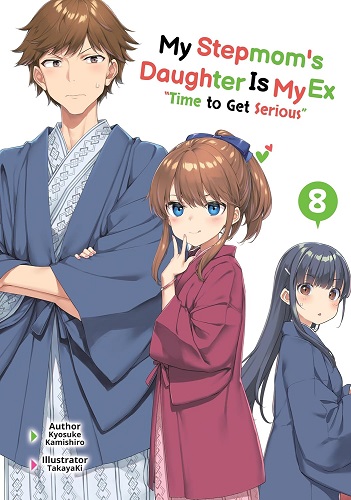
The student council are planning a getaway trip to a hot springs town (given that their president’s family is loaded, this isn’t as hard as it sounds), and Yume is asked to fill out the numbers a bit, so Mizuto, Isana, Minami and Kawanami end up coming along as well. Aiba has decided that this is the trip where she stops being the teasing flirt and seriously confesses to her senpai, and so the other girls also decide to make an effort. Well, apart from Isana, who is supposedly here for art study. Kurenai ramps up her attempted seductions of Joji, wanting to lose her virginity without really thinking trough what that actually means. Minami has finally accepted the fact that she’s still in love with Kawanami, and her own attempt to be serious baffles and annoys him. As for Mizuto and Yume… LEWD HAND HOLDING.

The main couple are still hamstrung by Mizuto’s own reluctance and Isana’s presence in their life (going poly would solve most of these problems, but I can’t see the author or publisher OKing that), so it’s the other couples that carry the book. This is easily the best volume for Minami, who, once she decides to stop being an annoying bitch around her ex all the time and genuinely try to help him, turns out to be pretty awesome. Both Kawanami and Hoshibe (the senpai) are dealing with past traumas that have left them either unable to move forward or literally ill, and this book is about getting past that with the help of others. It’s also about being yourself, to a degree – Kurenai fails here because she was just trying far too hard. She’d be much better off trying to raise Joji’s bottomless well of self-hatred first. Basically, at the end of this book we have one definite couple, two “give it a book or two” couples, and Mizuto, Yume and Isana. Who remain in stasis.

The 9th book may change that, as we are reminded that where there are stepparents there are also parents, and one of them is still alive. Till then, this is a good volume in a romcom that’s enjoyable provided you can wade past the wall of breast jokes.

If the Villainess and Villain Met and Fell in Love ~ She Was All But Disowned for Her Spirit Contract, But She’s Still Competing with Her Rival ~, Vol. 1

By Harunadon and Yomi Sarachi. Released in Japan as “Akuyaku Reijō to Akuyaku Reisoku ga, Deatte Koi ni Ochitanara: Nanashi no Seirei to Keiyaku Shite Oidasareta Reijō wa, Kyō mo Reisoku to Kisoiatte Iru Yō Desu” by GA Novels. Released in North America by Yen On. Translated by Judy Jordan.

I didn’t really have too many hopes for this one. The villainess market is, frankly, glutted, and the description of this series combined the villainess tropes with a magical academy *and* “I have this weak power that everyone hates me for, but it’s really the strongest”, as seen in endless isekais. On the bright side, this is NOT an isekai – our villainess is home grown. So yeah, book full of cliches. And I can’t deny that they’re there. But this is also a book that took me by surprise a number of times, and it did that by taking a big swing towards being dark. Brigitte’s life until the start of the book has been a tale of hideous abuse, the “heroine” in this story is not only arrogant but also sociopathic, and we may have a winner for the worst fiance in a villainess book – despite the fact that he barely appears.

We begin as so many of these books tend to begin: with Brigitte, the “villainess”, having her engagement broken and getting publicly humiliated by her fiance, who claims she was bullying the girl he is with now, Lisa. Brigitte’s world collapses around her, frankly. We learn that she was judged to have very little spirit power as a child, despite coming from a famous family of fire spirit users. Her father reacted to this news in a sensible, staid manner: he took his 5-year-old child’s hand and stuck it in the fire till it burned horribly. Needing to wear gloves all the time, she’s a shy, reserved child… till she meets the third prince, Joseph. Joseph tells her to her face that he likes stupid girls, and that she should dress in pink, gaudy clothes, wear thick makeup, and act arrogant. So, desperate for anyone to like her, she does. And then we get to page 1.

I apologize for summarizing the book using only the first 10 pages or so, but the first 10 pages are dynamite. My jaw dropped. After that, things turn a bit more typical, as she meets Yuri, a cool young man who has contracts with two major spirits, but gives everyone the cold shoulder. But honestly, the main reason to read this is the aura of toxic misogyny that permeates it. Not from the author, I hasten to add – this was deliberately baked into the world itself. More to the point, it’s coming from Joseph. He’s very unusual for a “fiance who breaks things off” character, remaining cool and collected even when attempting to do to Yuri what he did to Brigitte. But there’s an air of petty sadism around everything he does – he’s done it with Brigitte her whole life, and now that she’s gone he starts to do it to Lisa, who responds by… well, the other time in the book where I screamed “Holy shit!” was her response.

Given the cliffhanger to the book shows Joseph asking Brigitte to get engaged to him again, I think we’ll see more development of this in the second book. Till then, apologies to Yuri, and maybe next time I can get into the adorable romance that he and Brigitte develop.

Adachi and Shimamura, Vol. 11

By Hitoma Iruma and raemz. Released in Japan by Dengeki Bunko. Released in North America by Seven Seas. Translated by Molly Lee.

It may not feel like one, but the Adachi and Shimamura series comes out as a Dengeki Bunko title. One of the heavy hitters of the light novel world, skilled at many things, including, of course, cross-promotion with other series. And if you add to that Hitoma Iruma, who loves throwing in “if you get this, great, if you don’t, it doesn’t matter” references to their other series, you can sometimes get a crossover cameo pileup. And since we’re also dealing with a series that has not been (and probably is unlikely to be) licensed over here, I will let you know (and thanks to translator Molly Lee for confirming) that the kimono girl and the senpai who take up about half the narrative in this book are from the 3-volume light novel series “Watashi no Hatsukoi Aite ga Kiss Shiteta”, also a Dengeki Bunko title. Oh, and another Yashiro shows up. Not our Yashiro, and not the Ground Control to Psychoelectric Girl Yashiro, but the third one that we met earlier in this series. I need diagrams.

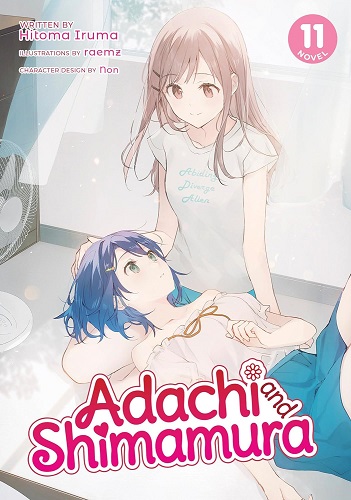
This is one of those volumes that really should be called Shimamura and Adachi – all the POV for the “main story” is hers this time around. It’s more a series of short stories than a novel (not the first time we’ve seen this), as we get to see Shimamura at 8 years old (hyperactive, full of life, hanging at the pool with her bestie Taru-chan), Shimamura at 15 years old (sullen, teenage drama, getting close to the Shimamura we meet at the start of the series), Shimamura at 18 years old (the present-day Shimamura, having a study date with Adachi that turns into a discussion about whether the attraction between the two of them is sexual or just romantic), and Shimamura at 22 years old (going on a vacation with Adachi, full of life and love, comfortable with herself and her girlfriend). There’s also brief chapters with Yashiro and Shimamura’s mother, Hino and Nagafuji, and Shimamura’s sister meeting another Yashiro.

Given that most of my experience with this series has been dragging Shimamura constantly in these reviews, it’s really amazing to see how far she’s come. The Shimamura at 18 and 22 is a Shimamura who has finally found the thing that she needed to shake her out of her torpor: being in love with Adachi. She’s still trying to figure out what this love is. Her discussion with Adachi about sex is, for this series, very frank (for any other series, not so much), and while it’s funny to see Adachi completely lose it multiple times over the course of a single minute, I also appreciated the conclusion they came to: Adachi wants to do sexual things but refuses to unless Shimamura does as well, and Shimamura has never thought about this at ALL, so is not ready. And that’s fine. Instead, we get the power of Adachi as a transformative force, transforming Shimamura into someone with real human emotions, joy, and energy. Go back to, say, the fifth book and read Shimamura, then re-read this one. Night and day.

12 is still the final volume, but before that Dengeki Bunko is releasing a short story volume (how is that different from most of the last few?), and “Vol. 99.9”, which is a collection of the bonus stories that came with the Blu-Ray release of the anime. That said, both of those will be a few more months till they get here, I imagine. Till then, enjoy Shimamura’s happiness, and Adachi’s Adachiness.