Category Archives: reviews

The 100th Time’s the Charm: She Was Executed 99 Times, So How Did She Unlock “Super Love” Mode?!, Vol. 2

By Yuji Yuji and Nami Hidaka. Released in Japan as “99-kai Danzaisareta Loop Reijō Desu ga Konse wa “Chōzetsu Aisare Mode” Desutte!?: Shinno Chikara ni Mezamete Hajimaru 100-kaime no Jinsei” by DRE Novels. Released in North America by J-Novel Club. Translated by Stephanie Liu.

Despite what a lot of writers will tell you, it’s pretty easy to write some more of what you’ve already written. When you’ve done a volume, introduced the character, the situation, etc. you can think of some ways to extend it out, add another subplot, new villain, etc. This is especially true if your publisher is brand new to the light novel market and does not want to have a bunch of single-volume series lest people think they’re failing. But honestly, sometimes the author has to take a step back, look at what they’ve already wrapped up in a satisfying manner, and say “I could write more. But do I *need* to write more? If I write another volume in the series, will it actively damage everything that I’ve created to date?” Unfortunately, we have a textbook example of that here, in a second volume of a series that really should have been a one-shot.

This is a book of two halves. The first half is fine. Alphina, who has mostly succeeded in running away from her suitors, infiltrates the school her brother Carl is attending to make sure he’s doing all right. She disguises herself as an assistant teacher, and the biggest problem she has is a classmate of Carl’s, Hipper, who seems to hate Carl for reasons that go beyond simple “jealousy” or the like. Alphina ends up uncovering a plot by religious cultists, which she is fortunately able to stop. Unfortunately, in doing so she reveals her identity, and has now been captured by the royal family and will be marrying the prince, someone that absolutely delights everyone except Alphina. This leads to the second half of the book, which is not fine.

I have complaints. The first volume found a good balance between “funny” and “annoying”, this second one tips it too far towards the latter. The comedy is so broad in places as to beggar belief. The use of the time loop, which frankly I thought was a gimmick we were done with after the first 10 pages of the first book, could actually have been clever were it not attached to the aforementioned annoying comedy, so it seems like a wasted opportunity. Most importantly, though, isn’t this supposed to be a romance? It’s a J-Novel Heart title, am I right? Why is it then, after two volumes, that every single love interest remains shallow at best and creepily possessive at worst? The book thankfully ends with a marriage averted for the moment, but the reader can’t help but agree with Alphina – marrying any of these zeebs would be a nightmare. Even the cover art has that “this is the final volume of a romance, let’s end on a wedding shot” art, except Alphina’s sweatdrop shows us she really, really doesn’t want to be here.

All this plus the return of a character I never wanted to see again. There’s room left for a third book in the series, and it wouldn’t surprise me to see one, but man, if you want to give Alphina a happy ending, try making the guys more than cardboard cutouts for the sake of the comedy.
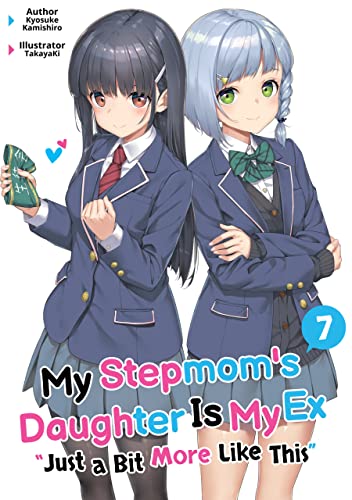
My Stepmom’s Daughter Is My Ex: “Just a Bit More Like This”

By Kyosuke Kamishiro and TakayaKi. Released in Japan as “Mamahaha no Tsurego ga Motokano datta” by Kadokawa Sneaker Bunko. Released in North America by J-Novel Club. Translated by Gierrlon Dunn.

I’ve talked a lot about the fact that this is in many ways a very typical Japanese high school romcom. There’s an obvious winning couple. But there’s also a second, losing love interest who is far more interesting than the main one, mostly because she has no filter whatsoever. Isana would be a nightmare to deal with in real life, as Mizuto and Yume have both observed, but as fiction she’s wonderful. And there’s also the fact that these are all teenagers, about 17 years old, and they are seriously horny. And this series has never been shy about its fanservice, having a very, very high “count the number of times the main characters think about breast size” ratio. This only increases with this book, as we get a new supporting cast when Yume joins the student council. There’s a cute-first year who’s short but stacked. There’s a spunky second-year who’s also… seemingly… top-heavy. Yume’s not small. Isana is very large. You get the ideqa. This book is for guys.

Yume is now on the student council, and is dealing with several things at once. The most normal is that the sports festival is coming up, and the council have to help out there. Also, one of the council members regards Yume taking first place as offensive, and declares herself a rival who will take first place in the next exams… even if that means studying a bit TOO hard. But most importantly, there’s Yume’s desire to try to break down Mizuto’s emotional walls. There’s humorous ways to try (which I’ll discuss below) and heartwarming ways, such as their joint birthday party, where we also learn that their parents actually met much earlier than either of them knew. That said… all of this may be for naught when Isana’s bra breaks during the sports festival and creates misunderstandings galore.

The funniest part of the book, if only as it has the most characters acting completely ludicrously, is where Yume gets advice on seducing Mizuto by taking a bath with him. This idea comes from Akatsuki, who does just this sort of this with Kawanami, but Yume does not really realize that Akatsuki is a TERRIBLE person to get seduction advice from. The scene almost turns heartwarming, but is also seriously funny, especially when Mizuto’s towel drops and… well, Yume’s not disappointed, at least. Other than that, Isana has pretty much resolved herself to being as blatantly forward as possible until Mizuto stops her, and most of the sexual humor in the book is hers. (Most of the painful comedy is hers as well – falling on your breasts while not wearing a bra and getting dragged along HURTS.) As for the main romantic relationship… baby steps. The presents were nice, but Mizuto is still not quite ready yet. This may take till graduation.

So yeah, another decent volume in this series. It won’t light a fire under you, but it’s cute and fun and has likeable leads.

The Do-Over Damsel Conquers the Dragon Emperor, Vol. 2

By Sasara Nagase and Mitsuya Fuji. Released in Japan as “Yarinaoshi Reijō wa Ryūtei Heika o Kōryaku-chū” by Kadokawa Beans Bunko. Released in North America by Cross Infinite World. Translated by piyo.

When I reviewed the first volume I mentioned that Cross Infinite World was putting it out a lot faster than they normally do their series, and the reason for that became apparent shortly after the release of the first volume over here: it’s getting an anime. It’s a good choice: I’m the Villainess, So I’m Taming the Final Boss got a decent if not dazzling anime as well, and the audience for the two series is exactly the same. Not just because of the author, but the same basic themes are here as well. iris may be a Villainess reincarnated into a game, and Jill a young woman who travels back in time to fix her past mistakes, but as protagonists they’re both doing the exact same thing: improvising and being badass as the universe does its best to kill them over and over and over again. And in this second book we get another think it has in common with Final Boss: for every Villainess there’s a Heroine, and heroines in these series tend to be evil.

Hadis and Jill are on their way to the capital to meet the rest of his family. Sadly, on arriving there, he’s attacked, accused of being a fake, and his magic and Jill’s is sealed. Hadis is mostly fine with this, and tries to make the series into a Slow Life book, gardening and cooking delicious meals. Jill is not particularly happy with his, so she and Zeke (half of her bodyguard duo) go into a nearby town so that she can join the Dragon Knights and gain intel. Easier said than done – she’s got the combat skills, even without magic, but the reaction of dragons to her means that she’ relegated to squire duties – which also means getting bullied. We also meet Hadis’ siblings, who turn out to not be as bad as she thought… at first.

Reading this book can be a struggle. Not because it’s bad, I really enjoyed it, but because Jill’s life is such a high wire act that at any moment you expect her to die and for this to become a Re: Zero sort of time loop story. Things are not helped by the introduction of Princess Faris, Gerald’s younger sister. In the first book she had merely been one half of the “ew” part of the story, as we knew Gerald was sleeping with her and that she was frail but not much else. Here we see her younger self, who turns out to be doing much the same thing Jill is – and for many of the same reasons. Alas, this makes them mortal enemies, and the two pretty much hate each other on sight by the end of the book. Final Boss also had its “heroine” antagonist, but Faris looks to be a lot nastier than Lilia ever was.

This really is “if you like Final Boss, it’s more of the same”. But that’s good, as it means it’s just as addictive. Roll on Volume 3.