Category Archives: reviews

Culinary Chronicles of the Court Flower, Vol. 9

By Miri Mikawa and Kasumi Nagi. Released in Japan as “Ikka Kōkyū Ryōrichō” by Kadokawa Beans Bunko. Released in North America digitally by J-Novel Club. Translated by Hunter Prigg.

This is one of those volumes where the audience knows the answer that the rest of the cast are searching for, but even by the end of the book they still have not quite figured it out. So much of this volume is about sacrificing personal hopes, dreams and happiness for the sake of the country, and the assumption that, deep down, everyone else will also be doing the same thing. Unfortunately for them, we’re able to peer inside Shusei’s head, and we’ve already read the previous eight books, so we know why he’s so determined to burn the entire country down to get what he wants. His birth father was able to throw it all away for the sake of love, but Shusei cannot do that, given Rimi’s position. He has to throw away everything else so he can have Rimi. And even Rimi still doesn’t quite get that, mostly as she still has the self-worth of a bent blade of grass at the side of the road.
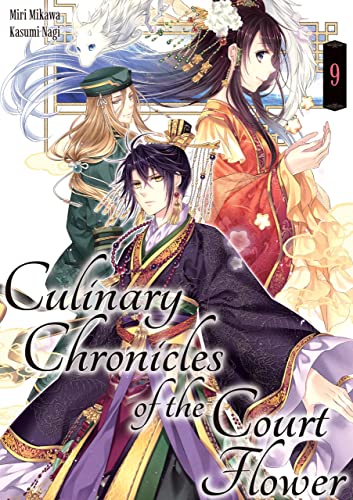
After the events of the previous book, Kojin and Renka are being politely held at the palace so that it can be determined what happened to Rimi. The only trouble is that Rimi refuses to point any figures. That said, the answer is obvious, and Shohi has his first massive temper tantrum in some time. This results in Kojin resigning and going back to his seaside estate, and Renka saying she’d like to take up the position being offered, but won’t do it without the Chancellor agreeing to it. And the Chancellor just resigned. So someone has to go to Kojin’s estate and play peacemaker, trying to persuade him to give Shohi another chance so that the country can remain peaceful and stable. The perfect choice to do this, obviously, is the woman Kojin recently tried to murder.

Fear not, those who worry about such things, there is plenty of food in this volume, and it plays the major role in reconciliation here.l Not between Kojin and Shohi, though that happens as well, but between Kojin and Shusei, as we learn that sometimes when you think the only answer is “tough love” but you’re also terrible at real human emotions, it can come off as hatred. I always love how these mysteries are filtered through Rimi, who is actually trying to understand why they’re stubborn and unyielding but can only do so in terms of imagining what foods would and wouldn’t work on them. Kojin’s breakdown is very well handled, and I also enjoyed reading about how yes, his wife really DOES love him, surprise! That said, all this is drowned out by the cliffhanger ending, as Shusei makes war inevitable.

I am assuming that the next volume will be that war. I am also hoping that we finally get a reveal as to Mars’ identity, if only so they can be killed off. (There was an attempt at a tragic backstory here, which didn’t work well because it was too similar to the main tragic backstory.) In any case, this remains an addictive shoujo thriller.
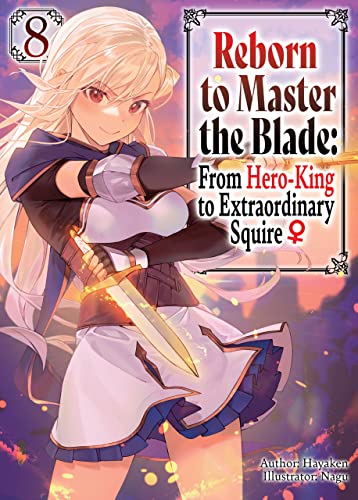
Reborn to Master the Blade: From Hero-King to Extraordinary Squire, Vol. 8

By Hayaken and Nagu. Released in Japan as “Eiyu-oh, Bu wo Kiwameru tame Tensei su. Soshite, Sekai Saikyou no Minarai Kisi ♀” by HJ Bunko. Released in North America by J-Novel Club. Translated by Mike Langwiser.

Reborn to Master the Blade is not, I think, a series that’s really trying to do much beyond having fun and writing a lot of Inglis fighting. The author admits in the afterword that they really don’t have much of an idea of where to go next, so there’s not really an end goal in mind. Sometimes this is a good thing. We’re here to see Inglis fight things, and the back half of this book is all that, showing us Inglis coming as close as she’s ever come to actually getting killed, and actually (gasp!) needing the help of other people once or twice in order to fend off the biggest Prismer yet. On the down side, Inglis does not show up until 100 pages into this book, and as I said last time, without Inglis this book is just spinning its wheels. I’m sorry, supporting cast, you are not quite interesting enough on your own.

The front half of the book features Lahti facing off against his brother, Windsel, with the winner likely becoming the next King. Windsel has several demands, which seem at least vaguely acceptable, but the last one, “let us execute Pullum”, is a no go, so they’ve got to do battle. This allows everyone to whip out their new special moves, which range from unsurprising (Leone, Liselotte) to very surprising (Lahti). After this, we cut back to the Prismer, and though Rafael, Rafinha and Yua try their best, it’s going to come down to Inglis in the end, when she eventually gets there, which is (of course) right when all hope is lost. That said, can she really have enough power to stop it? And, more importantly, can everyone stop her trying to heal it up so that she can fight it even more equally?

This is essentially a series written for guys, but it features a whole lot of kickass women with either swords, magic, or both. As a result, it tries hard to attempt to push back on “why are women fighting, they are too fragile, the man should be protecting them” and actually embracing that, mostly because “a guy has to protect his younger sister” is a stronger cliche than “women can fight as well as men” in the author’s mind. It’s a bit disappointed, but hey, at least Leon and Leone have worked things out. I was also rather surprised, contrary to what I’d guessed in the last review, that the “turned into a magicite beast” process does NOT appear to be reversible. That said, Yua was at least polite enough to rescue the only one we’d actually seen named, and hopefully they can at least do SOMETHING for him.

After a half-volume of fighting, the epilogue features a whole lot of eating. This is definitely an “end of arc” book, and the next one promises to be far more light-hearted. That said, it also promises fewer fights. I hope I’m wrong there.

Didn’t I Say to Make My Abilities Average in the Next Life?!, Vol. 15

By FUNA and Itsuki Akata. Released in Japan as “Watashi, Nouryoku wa Heikinchi de tte Itta yo ne!” by SQEX Novels. Released in North America by Seven Seas. Translated by Diana Taylor. Adapted by Maggie Cooper.

As many have noticed by now, this author really, really loves playing around in isekai tropes and cliches, and the more cliched the better – in fact, it comes as a surprise in this series when it ISN’T the cliche. When they’re investigating a local noble, you can guarantee that he is going to be a scummy noble who treats those he’s responsible for like crap, because scummy nobles are just what isekais do. (This is not unique to FUNA – Kuma Kuma Kuma Bear has similar ideas, though subverts them more often.) It doesn’t help that isekai’d Mile tends to regard this world as a giant bucket list full of things she wants to do, and most of this volume happens because she’s desperate to find a village of beastmen… mostly so that she can pet the little beastgirls. Let’s face it, FUNA is also not afraid to show that Mile can be creepy a lot of the time.

Mile and company start off by having a meeting with the Elder Dragons, which ends up being short on information but long on nail art. We then get the bulk of the book, as Mile really, really wants to find a beastman village, despite the fact that most beastmen are NOT like Lenny but are actually very wary of humans… and we see why when they get to the village, only to find that some of the village’s children have been kidnapped! Unfortunately, this is not a mission the Crimson Vow an take on officially… fortunately, Mile can get in touch with the Crimson Blood, who coincidentally look, act, and are the same as the Crimson Vow! But they’re not on the clock. Now it’s up to our heroines to investigate the kidnappings, which are genuinely happening, but also where each kidnapped girl ended up, which… does not go quite as expected.

So word of warning here, if you’re the sort who avoids slavery in your isekai books… well, first of all, you must read very few isekai books, but secondly, this book delves deeply into the nitty gritty of slavery in this world. It’s illegal officially, except in the “I am broke and enslave myself to pay off my debts” way, but unofficially it’s definitely around. Two of the three kidnapped girls are indeed either being worked to death for no money or imprisoned and in the process of being sold abroad. Mile and the others have no issues destroying the ones responsible. Sometimes, though, kidnapping can actually be a way out. When you’re a girl in a backwater village expected to marry a guy from the same village, which is a very misogynist one… honestly, getting taken in by the local evil noble ends up sounding like a pretty good deal. Especially if the noble, like Mile, has a taste for the fluff. Make My Abilities Average has always had an undercurrent of “sexism is everywhere, and it’s terrible”, and we even see it in a slavery plotline here.

The book ends with the Crimson Vow off to check the last item on Mile’s list… visiting a demon village. Will this advance the plot? Are we getting towards the end of the series? Who knows? But pretty good stuff.