Category Archives: reviews

My Stepmom’s Daughter Is My Ex: “The Only You in the World”

By Kyosuke Kamishiro and TakayaKi. Released in Japan as “Mamahaha no Tsurego ga Motokano datta” by Kadokawa Sneaker Bunko. Released in North America by J-Novel Club. Translated by Gierrlon Dunn.

This series is definitely one which enjoys being for otaku nerds, and expects its readers to keep up. Fortunately, it also has Yume, who is not an otaku nerd, and who sometimes needs things explained. (There’s a Haruhi Suzumiya joke here, and it’s remarked on how old that series is.) It also leans heavily on the sort of stereotypes such fans enjoy. And Isana Higashira leans heavily into those stereotypes. She’s the weird one. She talks like she’s from the 19th century. She’s got a really big chest. The whole nine yards. She’s also a hoot to read. I was quoting this book on Twitter while I read it, and everything I was quoting was one of her lines. That said, there’s a reason why, despite her plotline supposedly wrapping up in the second volume, the author came back to look at her in more depth. It’s because real life is not like light novels, and people don’t really get over being rejected by their first love that easily.
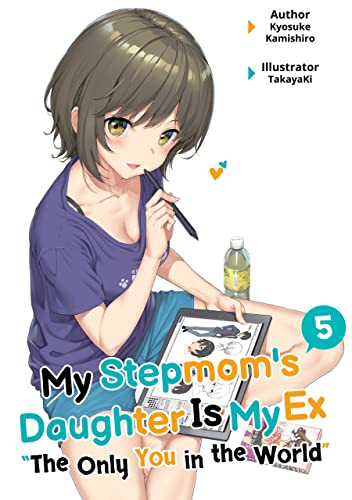
Mizuto and Yume return from their trip worse off than before, thanks mostly to Yume’s inability to spit her feelings out and Mizuto’s talent for rationalizing anything as “not in love with me”. They’re back home, though, which means that Isana can come over. A lot. And hang out with Mizuto, and get in compromising situations with Mizuto, and go out on a date with Mizuto (and Yume, who invites herself along), and introduce Mizuto to her mother. It should not really come as a surprise that, when school finally goes back into session, the rumor among the class is that Mizuto and Isana are dating. And Yume, trapped by her own inability to get her own feelings across, can’t say anything. Unfortunately, suddenly being the center of attention, and having the reason for that be a lie that everyone believes, makes Isana very unhappy.

The subtitle of this volume comes from Isana’s awesome mom, who sounds like she starred in a light novel series of her own as a teen. Isana suffers from an inability to read social cues, and when she asks things that to her are not obvious, she binds that everyone gets upset and she’s isolated. Mizuto is the first person her own age she’s met who not only does not get upset by her but is able to interact with her as a friend. This is why she fell for him so hard, and it’s also why, despite everything she’s told him, she can’t get past being rejected quite yet. The author mentions in the afterword that he originally ended the volume with Mizuto being more cool and dramatic, but that Isana was telling him that something wasn’t working there, so he went back and wrote the ending we have now, which feels more in character.

Yume will still eventually get together with Mizuto, of course, whenever this series ends. That said, I can understand why the author says Yume “feels like she’s losing” after this book. Isana, if nothing else, deserves her own spinoff.

The Drab Princess, the Black Cat, and the Satisfying Break-Up, Vol. 2

By Rino Mayumi and Machi. Released in Japan as “Jimihime to Kuroneko no, Enman na Konyaku Haki” by M Novels F. Released in North America by Cross Infinite World. Translated by Evie Lund.

Last time, I mentioned that we’d gone an entire novel without having the satisfying break-up of the title. Well, I’ve just finished the second volume, and I have some bad news for you. Now, this is not entirely bad. The scenes dealing with Prince Helios, how Seren thinks he feels about her and Marietta, how he *actually* feels about her and Marietta, and the fact that he’s really starting to mature and come into his own now lend a nice air of anticipatory horror to the whole thing. Helios isn’t a bad guy, just a teen who was overheard once at the exact wrong time and it’s going to destroy his life. That said, that’s about 15% of this book. The other 85% is Serena and Viol being adorable at each other while he teaches her magic. Don’t get me wrong, it’s cute, and they make a good not-yet-couple. It’s just compared to the underlying tension it feels a bit… dull?

The exam to become a High Mage is not that far away, so it’s time for Viol (or his alternate self/cat familiar Vi) to train Marietta to do better and better things. It helps that she’s a complete genius who picks up on everything much faster than he anticipates, to the point where he has to forbid her from learning how to FLY for fear she’ll try too hard and injure herself. Instead, they sneak out of her mansion and go to find magical beasts to destroy, so that she can gain experience. Which is good, because she really does show off that she’s unused to this, being terrified on her first encounter with one, and her magic therefore not being as strong as usual. But she improves, very quickly, and all is going well. Including her feelings for Viol, and Viol’s feelings for her. Now if they could only tell each other…

So yeah, it turns out that what this really is is one of the current genre of “sweet and syrupy romance” books, with a side order of magical creatures. Seren can’t stop staring at Viol, or thinking about how to please him, and near the end of this book realizes that she’s fallen in love with him. She’s also fully made her decision to become a High Mage and not the Queen, which is all very well and good but she really needs to tell someone about it. Viol loves Seren and sweets, in that order, and sort of suspects that Helios still likes her, but is certainly not going to try to fix things on his own. The result is a book where the high tension is surrounded by fluff. That said, I do really like the minor subplot of bringing more women into the “salons” that the noble men attend. Even if Seren does misread the reason, it’s good to see that for once we have a group of nobles and none of them are sexist dickheads! What are the odds?

There’s certainly more to this story – the author is still writing it as a webnovel. That said, these are the only two books to come out in print in Japan – two more seem to be digital-only. In any case, I really, REALLY hope that the break-up is dealt with in Book 3, because there’s only so many times I can read about these two eating sweets, y’know?

The Saga of Tanya the Evil: Alea Iacta Est

By Carlo Zen and Shinobu Shinotsuki. Released in Japan as “Youjo Senki” by Enterbrain. Released in North America by Yen On. Translated by Richard Tobin.

For most of this light novel series, there has bee one character pushing back against its main premise: Colonel Lergen. He’s been the one to boggle at the fact that a child is behind most of their major battles, and he also is able to see the terrifying soullessness that Tanya’s combination of military training and past-life management memories can do. We sympathize with him as the lone voice of reason. As such, the scene near the start of this book where he tries to “negotiate” peace with Ildoa is absolutely jaw-dropping. No one in the Empire (except Zettour and Tanya) is really aware of exactly how badly they’re losing the war, and nobody (including Tanya) is quite aware of exactly what the rest of the world thinks of the Empire as a nation. Actually, Rudersdorf may realize this as well. But his solution to the problem is not one that even the Empire can tolerate, and thus Zettour and Tanya are forced to once again make the title of the light novel be as accurate as possible.

For a series with the title The Saga of Tanya the Evil (or, for that matter, The Military Chronicles of a Little Girl), Tanya is not in this book as much as previous volumes. Huge chunks of the volume are dedicated to Lergen’s negotiation with the Ildoans,. and later with his leading the attack on those same Ildoans. We get lots of Zettour here, as he attempts to persuade his friend that he’s being stupid, and then, persuasion having failed, is reduced to assassination. But even this goes pear-shaped, because the Empire’s foreign office is so bad at everything that the Commonwealth use this opportunity to put in their own assassination attempt. As for Tanya, she’s still trying to think of ways that she and her unit can defect (and kudos to her for actually thinking of the unit here at all), but that’s getting more and more difficult.

I want to take some time to talk about the artwork of Shinobu Shinotsuki, which tends to run to two different kinds. There’s the overdramatic gorgeous pictures, such as the ones we see in the color pages. And there’s the ones that look like a total cartoon. Sometimes literally, as one shot of Lergen and Calandro screaming at each other shows drops of snot coming from one nose as if they’re Crayon Shin-chan, while the background has cute l’il caricatures of Tanya and Visha. (Visha also gets a picture of the volume’s funniest moments, trying to eat as much as possible as quickly as possible because they finally have good food and will never get more of it.) The most telling moment, though, is when we read, in Tanya’s matter-of-fact narration, about her idea for an initiative, along with her misgivings about it, and the illustration shows her laughing maniacally as if she’s just shot a dog. One wonders how much of this chronicle can be trusted.

Good news, we get the 12th volume in a few months. Bad news, that’s the latest from Japan, and it came out three years ago. That said, we have a long ways to go before the Empire finally falls, so strap in.