Category Archives: reviews

Death’s Daughter and the Ebony Blade, Vol. 1

By Maito Ayamine and Cierra. Released in Japan as “Shinigami ni Sodaterareta Shoujo wa Shikkoku no Tsurugi wo Mune ni Idaku” by Overlap Bunko. Released in North America by J-Novel Club. Translated by Sylvia Gallagher.

It has become very common in novels these days, be they Japanese or no, to have something that is basically “I want to write my kind of book, but it won’t sell unless I give it the current popular gimmick”. So we get isekai economic policy books, and isekai military history books, and villainess fantasy magic battle books. Death’s Daughter and the Ebony Blade sort of falls into that category, though the genre it’s using – generally referred to as “raised by wolves” – isn’t hugely popular. The idea is that you have a protagonist who was raised by something so outside of normal humanity that they grow up to be very weird. Technically Faraway Paladin should have been this, if he hadn’t basically grown up to be Superman. But Olivia in Death’s Daughter definitely qualifies. She is described more than once as lacking in manners and common sense. But boy, she can kill people really, really well.
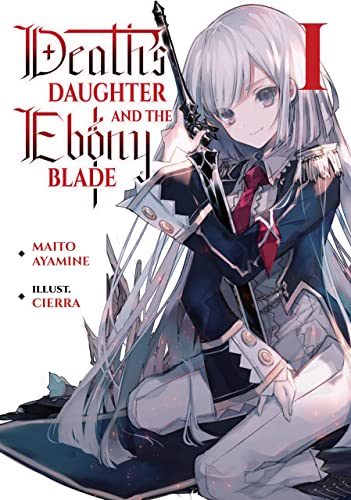
Three shinigami discover a baby outside of an abandoned temple, and rather than eat the baby’s delicious soul, one of them decides to try raising them as a child. Olivia gets fifteen years of combat practice, history lessons, and not much else. Then one day her mentor simply vanishes without a trace, and she goes off to look for him. Meanwhile, the Empire is battling the Kingdom, and the Empire is winning. For some reason, while searching for her shinigami dad, she decides to join the Kingdom as a soldier, something she does by going to the nearest Empire stronghold, decapitating everyone, and presenting their heads to the general. This is good enough for them, and now we watch Olivia tear her way through enemies, befriend nerdy guys who have a good eye for tactics, and try to learn what it’s like to be human.

To be honest, that last part doesn’t happen very much. The biggest flaw in this book is that Olivia does not really develop all that much as a character. Sure, she’s introduced to the wonders of soft bread and cakes, but she still does not understand how humans think, and mostly does not bother to try. I did appreciate that her aide (and oh boy, there’s an OT3 there I’d love to see but will not) is able to get her to dress up and perform basic award etiquette, but that’s about all we get. (Also, be warned, there’s a “the chest is too tight/the hips are too loose” gag here. I thought those were banned by the Geneva Convention?) The bulk of the book, though, it military combat, with the Empire gradually realizing that the tide is now turning against them, thanks entirely to the presence of Olivia cutting down most of their important generals.

This is the sort of series where I know development will be slow in coming, so I’m willing to give it more time. Olivia is fun, and I also liked Ashton and Claudia. Recommended only if you like military histories and don’t mind a lot of battle carnage, though.

Is It Wrong to Try to Pick Up Girls in a Dungeon?, Vol. 17

By Fujino Omori and Suzuhito Yasuda. Released in Japan as “Dungeon ni Deai o Motomeru no wa Machigatte Iru Darou ka?” by GA Bunko. Released in North America by Yen On. Translated by Dale DeLucia.

The term ‘gaslighting’ has gotten so overused lately that I hesitate these days to mention it in a review. But, I mean, the definition of gaslighting is ‘manipulate (someone) by psychological means into questioning their own sanity’, and that’s exactly what’s happening for most of this 17th volume of DanMachi, so… there we are. I expected this volume to be really dark, and indeed it was, with the first half of the book in particular being nothing but punches to the gut over and over again. But that’s something this author specializes in, and for once we don’t have to worry about the turnaround and hope spots coming in the next volume. No, this is not the end of the arc, but at least this book is allowed to come to a definite emotional conclusion, as Freya plays her last desperate card and ends up losing. Now it’s just a question of what’s going to happen to her… assuming that her Familia don’t just murder everyone.

After Syr is rejected by Bell at the end of the last book, Freya finally snaps. Hestia’s family is taken out in approximately two seconds, and Freya basically tells Hestia “give me Bell”. Hestia refuses, and Hermes reminds Freya of a rule that shows off to the reader the ludicrous timescale of this entire series. As a result, Freya decides to go all out and brainwash ALL OF ORARIO, including the Gods, into thinking Bell has always been with Freya Familia. The exceptions to this are a) Freya herself, b) Bell, who rapidly loses his mind when everyone seems to recognize him as someone else, c) Hestia, who fired off all her divine power at once to avoid this, and d) Asfi and Lyu, who were able to escape the city in time. Now Hestia has to figure out a way to stop this before bell finally breaks and accepts that he’s under a memory “curse”.

I joked on Twitter that Books 1-10 supposedly starred Hestia, but really starred Aiz, and that Books 11-20 were the same but with Lyu. Hestia has been Bell’s goddess, but as a character she’s always played a supporting role in the series, and sometimes barely shows up. Thus it’s nice to see her actually managing to save the day, and her entrance at the end is appropriately awesome. That said, once again the thing that saved Bell from cracking and giving in is not Hestia, or any of the other women in love with him, but Aiz. All of the women with strong attachments to Bell are less affected by Freya’s mind control (and bravo to Eina, who gets a great scene of defiance before she’s beaten down by EVEN MORE MIND CONTROL), but it’s seeing that Aiz is able to remember a different past with Bell, one where she trained him, that gives him hope and strength. All the other female leads are still chasing after her.

And so we’re ready for another War Game, with Freya Familiia vs… well, possibly everyone else, though I suspect the rules will winnow down the opposing team a bit. Still it, should be great fun to read whenever it comes out. It’s still not out in Japan. But this was an excellent psychological torture volume with a pump your fist ending.

Culinary Chronicles of the Court Flower, Vol. 7

By Miri Mikawa and Kasumi Nagi. Released in Japan as “Ikka Kōkyū Ryōrichō” by Kadokawa Beans Bunko. Released in North America digitally by J-Novel Club. Translated by Hunter Prigg.

I’m starting to get the feeling that the consummation that keeps getting put off between Rimi and Shohi is never actually going to happen. Leaving aside the fact that Rimi still thinks of herself as a mom more than a lover to him, there’s also the fact that the Chancellor exists. There are other aides in this book as well, and some of them like Rimi and some of them dislike Rimi, but they all seem to see Rimi as, well, as a real human being. The Chancellor, on the other hand, regards Rimi as this sort of otherworldly poisonous creature whose mere presence destroys the Emperor and everyone around him. Leaving aside the fact that there’s a name for that and it’s called “being the protagonist”, it does mean that Rimi is going to find becoming Empress very hard to do. We already knew that, of course, but it’s getting even harder, especially with the arrival of an even bigger rival than the Four Consorts: a better political marriage match.

Rimi is delighted to hear that the court will be seeing the return of Shar, ambassador from Saisakoku. Things get less delightful when the delegation also has an extra person, Princess Aisha. The princess is gorgeous, and is clearly there to deepen ties between the two countries. What’s more, the best way to do this would be to move Rimi quietly to the side and let Aisha be impress. It’s the sensible thing to do. That said, Shohi is reluctant, not just because he loves Rimi, but also because the young princess is a little hellraiser, running around the court like a bull in a china shop and taking very badly to any attempt to criticize her. When things finally blow up to the point that the princess runs away, Rimi and company need all the allies they can get to find her. Even if that means seeing Shusei again.

This series is mostly a romantic thriller, but I do appreciate that in every book there’s always one scene which is hysterically funny, and here it’s right in the center, with Princess Aisha showing off to the four consorts in a way that is both jaw-dropping and also makes you want to find a ball to see if she can balance it on her nose. The best part of the book is Rimi and Aisha’s relationship, as, even though she knows that Aisha is there to destroy everything Rimi has done up till now, she can’t help but try to make things better because she’s that sort of person. (She does, this, of course, with a meal, in case you’d forgotten what book you’re reading.) Shohi too continues to develop and grow into his Emperor title. If it weren’t for the Chancellor, there would be very little getting in the way of their union.

Sadly, there is the Chancellor, and another vicious cliffhanger. We’ll have to wait till next time to resolve it, but I remain addicted to this series… so much so that I look forward to Sugar Apple Fairy Tale in a few weeks from Yen On, by the same author.