Category Archives: reviews

Loner Life in Another World, Vol. 3

By Shoji Goji and Saku Enomaru. Released in Japan as “Hitoribocchi no Isekai Kouryaku” by Overlap Bunko. Released in North America by Seven Seas. Translated by Eric Margolis. Adapted by Veles Svitlychny.

Increasingly reading Haruka’s narration in Loner Life is sort of like trying to solve a puzzle. Class Rep actually lays it out for us midway through the book: Haruka simply is incapable of seeing anyone’s actions except in the absolute worst way – and that includes his own. It’s especially true of him, in fact, because – with the exception of Angelica, who he has a very different kind of relationship with – he does not want to have anyone get too close to him or even like him all that much. For all that he complains about constantly getting lectured or having no money, it’s a situation he deliberately engineers himself. And I hate to break it to him, but the ship has definitely sailed with some of the girls – Class Rep, if no one else, certainly has feelings for him. But it gets to the point where even a spy sent to see what Haruka is like gets the absolute worst impression of him… at least till everything blows up.

After getting back from the Ultimate Dungeon, Angelica in tow, Haruka and his friends now have to go around trying to clear out all the other, lesser dungeons that lie around their town. Haruka’s casual, vicious approach to this makes everyone feel incredibly sorry for the monsters who just happened to be in his way. That said, he’s also casually doing things like saving the livelihoods of a dying hamlet by getting rid of the dungeon (and also giving them medicine and food, something he fails to mention in his tortured narration) or converting the general store in town into a 5-story department store with the latest fashions (also created by him, which prompts the girls to wonder when exactly he read so much about fashion). But when the “Stalker Girl”, aka spy, arrives from the noble city that financially cripples their town, it’s Haruka who sees the larger picture as to what’s going on.

It’s not quite as jaw-dropping as the speech from When Supernatural Battles Become Commonplace, but Haruka’s breakdown near the end of this book is startling in how (seemingly) out of character it is, as for once he briefly breaks his facade to try to convince the girls that they’re all in serious trouble here. The corrupt lord ruling the area is not above sending soldiers to wipe them out, and he’s also certainly going to kill the spy once she gets back and delivers her report. He spent the entire time he was dungeon crawling with the spy at his absolute trashiest and worst in order that she could go back and say that he’s not worth caring about, but when this didn’t work he finally snaps and has to fix things. Class Rep and the others get it, even if Haruka doesn’t want them to – she says he and Angelica “destroy tragedies”, and that’s as good a description as any.

One last thing: yes, this is the one with the vibration magic. Between that and Haruka’s “nighttime activities” with Angelica, the light novels are 200% hornier than the manga equivalent. The manga is still probably a safer bet, but the light novels remain a fascinating but flawed experience.

Formerly, the Fallen Daughter of the Duke, Vol. 1

By Ichibu Saki, Nemusuke, and Ushio Shirotori. Released in Japan as “Moto, Ochikobore Koushaku Reijou desu” by Mag Garden Novels. Released in North America by J-Novel Heart. Translated by Andrew Schubauer.

The idea of the “twist ending” has gotten a bit of a bad rap in recent years. This can mostly be blamed on the films of M. Night Shyamalan, whose films got to the point where the real twist ending would be that there wasn’t a twist. There’s always the danger of alienating your audience as well – to quote Futurama, “it’s not ironic, it’s just mean!”. When done properly, though, a good twist ending can cause a person to immediately go back and look at the entire plot all over again. And, in a case like Formerly, the Fallen Daughter of the Duke, it can cause you to want to get the next book in the series. I won’t lie, this felt very much like a “villainess by numbers” storyline. Claire is more a rival than a villainess, but every single plot point in this book is predictable and right on the beat. At least, until everything turns out bad.

This book hits the ground running, picking up right as our protagonist, Claire, is rejected by her fiance, sister, and family. She quickly realizes that staying in her kingdom will do her no good at all, so resolves to escape to a nearby abbey. That said, it’s hard to escape when you’re the daughter of a duke and you have retainers that go with you everywhere. Then she runs into a young man and his group of friends, who help her ditch the retainers and offer to take her to their nearby country – which is much better off than the one she just came from. Oh, and said young man is really the prince of said country. Plus, the pitiful amount of magic she thought she had turns out to have been a massive trap. She’s really ludicrously powerful. So far so boring. But… why does she keep waking up in Japan? Is this a game? Is this a secret hidden route of the game?

Let’s start with that last part, because after a number of books where the “villainess” dies in every route, it’s refreshing to see this is the one bad route for Claire in the game. The player character, Charlotte, has a normal amount of routes and friends, and is helped by her older sister and NPC Claire, who is set to marry the prince. But if you play the secret hidden route, where you do something truly nasty to destroy Claire’s life in many ways, you get the chance to win the heart of the prince for yourself. That fits with the portrayal of Charlotte in this volume – she’s astonishingly stupid and petty, as befits a side route that was only added later for extra content, and where not as much thought was required. And then there’s the ending, which made me wonder what in God’s name the series was really going to be about. Nicely done.

That said, you’ll have to plow through a lot of “pleasant but predictable and a bit boring” to get to the good bits. it’s worth it, though.

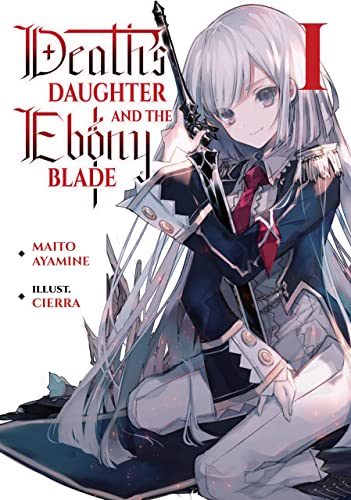
Death’s Daughter and the Ebony Blade, Vol. 1

By Maito Ayamine and Cierra. Released in Japan as “Shinigami ni Sodaterareta Shoujo wa Shikkoku no Tsurugi wo Mune ni Idaku” by Overlap Bunko. Released in North America by J-Novel Club. Translated by Sylvia Gallagher.

It has become very common in novels these days, be they Japanese or no, to have something that is basically “I want to write my kind of book, but it won’t sell unless I give it the current popular gimmick”. So we get isekai economic policy books, and isekai military history books, and villainess fantasy magic battle books. Death’s Daughter and the Ebony Blade sort of falls into that category, though the genre it’s using – generally referred to as “raised by wolves” – isn’t hugely popular. The idea is that you have a protagonist who was raised by something so outside of normal humanity that they grow up to be very weird. Technically Faraway Paladin should have been this, if he hadn’t basically grown up to be Superman. But Olivia in Death’s Daughter definitely qualifies. She is described more than once as lacking in manners and common sense. But boy, she can kill people really, really well.

Three shinigami discover a baby outside of an abandoned temple, and rather than eat the baby’s delicious soul, one of them decides to try raising them as a child. Olivia gets fifteen years of combat practice, history lessons, and not much else. Then one day her mentor simply vanishes without a trace, and she goes off to look for him. Meanwhile, the Empire is battling the Kingdom, and the Empire is winning. For some reason, while searching for her shinigami dad, she decides to join the Kingdom as a soldier, something she does by going to the nearest Empire stronghold, decapitating everyone, and presenting their heads to the general. This is good enough for them, and now we watch Olivia tear her way through enemies, befriend nerdy guys who have a good eye for tactics, and try to learn what it’s like to be human.

To be honest, that last part doesn’t happen very much. The biggest flaw in this book is that Olivia does not really develop all that much as a character. Sure, she’s introduced to the wonders of soft bread and cakes, but she still does not understand how humans think, and mostly does not bother to try. I did appreciate that her aide (and oh boy, there’s an OT3 there I’d love to see but will not) is able to get her to dress up and perform basic award etiquette, but that’s about all we get. (Also, be warned, there’s a “the chest is too tight/the hips are too loose” gag here. I thought those were banned by the Geneva Convention?) The bulk of the book, though, it military combat, with the Empire gradually realizing that the tide is now turning against them, thanks entirely to the presence of Olivia cutting down most of their important generals.

This is the sort of series where I know development will be slow in coming, so I’m willing to give it more time. Olivia is fun, and I also liked Ashton and Claudia. Recommended only if you like military histories and don’t mind a lot of battle carnage, though.