Category Archives: reviews

Tearmoon Empire, Vol. 5

By Nozomu Mochitsuki and Gilse. Released in Japan as “Tearmoon Teikoku Monogatari” by TO Books. Released in North America digitally by J-Novel Club. Translated by David Teng.

The structure of this book is slightly off, as the author admits that the story got away from them and the island arc that should have concluded the 2nd “arc” of this story ended up being the first third of this 5th book as well. Still, it works out, as we get to see Mia turn a corner and fend off another of her fates written in a long history book… or at least it was long. Yes, sometimes when you’re trying to stop the bad guys who can mess with the fates, you end up finding that your fate can sometimes get even worse. Now Mia’s not being executed at the guillotine or cut down in her adult years for not being Empress, the history books say she’ll be killed in a few scant months. Can she avoid this fate while continuing to work hard to save her kingdom from famine, win over more allies by being kind and charming, and also eat delicious sweets? The answer should be obvious.

The one thing I took away from this book is that I think Mia handles plots against her, or large conspiracies, much better than sudden random events conspiring against her. When she has to deal with a cave-in, a seemingly deadly fish attacking her, or even just horses sneezing in her face, she seems to always end up on the wrong foot. But the larger, more epic scenarios are where she shines – and yes, by now even the narrator is having trouble saying EVERYTHING she does is due to her selfishness and need to eat sweets, although god knows they try to say so anyway. In her confrontation with Esmeralda, where she sees the traitorous past of their nation as found in a secret underground ruin, stares destiny right in the face, and says “to hell with that”, she really is learning to be a good person – and yes, it’s framed as her having to “deceive” Esmeralda by saying they’re best friends, but I don’t doubt it’s actually going to come to pass. Mia is no longer as passive or luck-driven as she was in past books.

The 2nd half of the book, back at school, is even better. Finding from Bel’s now-changed history book how she’s going to die, she takes steps to avoid it, the first of which is getting even better at riding horses. The way she does this is actually quite clever. You see, she gets up early, practices really hard, learns to read the movements of the horse, and treats them well, even going so far as to help save the life of the pregnant horse that she had been eyeing up as a replacement mount (as opposed to the horse that keeps sneezing on her). See? I told you it was clever. Mia is doing things correctly and doing them well. This culminates in the highlight of the book, where she races Ruby, the daughter of the House of Redmoon, in a Belmont Stakes with one of her retainers at stake. The race is fantastic, with Mia being both very much in character (she’s screaming and whining the entire time) but also incredibly awesome. And we also see her changing history once more, as one reason she was executed her first go-round is that she pissed off Ruby so much she persuaded her father not to support them with military might… something that ended up being fatal to them both. This time around, everyone wins, and Mia’s solution to what to do about Ruby is brilliant. I don’t even care if she wasn’t thinking long-term here. It’s still brilliant.

There are, of course, a few plotholes with the new arc, but they’re acceptable. Miabel did not vanish when Mia’s fate changed, despite the fact that she did not live long enough to have kids, much less grandkids. Even the author acknowledges this is a handwave, but it’s fine, as we also get sweet scenes of Miabel managing to stay her innocent, sweet self even in a bad future where she has to be hidden from the world. That said, Mia is still the star, not her granddaughter, and Mia is the reason that these books keep getting better. I can’t wait for the next one, and I would say that this is essential light novel reading.

Culinary Chronicles of the Court Flower, Vol. 2

By Miri Mikawa and Kasumi Nagi. Released in Japan as “Ikka Kōkyū Ryōrichō” by Kadokawa Beans Bunko. Released in North America digitally by J-Novel Club. Translated by afm.

Last time I talked about the similarities between this series and The Apothecary Diaries, but hey, at least Rimi does no go around solving crimes… oh wait, yes, she does. In this volume, there’s a large chunk in the middle with a precious treasure being stolen, and Rimi, being the foreign girl who made food out of “wood”, is suspected of having magicked it away. So, um, yeah. Fortunately, the two books do have one major thing separating them, and that’s the heroine’s personality. Rimi and Maomao could not be more different, with Rimi being a more Usagi Tsukino sort of character, who may not be the sharpest knife in the drawer (though her emotional maturity is developing by leaps and bounds), but who knows just the right things to say to people to earn their trust. Of course, the delicious food helps as well. In fact, Rimi’s biggest problem may be that she’s so lovable that there may be civil war in the future, if the two men who’ve fallen for her don’t work things out…

Rimi is temporarily working with Shusei in the culinary department, and there’s an important assignment. The four consorts have to stand with the emperor soon for an important ceremony, and one must stand next to him and hold the Scattering Lotus, a highly valuable treasure. Needless to say, the competition to be that consort is high, and previous consort battles have even led to death. Shusei and Rimi have to work to pacify the consorts and get them to make a decision about what order to stand in without it coming to blows – even though everyone fears it will. And then, as I noted above, the Scattering Lotus is stolen and Rimi is the prime suspect. Is every book doomed to have her fighting to not be executed? Oh yes, and also the Emperor is far more interested in sleeping with her than any of the Four Consorts. That’s probably going to be a thing.

Rimi remains funny in this story, continuing to speak the language of the country she now lives in slightly off-center, so that things she says sound slightly to very rude. (The Emperor suggests she’s doing it on purpose, which I do not think she is… yet.) But she’s also the nicest person in the book, her life not really damaged by political schemes because she’s been raised entirely apart from everyone else. Sometimes this works against her, but it also allows her to see past the fronts that the other four consorts throw up and see what they truly have in common. I also love the concept of the treasure itself and what the solution was. That said, there’s more concerning things here as well. Someone high up seems to have it in for her, and while she escapes his grasp here I will not be surprised if he’s back in the next book, especially as he seems to regard her as some sort of sorceress.

This isn’t a great light novel, but it’s solidly good, and Rimi is a fun protagonist who I think is not as airheaded as she seems… though admittedly, that’s a low bar to clear. I’m happy to read more.

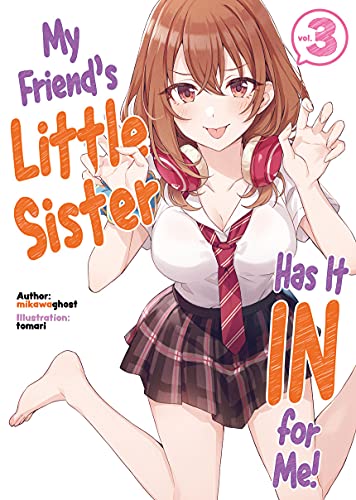
My Friend’s Little Sister Has It In for Me!, Vol. 3

By mikawaghost and tomari. Released in Japan as “Tomodachi no Imouto ga Ore ni dake Uzai” by GA Bunko. Released in North America by J-Novel Club. Translated by Alexandra Owen-Burns.

Someone needs to tell Japan that “having the rest of the cast being creeped out about the appalling character” is not a get out of jail free card for everything the character does. I’ve said in the previous books that the shotacon tendencies of Sumire are not funny but awful. Well, she’s the main character of this book, and so we get a lot more of it than even the previous two, and it’s still awful. Saying that a guy would be the perfect husband if only he were 5 years old is not a “LOL” moment. So be aware as I write the rest of this that this is a big black mark, and made me not enjoy this book nearly as much as the previous two. That said, I’m still reading it, because I do like the cast and the romantic comedy situations. With, well, one exception. Fortunately, this is not We Never Learn, so the teacher has precisely zero chance of winning the romantic sweepstakes.

We pick up right where the cliffhanger left off, as Sumire begs Akiteru to marry her. As expected, her family has decided enough is enough, and is going to arrange marry her soon… which means she won’t be able to draw anymore. This is basically the only reason Akiteru agrees to the scheme. After some “wacky” date situations, which I will not go into as they are dumb, a trip that’s supposed to be to the beach becomes a trip to her remote mountain village, where her father wants to meet Akiteru… and force them to get married immediately. Can they possibly get around the marriage ceremony with a 100% success rate? Can Iroha continue to try to cleverly juggle all these relationships in the air, given sempai is a dense MF and won’t do it for her? And can Mashiro finally admit she’s secretly their star writer?

Again, this series leans pretty hard on the Higurashi pastiche. Their game is subtitled “When They Cry”, and Sumire’s home village essentially turns out to be Hinamizawa, complete with terrifying elders and obscure rituals. Having already mentioned the volume’s big weaknesses, I do want to applaud its really good moment, when Mashiro’s editor (who we meet here, ad boy does it take some fancy footwork to explain her presence) points out to Akiteru that he needs to be able to offer his fellow game creators a reason to stay on with him, or else they’re going to look for other opportunities. What can he personally offers them? (Other than, of course, being the romantic lead who has no idea half the cast are in love with him.) It’s not a question that’s answered here, but I do appreciate it was brought up. Iroha also remains quite enjoyable, a bit less “annoying” than the first two volumes, probably as she’s trying harder to have him “get” her feelings.

That’s unlikely to happen soon, and a cliffhanger means we don’t even get this one resolved in one volume. Still, hopefully it won’t take up all of Vol;. 4. I think two volumes starring Sumire is two too many.