Category Archives: reviews

Reborn to Master the Blade: From Hero-King to Extraordinary Squire, Vol. 1

By Hayaken and Nagu. Released in Japan as “Eiyu-oh, Bu wo Kiwameru tame Tensei su. Soshite, Sekai Saikyou no Minarai Kisi ♀” by HJ Bunko. Released in North America by J-Novel Club. Translated by Mike Langwiser.

You have to find something to latch on to, when you’re reading all these light novels. So many reincarnations, and overpowered swords being wielded, and magic determining your lot in life, etc… all of which this book has in abundance. If your goal in reading a new light novel series is to find something different from what’s come before, keep walking along and try to find something else. But as I said, you look for the little things. Things like our hero, now reincarnated as a rather voluptuous teenage heroine, feeling extremely uncomfortable at walking into a room and getting leered at, something that rarely comes up in these kind of books. (To be fair, there are normal “let me massage your boobs” bath scenes as well, so it could just be a coincidence.) More importantly, though, is that our heroine, Inglis, is… well, a bit of a battle thirsty meathead. No interest in power or money or romance… she wants a good fight. Meathead heroines might keep me reading.
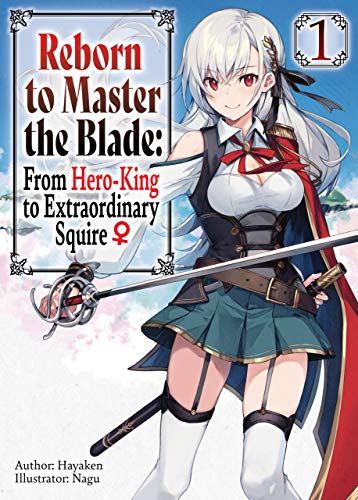
Our hero is a king who united the land and won the day, and is now dying late in his years. A goddess comes to grant him a wish, and he asks to be reborn as simply someone who doesn’t have to worry about ruling or politicking, but can just FIGHT FIGHT FIGHT. He gets his wish… but is rather surprised that he’s reborn as a girl. Inglis rapidly grows up to find that things are not really the way they were back in her previous life… indeed, her own kingdom is now forgotten in the mists of time. On the bright side, this means that she can call upon aether and mana that others don’t have a clue about. On the downside, she has a magical blessing of zero, so cannot become a knight. That’s fine, though, She sets out to become a squire to her cousin Rafinha, who can become a knight. After all, Inglis is here for only one thing: honing her blade.

The book has a lot of the sort of things you’ve seen in these sorts of books before. There’s a group of arrogant nobles that abuse the common folks and keep slaves, and the one example of them who’s not that sort is promptly sabotaged. We’ve got to go off to knight training school, which I’ve no doubt will keep the second volume very familiar as well. But I dunno, it was pretty good. Inglis is a nice mixture of an old male king and a young teenage girl, and I was amused that she has a hobby of admiring herself in the mirror – it’s nice to see a hero with actual vanity. Her cousin Rafinha, unlike other books of this sort, is also quite powerful, and together the two of them take out monster and bad guys with ease. If you think that’s boring… well, so does Inglis, and that’s why she’s searching for fights.

So it’s not essential, but it’s good enough. I’ll pick up the next volume.

Sword Art Online, Vol. 22: Kiss and Fly

By Reki Kawahara and abec. Released in Japan by Dengeki Bunko. Released in North America by Yen On. Translated by Stephen Paul.

After the cliffhanger for the last volume of SAO, a lot of people were anxious for the continuation, in particular wanting to see more of a heroine who’d only shown up in the Progressive series before now. Well, I have good news and bad news. The good news is that Argo is here, and gets a supporting role at the start of the book. The bad news is that the role is in a short story, and indeed this is a short story collection, taking the various pieces Kawahara wrote as DVD/BD extras in Japan and stitching them together to make a book. This is not necessarily a bad thing – the first three stories are decent enough, and the final story I’d go so far as to call excellent. But I have to admit, starting a brand new arc, the first thing the creator has done that wasn’t published online… and then switching to the first short story collection since Vol 8? The reader cannot help being a bit bummed out.

The cover art cannot entirely escape Kirito – he’s there in the bottom left corner – but does show off the heroines of the various short stories (including one who should be a spoiler). In The Day Before, Kirito and Asuna go to buy the log cabin he’s had his eye on before getting married, but run into Argo, who’s got a big problem. In the Day After, Asuna is having trouble getting her avatar used to ALO – far more trouble than everyone else. Could she be… haunted? Rainbow Bridge is a sequel to an anime extra episode that showed off the cast in swimsuits – here they try to figure out why the quest they did was so unsatisfying. Finally, Sisters’ Prayer is a prequel to the 7th book, showing us how Yuuki, her sister, and a friend they meet who also has a terminal illness decide to start their own guild.

As with most short story collections, the quality varies. I love Argo, but she did not really have a lot to do here, and you get the sense Kawahara wrote her in as she was added to the anime episodes at the last minute. The Day After is better, benefiting from a lack of first-person Kirito and also tying up one of the loose ends of the series, showing us that Kirito’s first love is fine with Kirito’s current love. Rainbow Bridge is the slightest story in the book, but does give Leafa a chance to show off her Norse Mythology nerd-ness, and also allows for a cool action sequence. The best story is the last one, a bittersweet yet uplifting tale of Yuuki and her sister, playing in a “safe” VR game for terminal patients, finding out that there are better ways to live your life even if you can’t leave your hospital room, and helping another girl who wants to be in SAO with her friends so badly she is OK with dying to do so. It’s really fantastic.

So yes, this is definitely worth reading, and I enjoyed it. But it does not solve the growing need for the next volume of Unital Ring. That comes in the fall, alas.

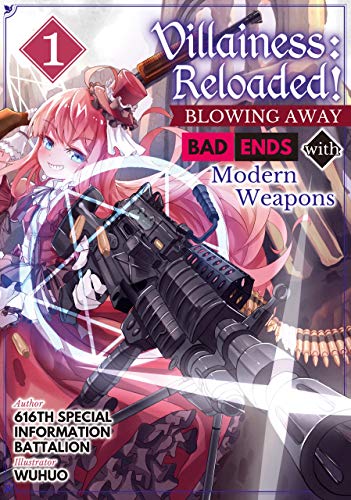
Villainess: Reloaded! Blowing Away Bad Ends with Modern Weapons, Vol. 1

By 616th Special Information Battalion and Wuhuo. Released in Japan as “Doushitemo Hametsushitakunai Akuyaku Reijou ga Gendai Heiki wo Te ni Shita Kekka ga Kore desu” by K Lanove Books. Released in North America by J-Novel Club. Translated by Shaun Cook.

Gotta be honest, I got the premise to this one mixed up. I am reading far too many of these villainess stories lately, and I had thought this was a “Peggy Sue” sent back to the past story like Tearmoon Empire. But no, it’s a “I’m the villainess in an otome game” story like Bakarina… in fact, clearly inspired by Bakarina in many ways. That said, while this is mostly light fluff, the choice of the author to start things off with an ominous, bloody prologue filled with death and a genuinely evil villainess for once had me raising an eyebrow… then raising the other when it’s never brought up again. Instead, for the most part, this is a pretty fun story of a military otaku, brought into an otome game world, who, like Katarina, tries to avoid her bad endings that will happen in ten years time. *Unlike* Katarina, she does so by making lots and lots of guns.

After the ominous introduction I mentioned before, we’re introduced to Astrid, a promising 4-year-old with a lot of magic talent and the daughter of a duke. She also, as you may have gathered, has memories of a previous life in Japan…a college girl who was a serious military otaku. What’s more, she knows this is the world of an otome game she once played… and that, yup, she’s the villainess who gets exiled in the end. As with Katarina, the idea of “being nice to everyone and not being evil” rarely occurs to her (though it does on occasion). Instead, she’s going to be spending time figuring out how to introduce rifles, pistols, shotguns, and grenade launchers via the power of magic, imagination, and the spirits that end up doing whatever she wants. Now if only she could avoid all those pesky love interests, who for some reason seem even more fascinated with her.

Obviously, there’s a lot of Bakarina here. The heroine is clueless about why all the love interests seem drawn to her, though Astrid is slightly more self aware… but that’s only a matter of degree. I’d argue that another good comparison is The Eminence in Shadow, as you see Astrid for most of the first half of the book just go nuts making and using all kinds of weapons, to the horror of her maids and family (with the exception of her mother, who seems to know everything Astrid is thinking… mostly as her poker face is terrible). The first half of the book is better than the second half, which shows Astrid as a six-year-old and then eight-year-old, going through school, studying advanced blood magic methods, helping other students, and trying to figure out why the prince in her class won’t leave her alone. In other words, it has far less dakka, and that’s not something you want to hear from a series like this, which depends on its gimmick of “Astrid’s Got a Gun”.

Still, it is interesting enough that I’ll pick up a second volume. Astrid desperately needs an injection of common sense, as she researches ways to affect the brain so that she won’t suffer from PTSD when she has to kill people to avoid exile. Realizing that she’s only creating her own fate now rather than avoiding it is beyond her narrowly focused mind, alas.