Category Archives: reviews

Holmes of Kyoto, Vol. 5

By Mai Mochizuki and Shizu Yamauchi. Released in Japan by Futabasha. Released in North America by J-Novel Club. Translated by Minna Lin.

If nothing else, Holmes of Kyoto has let me know that I would be an absolutely terrible detective. Each of my last two reviews has had some equivalent of “well, I was wrong about _____, but I’m pretty sure I don’t have to worry about ________” for a while. And each time I’ve been wring. And I’m wrong again. Fortunately, that’s not the only mystery in this series, which holds an awful lot of genre balls in the air. It’s a travelogue, as we see Holmes and Aoi (and others) traveling to Amanohashidate and getting long scenes explaining why it’s so amazing. We get mysteries, as a Sherlock Holmes society is startled to find they have their own mystery to solve at one meeting. We have the ongoing not-quite-there-yet romance between Holmes and Aoi, and the book sometimes feels like a ticking clock counting down till her 18th birthday. And we get another appearance by Holmes’s Moriarty, Ensho, and their ongoing cat and mouse battle, which is far more deadly serious than previous books. The series gives you bang for your buck.

We get four stories here. In the first, Aoi and Kaori go on a hot springs trip they were invited to before, with Holmes and Akihito tagging along (and Holmes’ dad, so it doesn’t look skeezy) and meet up with Kaori’s sister, who’s now working at the same hot springs… and has a secret. In the second story, Holmes takes Aoi to a meeting of the Sherlock Holmes Society in the area, and there’s also a potentially valuable manuscript… which is promptly stolen. In the third story Holmes and Aoi go to a soccer exhibition match and try to resolve a burgeoning love affair between a player and his ex-teacher. And finally Holmes has to deal with Ensho, who is reduced to burgling the antique shop… as well as dealing with things he’s been putting off for some time.

I want to dance around actual spoilers, so let’s discuss some other stuff. I’ve said this before, but the series is very frank about knowing about what is and isn’t acceptable in terms of an age-gap relationship, and Aoi being seventeen still is mentioned quite a few times. The Sherlock Holmes Society was the funniest part, with lots and lots of Doyle and Holmes trivia (I am amused Holmes saw the manuscript was a fake because of the handwriting, rather than, judging by the summary, because it was mawkish crap). I was also highly amused at Holmes’ soccer fandom, as he talks about the excitement of the local team constantly being promoted and relegated… as if that’s a good thing. That said, the highlight of the book is absolutely the final story, which is 100% thriller. I also have to empathize with Ensho a bit here… Holmes’ “you can achieve anything in life, no matter how poor you are, if you work hard enough” is kind of ergh.

There’s still many, many volumes of this series to go in Japan, and I am curious to see where the series goes from here. If you enjoy mysteries, antiques, or deftly handled college boy/high school girl romance, this is a good read.
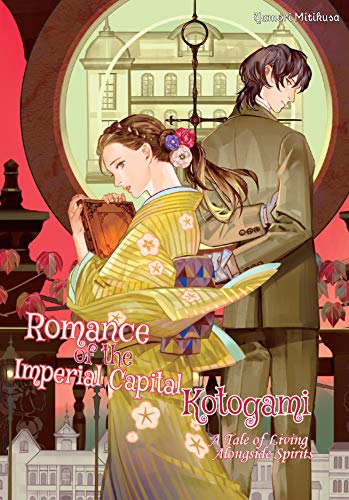
Romance of the Imperial Capital Kotogami: A Tale of Living Alongside Spirits

By Yamori Mitikusa and Tokihito Saiga. Released in Japan as “Teito Kotogami Romantan Kinrou Otome to Oshikake Juusha” by Kotonoha Bunko. Released in North America by Cross Infinite World. Translated by Evie Lund.

When I first saw that this title had been licensed, I thought that the synopsis sounded like one of Viz’s Shojo Beat supernatural titles. We’ve seen a lot of these “young human woman ends up caring for a number of yokai” series there – Kamisama Kiss, The Demon Prince of Momochi House, and Kakuriyo: Bed and Breakfast for Spirits. This one is not quite like that – the yokai are definitely serving her rather than the other way around – but it has a similar vibe. That said, it’s not a copycat, and this is certainly a wide genre to pull from. It also deals with survivor guilt, abandonment issues, and even good old fashioned murderous jealousy. Also, despite the ‘romance’ in the title, this is very much a book using the original definition of that word. Which is good, as for most of the volume the power dynamics between our heroine and any potential partner are too vast to be comfortable, and the heroine is definitely not ready for that anyway.

Our story takes place in not-quite-Japan around the Taisho period – the names have been changed to make it a fantasy, as this is a world where yokai are quite active. To help, the world also has Narrators, whose who can “read the story” of a yokai and control their nature, making them a kotogami. (If you think this sounds like Natsume’s Book of Friends, you’re not far off.) Our heroine Akari, however, despises all fiction and anything resembling a story. She works at a company that, among other things, makes grandfather clocks, lives in the company dorm, and avoids men telling her that she really should get married and settle down. Then one day her apartment burns to the ground thanks to a yokai on the loose. In the chaos, she runs into a police inspector and a kotogami who seem to know more than they’re saying, and ends up staying at a manor house filled with books, all with kotogami in them. Can she recover a normal life? Can she learn to enjoy fiction again? And how is this connected to her tragic past?

As with most of the best novels for women, the heroine is the main reason to read this. Akari is grumpy, practical, clearly hurting but also determined to live life the way she wants, and does not take shit from anybody. She’s also very good at her job (which is not always a good thing… there’s an underlying sexist society here, of which Akari and the author do not approve) and, as it turns out, VERY good at being a Narrator, whether she wants to be or not. Tomohito, the kotogami that she first meets, is seemingly goofy, silly, and a bit pathetic, but readers will be completely unsurprised to see this masks a very different sort of being. The “mystery” of the book is handled quite well, with revelations coming in at just the right time, along with one or two dramatic action scenes. And the supporting cast are also fun.

This is a one-shot, and I think ends on just the right note. I’d like to read more by this author (they apparently have another series out from Earth Star, this one more isekai fantasy), but am content with having read this.

The Reincarnated Prince and Felvolk’s Greatest Treasure

By Nobiru Kusunoki and Arico. Released in Japan as “Herscherik” by M Novels. Released in North America by J-Novel Club. Translated by afm.

After the end of the previous book, things are going pretty well for the Kingdom Formerly Known as In Woe. The King and his sons are running around trying to slowly fix everything that Barbosse broke, and also trying to track down the corrupt nobles who benefited from it (as opposed to those who were just threatened into obedience). Indeed, the previously unseen Sixth Prince has returned, as he was going all around to various countries trying to gain allies and also get enough evidence to get rid of the thorn in their side, only to find Hersch took care of everything first. Herscherik is buried under paperwork, because oh my god there’s SO MUCH potentially crooked stuff to review, but there’s still time to go out to his favorite outdoor market. While there, however, he runs into the grocer he likes, who asks him to talk to two clearly suspicious people – a young red-haired woman and a man disguising his huge wings. Disguising because being a beastman in Gracia is punishable by death.

Those who recall the events of the third book might be looking at the cover of the fifth book and saying “oh dear, I hope this isn’t a trend”, but no, I’d be a lot crankier in my review if it were. For the most part this book is very good, showing off how difficult it can be to take definitive action when you are running a kingdom and have to obey its laws… even when some of the laws have reasons that are lost to the mists of time. Both “Kurenai” and “Ao” (Hersch is still giving codenames to people, and is still terrible at the names) have suitably tragic backgrounds, are suitably broken and fatalistic, and are cheered immensely be Herscherik basically being himself. We also meet the sixth prince’s bodyguard, Tatsu, who comes from a land that sounds very much like ancient Japan… and he seems to know that Kuro is still hiding some secrets. But that’s future Herscherik’s problem. The current one has his hands full trying to stop another self-sacrifice that ends in death.

The book has several sequel hooks, and the afterword has the author hoping to see us again soon. Unfortunately, when series are licensed from Japanese publishers, we do not get guarantees that the series will go on until a proper ending, and rumor has it that the series has been cancelled by the publisher in Japan. This is a shame, as it has a lot of elements that I quite enjoyed, using just the right amount of “I have my memories as an office lady from Japan”, having Herscherik be ludicrously good at political intrigue but also ludicrously bad at physical and magical things, so he always needs allies to kick asses for him, and good guys you want to root for. Perhaps one day we can get more of this, but until then, I’m glad I read what I did. Plus, as the books have a bit of “and in later years” history text to them, at least we know the good guys won down the road.