Category Archives: reviews

The Girl Who Wants to Be a Hero and the Girl Who Ought to Be a Hero, Vol. 1

By Inori and Akamoku. Released in Japan as “Yuusha ni Naritai Boku to, Yuusha ni Narubeki Kimi” by Dengeki Bunko. Released in North America by Yen On. Translated by Genevieve Hill-Kaminishi.

I do love a good title, and this one is very good. Especially because the double meaning of the English word wrong-footed me about what was going to happen in the book. I had assumed this was about our protagonist, who wants to be a hero, and the love interest, who is the one who SHOULD be a hero instead of our protagonist. But that’s not it at all. Well, the first part is, Ruchika definitely wants to be a hero, at least at first. But Leonie’s “ought” is that she’s the daughter of the late, great hero, the one who sacrificed her life to defeat the demons and bring peace… well, peace between humans and demons, at least. Leonie ought to be just as good if not better than her, right? So when Leonie is seen to be good but not fantastic, well, there’s quite a few people who don’t like that. And that leads to the strongest part of the book, showing how damaging education can be when done badly.

Ruchika arrives at Kars Kingdom, ready to be a hero, which of course requires going to the hero institute that you get in these sorts of books. Unfortunately, she underestimates how far it is from home and how much things cost, so by the time she gets there she’s lying on the street starving to death. She’s saved by Leonie and her friend Nur, who feed her – and on seeing Leonie, and getting food from her, Ruchika decides immediately that she’s in love and proposes to her on the spot. This is apparently how demons do things, but Leonie is human. As it turns out, they’re all going for the exams to get into the institute, which are notoriously hard. Ruchika aces the practical and scrapes through on the written. Leonie aces the written, and… does okay on the practical, not great. Still, it’s nothing a good teacher can’t fix… oh, dear.

There’s lots of good stuff here, especially the relationship between Ruchika and Leonie, but allow me to talk about the way people learn to be heroes here. Everyone gets a device called a Gear, which is sort of mildly predictive AI, and it tells you who you’re most compatible with, what style of fighting you should do, and what moves to make when you fight. Everyone abides by what the gear says, it’s a rule. Ruchika hates the idea of gear in general (with the possible exception of her gear, which has big Homunculus Tears vibes if you’ve read that Inori book), since she runs on instinct, and really begins to hate them more when it’s apparent that trying to do what the gear wants is slowly destroying Leonie… helped along by a teacher, who has a grudge against her mother, out to get Leonie expelled. It is very hard to learn how to do things and be a good person when the person teaching you belittles, mocks, and hurts you, and encourages others to do the same. It’s even worse when you add AI learning to the mix. This hit very hard for me. Fortunately, Ruchika is exactly the sort of protagonist this book needs, and helps Leonie to find out what she really wants to be doing.

Now, this is a book that came out in 2023, with one volume to date in Japan, so I know what some folks are going to say. That said, Dengeki Bunko do have a larger history than most publishers of giving Vol. 2s or later volumes out of the blue if something changes. And this is a very good book to try to see that change happen. Buy it, you’ll like it.

The Tanaka Family Reincarnates, Vol. 3

By Choko and kaworu. Released in Japan as “Tanaka-ke, Tensei Suru” by Dragon Novels. Released in North America by J-Novel Club. Translated by Sasha Schiller.

It has to be said, if you’re going to have a family consisting entirely of airheads, it’s best to have them not only incredibly overpowered but also on the side of the angels. And make no mistake about it, the whole family are wacky. Emma is the poster child and the worst one, but her father is right behind her, followed by her two brothers. Melsa is easily the most sensible in the family, and we see that here in a book where she gets far more focus than the previous two, but at the end of the day she too is basically saving the world so that they can eat rice and miso again. That said, airheaded does not mean dumb, and all of these folks are rather brilliant, which is also why they know it’s a bad idea to get so many honors from royalty. Emma grasping at straws and asking for the rights to the slum district as her reward is a way of showing off the family’s compassion and observation, and the fact that they’re not going to be “normal” nobles.

We pick up from where we left off at the end of the last book, as Emma has accidentally revealed that she can speak the foreign language that no one else seems to be able to. Indeed, this becomes a more important plot point than I thought, as it’s suggested that it’s not just the diplomats being lazy but some inherent world thing that makes the language incredibly difficult to grasp. This also makes Emma phenomenally valuable. And so the rest of the family have to admit that they can also speak it, which causes even more of a fuss. (Fortunately there’s an in-world handwave they can use so they don’t have to pull out the isekai card.) Now, while Emma continues to socialize, be so kind and caring that she has people thinking she’s a literal saint, and getting bullied in a way that she’s gonna love, her mother is off to the Eastern Empire, where she discovers this is not just a simple famine, and that if something is not done fast the entire nation may be wiped out, people and all.

I usually enjoy a story where everyone is misinterpreting what’s going on, and the Tanaka Family makes that its bread and butter. Everyone except her family assumes Emma is this fragile maiden who is at death’s door after her tragic accident, when really most of the time she’s just overworking herself and avoiding reality. When petty nobles Robert and Brian decide they’re going to get revenge on her, I immediately knew exactly what was going to happen, but that does not diminish the humor of it, and it helps that it also ties in with a more serious plot. Most of all, Emma can get it together, usually when she’s not being stared at by hundreds of nobles. Her forced engagement of the tailor and seamstress was a thing of beauty. (I could have done without another “fantasy worlds don’t know about scurvy” plot, though.)

I assume the next volume will send our family off to the Eastern Empire to battle plant monsters, and I beg them to avoid the obvious fanservice. The fetishes of the leads are bad enough. Still, this remains an absolute hoot, and I can’t wait for the next book.

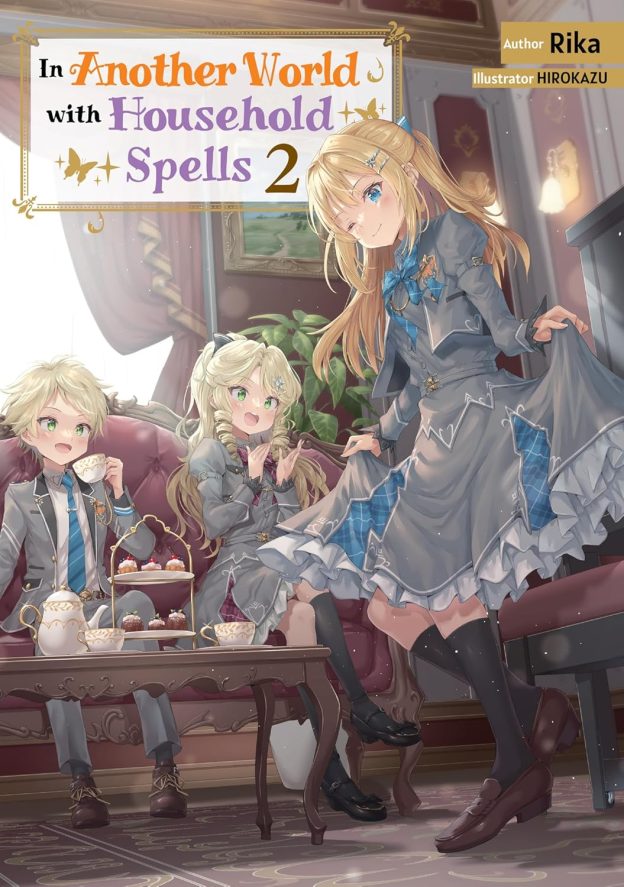
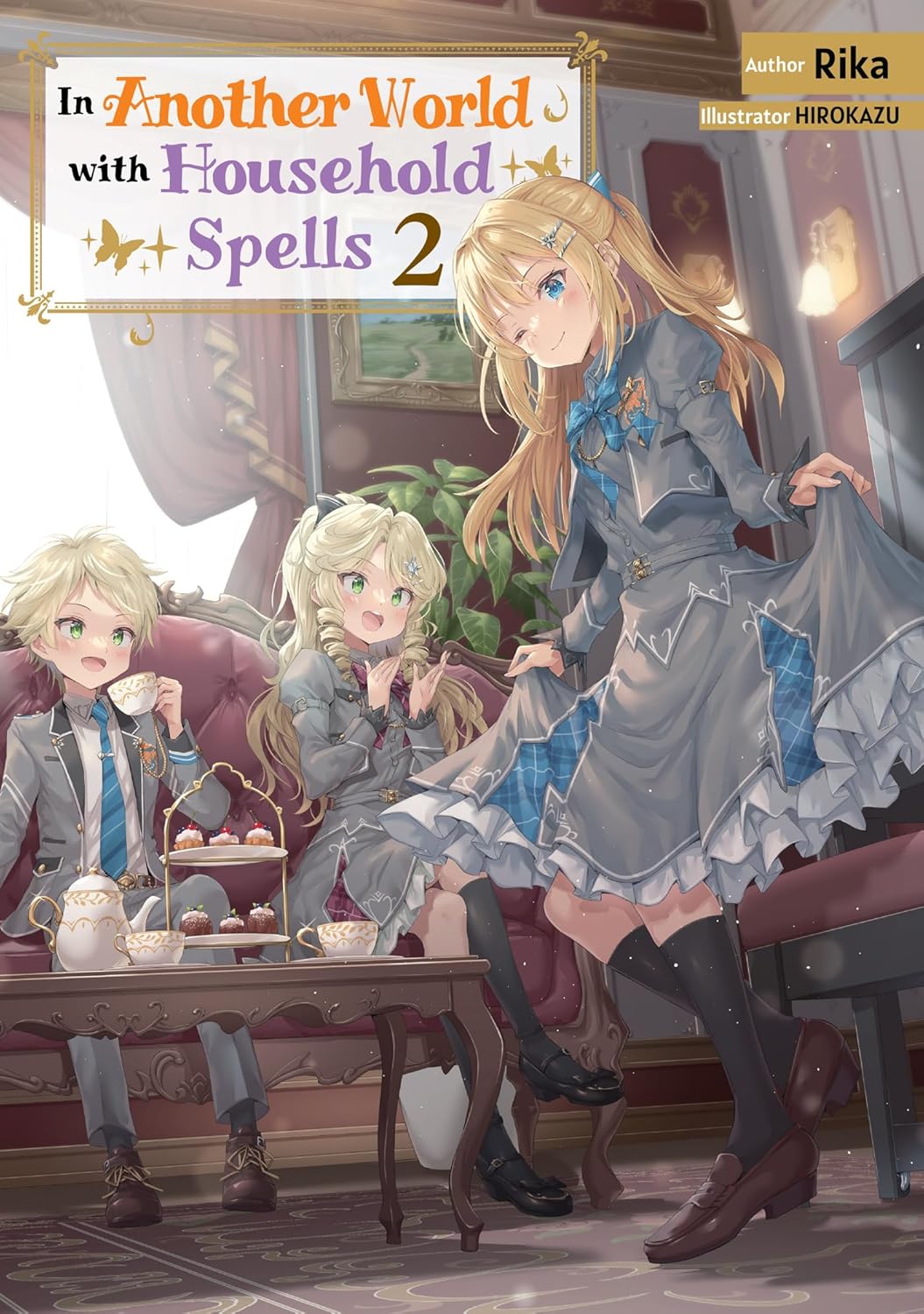
In Another World with Household Spells, Vol. 1

By Rika and HIROKAZU. Released in Japan as “Isekai ni Kita kedo, Seikatsu Mahou shika Tsukaemasen” by Mag Garden Novels. Released in North America by J-Novel Club. Translated by sachi salehi.

This is the definition of “Fine, I guess”. It doesn’t really do anything wrong, apart from one thing I’ll mention later. The heroine is a classic “I just want a quiet life where I can earn money to help my family” type who does not realize that every single thing that she does draws a tremendous amount of attention to herself. She’s seriously OP, but not in a flashy way. She doesn’t invent mayonnaise, but she does pretend that Mozart and Bach compositions are her own. There’s a royal family, but they’re pretty nice, and the prince her age clearly has a crush on her that is coming out as “you’d better watch your step!”. But there is nothing here to make someone who has read large amounts of “woman is reincarnated as a noble girl and attends a magic academy” books want to add another one to the pile. It feels like the bulk of the book was written to keep up with the trends.

One day Kaoru Aoyama is working her office job and living in her apartment, the next she wakes up as Patience Granger, a ten-year-old noble girl. She wasn’t even hit by a truck! Patience is, unfortunately, recovering from near death. In fact, it appears the real Patience DID die, and now Kaoru is in her body, with a sort of soul of the real Patience insider her yelling when she does things that are not appropriate for nobility. Unfortunately, their family is flat broke, as her father was fired from his royal position for reasons that we never actually find out in this volume. Fortunately, after recovering, she’s taken to the church and told she has “household spells” for magic, one of the most common types. That’s fine with her, though, and like so many other protagonists in these books, she experiments without knowing what not to do and winds up really overpowered.

First off, I understand that it’s in the original, and that there’s not really a Western alternative, but man, when the heroine talks about being a shotacon all the time, I don’t care if she insists “but not in a pervy way!”, it reads wrong and makes you like her less. There has be be a way around the word. Patience’s main trait, besides being oblivious to her own misguided attempts to not stand out, is her adoration of her two cute younger brothers, as well as the kids her own age, who her 25-year-old self sees as cute little ‘uns. If you can get past that steep hurdle… I did like her relationship with the first ;princess, who she is clearly rehabilitating. It’s implied that her late mother and the Queen had some history, and everyone and their brother talks about how their family is supposed to be filled with genius scholars, so there’s clearly a lot of backstory still to dole out. As for romance… she’s ten. Let’s table that for a while.

I’ll read the next volume of this – I do want to see what’s up with her otherwise nebbish dad. But for those who have to much to read already, there’s no reason to add this as well.