Category Archives: reviews

Sword Art Online, Vol. 10: Alicization Running

By Reki Kawahara and abec. Released in Japan by ASCII Mediaworks. Released in North America by Yen On. Translated by Stephen Paul.

If the 7th Sword Art Online novels felt rushed because we weren’t used to the pace of a single volume story, then this book has the opposite issue. Alicization Running is filled with cool scenes, exposition, and character development, but it is the very definition of “Part 2 of 10” – it doesn’t stand on its own as a novel, really. For those who expected we’d see Kirito and Eugeo reuniting with Alice in this book, she’s barely even mentioned except as a goal, because to get to her they have to become Knights, which means winning a tournament, which means going through sword training school, which means winning ANOTHER tournament. Kawahara is stretching this out, for good or ill. Fortunately, it’s partly good – this is still readable, and by now I hope the average Sword Art Online reader takes Kirito’s success with a sword for granted and does not grind their teeth at it.

The other good news is that the first third or so of this book is devoted to Asuna in the real world, who is trying to figure out what happened to Kirito, who is not, as we may have expected, in a hospital but has instead completely vanished. We do eventually find out where he is, with a lot of seeming villains who are really helping out heroes and the like. We also get more of one of my least favorite things in Sword Art Online – praising Akihiko Kayaba, the villain of the first arc who condemned thousands to death, but is really just a misunderstood man with a dream, something that even Asuna says she can respect, which just makes me shake my head. Unfortunately, the rest of Asuna’s section is taken up with huge swaths of technobabble as Kikuoka explains what they’re trying to do here, why they’re trying to do it, and why Kirito is here. Some of those explanations are a bit disturbing – the author even has to remind us in the afterword that he does not necessarily agree with his characters (I’m guessing he’s meaning the use of DELICIOUS TASTY BABY SOULS).

Meanwhile, Kirito’s having an adventure, and while he does think of Asuna and the others, and misses them, his focus is on getting to the central capitol. This involves a lot of showing off, because this is Kirito after all, as well as forging him an amazing weapon that can be the equal of the sword Eugeo possesses (which is a black blade almost identical to his Aincrad one). He also gets to face off in a battle with the #1 swordsman at the school… who sadly is not the young woman on the cover. She’s the second strongest swordsman, and the plot is set up to build to a final battle against her that never happens. I’d like to say it’s not just because she’s a woman, but let’s be honest, it probably is. As always, Kirito is at his most interesting when he’s upset or something goes wrong, such as when his classmates’ petty bullying and destruction leads him to the literal power of prayer to fix things (fortunately, this is a gaming world, so it succeeds).

I wish we had more of Eugeo, who’s a nice sweet kid but not much else – he got far more development last time. As for the regulars who aren’t Kirito or Asuna, well, Leafa and Sinon get to have a confab with Asuna at the start of the book, but Lisbeth and Silica are reduced to begging on the back cover. Yui actually fares better than they do – her discussion of AIs, and how in the end she isn’t the amazingly self-aware fairy daughter she appears to be, is well-written and also chilling. This is a necessary volume of Sword Art Online if you want to read more of Alicization, but by itself it’s a bit frustrating. Recommended for fans of the series, but I’m hoping for a bit of a Turning point next time…

Also, Kirito spends most of the book being protected by invisible sentient head lice, who I can’t help but picture as Jiminy Cricket. I just want to throw that out there.

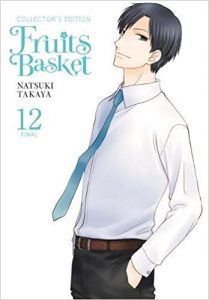
Fruits Basket Collector’s Edition, Vol. 12

By Natsuki Takaya. Released in Japan by Hakusensha, serialized in the magazine Hana to Yume. Released in North America by Yen Press. Translated by Sheldon Drzka.

At last we come to the end of one of the most influential manga series out there, at least in North America. Fruits Basket brought so many new people into the fandom, and also made so many more want to create. It was almost like lightning in a bottle – Takaya’s two series after this are good but did not have nearly the same amount of popularity, and the less said about Fruits Basket Another the better. But Fruits Basket itself is compulsively re-readable, incredibly emotional, and thoroughly satisfying, even if it is also flawed, as this last volume so amply shows. The curse is now broken, but the aftermath still needs to be dealt with, and nothing is going to be the same again.

My favorite moments in the book were the things that didn’t quite happen, even though they should have in order to provide closure. Akito attempts to apologize to the rest of the zodiac, but can’t quite pull off the words, instead giving what amount to exit interviews to most everyone as she deals with her tortured feelings for Shigure, who is at last willing to reciprocate them, since they’re entirely on his own terms now. The Shigure/Akito relationship is easily the most problematic of the series, and trust me that’s saying something. It leaves me with a vague sense of emotional dissatisfaction, even as it makes the most sense in story terms. Takaya even says she felt a bit uncomfortable with it. Meanwhile, Rin is looking at everyone else smiling and moving on and wondering why she’s still filled with rage and hatred. Healing is something that happens different ways for everyone, and it doesn’t have to happen overnight, especially when you’ve been abused as much as Rin has. And the Sohma’s head maid is offered a chance to help Akito forge a new path with the Sohma Family… and walks away from it, unable to let go of the past, in one of the starkest and best moments in the volume.

As for the main cast, everyone gets a brief few pages to show how they’ve changed and grown, and also to show that almost everyone is now romantically paired. You have to feel bad for Momiji and Kagura – if you’re going to pair everyone up in the most cliched way possible, why not simply go all the way? In general, the more attention paid to the couple during the manga itself, the better the scene – Kyo and Tohru get the bulk of the pages, obviously. Some pairings are a bit last minute hookup, like Hatori and Mayu. And some pairings feel like a gag taken one step too far, like Kazuma and Hanajima, where you get the sense that Takaya simply finds the idea of this too funny to not go through with, even though it doesn’t really work. It’s also nice to see Shigure’s editor happy at last, but again, this reads like connecting the dots. Fruits Basket works best when the romance is focused on Kyo and Tohru.

The second half of the omnibus, as predicted, was a sort of combination of various parts of the two fanbooks, showing off favorite scenes/pairings/characters along with some discussion of clothing and the like. There’s also an interview with Takaya that was done recently, where she looks back at the series. I don’t think the extra content is worth buying in and of itself. But if you want to upgrade your old Tokyopop paperbacks, and don’t mind that the series has a noticeably different translation (“you did your best”, FYI) , you should absolutely get this, and relive a magical shoujo classic. Also, the second to last chapter still makes me cry every single time.

Konosuba: God’s Blessing on This Wonderful World!: Love, Witches & Other Delusions

By Natsume Akatsuki and Kurone Mishima. Released in Japan as “Kono Subarashii Sekai ni Shukufuku o!: Chūnibyō demo Majo ga Shitai!” by Kadokawa Sneaker Bunko. Released in North America by Yen On. Translated by Kevin Steinbach.

First of all, I would like to state, for the record, that it was Yen On’s decision not to use an oxford comma in the subtitle. I am merely replicating their choice. And if you think that’s a somewhat silly way to start a review, then you’re clearly not the right audience for KonoSuba, whose second light novel is content to replicate the choices of its first, showing that it is quite happy to have its dysfunctional cast behave badly in hilarious ways. Kazuma whines and moans (and tries to get laid with a succubus, which works about how you’d expect); Aqua is the brattiest goddess you’ll ever see (indeed, the book begins with a much nicer example); Megumin cares about explosions and nothing else, and Darkness’ masochism is in full force. There’s a hint the next book will advance what passes for a plot, but in the meantime, enjoy the antics.

The book starts off on the right foot – indeed, it may be my favorite part – with a story about a foolish young man, seeing Kazuma surrounded by hot girls and not much else, offering to switch parties with him for the day. Kazuma, who is no fool, accepts, and you’d think we’d stick with other guy and watch the fallout. But no, instead we follow Kazuma and see his normal day with a normal party. He uses his adventuring powers wisely, helps save the day, gains the respect of his teammates – it’s peaceful, heartwarming, and would no doubt be incredibly dull it it lasted any longer than it does. We then return and see the aftermath of Dust’s day with Aqua, Megumin, and Darkness… and yup, he’s begging to switch back. Predictable, but still hilarious.

Even when the book takes a turn for the slightly serious, there’s still gags lurking in the background. That’s a good thing, to be honest – this really isn’t a series you want to see depth and feeling in. Taking it too seriously would ruin the point. So when we get the climax with everyone fighting against the giant spider mecha with the bomb inside it, it’s undercut by the creator’s hilariously mopey diary about the building of the thing. There’s even some mild romance in this, though as ever I see the group as more of a family than anything else. When Kazuma requests a “dream visit” from a succubus, he’s clearly expecting Darkness based on his reactions – we’ve heard before that were it not for her masochism, she’s exactly his type – and Darkness’ atypical reactions seem to suggest she’s far more open to this than you’d expect a comedic harem girl to be. Of course, nothing comes of it…

The book ends on a cliffhanger, and the afterword is already announcing side-stories to be released (which have not, as of yet, been licensed here, I add for clarification). Clearly it was a runaway success in Japan. You can see why. It’s mocking a very popular Japanese light novel genre, and doing it well.