Category Archives: reviews

The Devil Is A Part-Timer!, Vol. 7

By Satoshi Wagahara and 029. Released in Japan by ASCII Mediaworks. Released in North America by Yen Press. Translated by Kevin Gifford.

Unlike the DanMachi collection released on the same date, this volume of short stories is not interconnected into a pseudo-plot – it’s just a collection of four short stories. Fortunately, the stories are all quite good, so we also lack the lows of that DanMachi collection as well. Devil Is A Part-Timer! is very strong when it’s talking about nothing in particular, so this volume plays to those strengths, showing our heroes going up against fraudulent shysters, adopting stray kittens, buying futons for their magical sword babies, and learning how to work fast-food without losing your mind. It’s also a good volume for shippers, particularly if you ship Maou and Emi, as the entire third story is basically about how great they work as a couple, and how much this seems to upset Emi.

The first story is probably the slightest – ironically, it’s the one they chose to adapt into the anime, as Maou has to deal with the fallout of Urushihara being tricked into buying a lot of useless stuff. He (and the reader) learn about how these schemes are done, and how difficult it can be to recover anything from them. The kitten story is probably the cutest, and again revolves around one of the themes of this novel series, which is explaining what seem to be obvious concepts to those completely unfamiliar with modern-day Japan. Not only does Maou not really know how to take care of cats, he’s not aware there are vets. And even worse, he’s not aware how fast he and the others can bond with a kitten. The third story, as I said earlier, is basically pure ship tease, with Maou and Emi buying a futon for Alas Ramus and everyone around them thinking they’re such a great couple. It’s amusing precisely because everyone is correct – when she’s not panicking about the very idea, they are a great couple.

The final story is easily the longest of the four, and takes place right before the series begins. It focuses on Chiho and how she came to get a job at McRonald’s and meet Maou, as well as why she fell in love with Maou. It’s nice to see Chiho interacting with her friends at school – indeed, I suspect one reason this story came out is to give greater depth to Kaori and Yoshiya in anticipation of them appearing in the main story later on. (It’s also very refreshing to see a ‘two girls, one boy’ high school friendship with no romantic tension whatsoever.) Chiho is a fairly sheltered girl whose father is a police officer, and so feels she’s lacking life experience, one reason why she applies for the McRonald’s job. There’s a lot made in this story about the ‘career survey’ all Japanese students dread, and exactly how relevant it needs to be. Mostly, though, this is a good showcase for Chiho and demonstrates how far she’s come in the six volumes since.

This isn’t essential reading, but all volumes in this series are good, and if you’re collecting it there’s no reason to pass it up. The Devil Is A Part-Timer! remains among the best Yen On releases.

Is It Wrong To Try To Pick Up Girls In A Dungeon?, Vol. 8

By Fujino Omori and Suzuhito Yasuda. Released in Japan as “Dungeon ni Deai o Motomeru no wa Machigatte Iru Darou ka?” by Softbank Creative. Released in North America by Yen On. Translated by Andrew Gaippe.

I knew going in that this was going to be a short-story collection, but it turns out that’s not quite true. What it is is more “A day in the life” – there’s still an overarching plot going on, and stories do affect other stories, but each of the six main stories is also self-contained and stars a specific member of Hestia Familia. Omori said that he wanted to write stories about love in this volume, which may make some readers cringe, and rightly so. DanMachi works best when the harem romance is used as a spice, in my opinion, and this is definitely a heaping helping of main course romance. That said, I have an easy way to tell whether you’ll enjoy a story or not – the longer the story, the better it is.

Unfortunately, that means the book begins with its worst story. I’ve never been a fan of “we’re not blood related so it’s not really incest” stories, and so Mikoto’s crush on her adoptive God father Takemikazuchi merely aggravated me, especially as it’s surrounded by a host of other cliches. I suspect the author meant it to be the funny one of the group. Eina’s story involved Bell protecting her from a stalker, but was probably the most boring of the stories, much like its female lead (sorry, Eina). Syr’s story was all right, but it teased that it was going to finally show off how she was related to Freya – fan rumor suggested she IS Freya, but that seems unlikely – but left things a bit too vague to be satisfying.

The longer stories fare much better. Lilly and Hestia are the only characters who get to definitively talk about their love for Bell openly in the series, and we see that love being put to the test on Lilly’s end, as not only has the rest of the group been told about Bell’s special skills (and thus that his stats are literally driven by his love of Ais), but she’s feeling useless in the dungeon as well, and ends up with a huge case of self-hatred (which honestly is always sort of boiling beneath the surface of Lilly). Help comes in the form of Finn, who is not only the only other hobbit – sorry, prum – in the book, but also far more savvy about romance (well, except for the advances of the amazon with the crush on him). As for Welf, his is the least romantic story in the book, though we see his respect for Hephaistos borders on love, and she also loves seeing his growth. Welf actually drives the main plot, as his magic sword skills are now well known – and people are trying to use them for evil.

The final story stars Hestia, Bell and Ais, and I enjoyed it a great deal as well, though a brief caveat that people who dislike jealous, petty Hestia will probably dislike it a bit more. That said, Bell finally seems to be catching a clue about how Hestia feels about him, though it’s not clear whether he’ll actually do anything about that. (Finn mentions harems to him at one point, but I honestly don’t think this is going to be that kind of series.) As for Ais, she’s showing a lot more emotion in her own stoic way than she ever has before, and we see her as furious as she ever gets when seeing how a reclusive village worships an ancient dragon. I suspect this may be related to backstory we’ll get more of in Sword Oratoria.

So in the end a bit of a mixed bag, but still well worth reading for fans of the series, especially if you like Lilly, Welf, or Hestia. There’s a bit of a tease for the next book at the end, and I sense we’re about to get a more serious arc next. Perhaps with a more normal focus on action rather than romance?

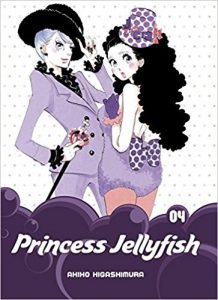
Princess Jellyfish, Vol. 4

By Akiko Higashimura. Released in Japan in two separate volumes as “Kuragehime” by Kodansha, serialization ongoing in the magazine Kiss. Released in North America by Kodansha Comics. Translated by Sarah Alys Lindholm.

I’ve mentioned before that I read this book more for Kuranosuke than Tsukimi, mostly as I keep waiting for everything to come crashing down on him and it just hasn’t yet. Kuranosuke is a giant whirling ball of poor impulse control, and while most of the time this is channeled in a good direction, and I do like that he’s helping the others in his own way, I always grit my teeth a bit when the moral seems to be “consequences are for other people!”. We get a bit of backstory as to how he came to the mansion as a child, and a bit more insight into the relationship he has with his older brother. I liked this, it makes sense for the character. Best of all, though, we have several moments, especially in the second half of the book, where Kuranosuke is thrown off his game, and forced to actually deal with unplanned things. He really shines then.

Speaking of the second half of the book, Nisha is a highly welcome breath of fresh air, and provides a dose of reality to the series that is desperately needed, as Kuranosuke has his head in the clouds just as much as Amars seems to. In particular, they are reminded that if they expect to make any money at all, Tsukimi’s jellyfish dresses need to be priced as haute couture, which is to say way, way above anything that the Amars crew could ever afford. We get a visit to an outlet store for expensive clothing, and while Tsukimi remains horrified, it really is a good object lesson in how the other half lives. She is not the target market for her dresses – people like the rick old ladies who came to the fashion show are. It will be interesting to see how well the dresses succeed in future books.

As you’d expect, there’s also lots of other things going on in these two volumes. Tsukimi and Shu get closer, even as she still has tremendous trouble dealing with a man AS a man (Kuranosuke dressing as a woman helps), and the residence is still very much on the chopping block, which gives Inari a chance to give a magnificently villainous speech tearing down Tsukimi – it’s cliched by design, and after all, if it does what it intended, why not use the cliche? That said, I think Tsukimi will be fighting back soon thanks to her fellow neighbors, who now that they know the strength of their resolve are prepared to bring them in to the protest fold.

There’s more tiny little character moments – I loved Jiji agreeing to run operations for the newly minted Jellyfish fashion business, if only as it gave her something to do for the first time in the entire series. Essentially, Princess Jellyfish’s fourth volumes shows the work of an assured manga artist continuing to draw us into the world of fashion and introverts, and you eagerly read on to see what happens next.