Category Archives: sword art online

Sword Art Online, Vol. 9: Alicization Beginning

By Reki Kawahara and abec. Released in Japan by ASCII Mediaworks. Released in North America by Yen On. Translated by Stephen Paul.

Here we go, ladies and gentlemen. This is it. This is the Big One. This volume of Sword Art Online begins the Alicization Arc, an arc that will not end until Vol. 18 rolls around in December 2019. And you can tell from the writing in many ways, as Kawahara is taking his time to set things up and carefully introduce things that will clearly have relevance later – not least of which is Alice herself, whose disappearance is one of the major plot points of the book, but it’s not resolved here. For those who love the main heroines of Sword Art Online, well, you may be in for some hard times. Asuna is here at the start, as well as Shino. We even hear about future plans, as Shino discusses the next Bullet of Bullets tournament and Asuna and Kirito make plans for going to college overseas. Unfortunately, life has other plans. Fortunately, we have a new heroine, in the best Sword Art Online tradition, to help Kirito with this crisis. He’s even on the cover. Wait, he?

Yes, that’s right, the author has finally realized that the occasional appearance by Klein isn’t cutting it, and gives Kirito someone who can be an equal as well as (sort of) a childhood friend. The conceit of this book is that Kirito is testing a new VR system that’s the most realistic one yet – unlike Aincrad and the other VMRROs we’ve seen to date, this new system is able to mimic things down to the last detail. It’s also, apparently, able to give you vivid backstory if need be – the first 60 or so pages of this book are Kirito, Eugeo and Alice as kids hanging around their medieval fantasy hometown and getting involved in things that they should not. Unfortunately, after an attack in the real world by an ex-member of Laughing Coffin (really, all of these guys basically got away scot-free, didn’t they?), Kirito now finds himself, grown up, in the same world, though he’s now himself and Eugeo doesn’t seem to know him. Now he has to a) find out where he is, b) find out how to return to Asuna, and c) join forces with Eugeo and rescue Alice, who was taken away years ago by Knights as a punishment for transgressing one of the many Laws..

The viewpoint here is, with the exception of the childhood prologue, 1st person Kirito as usual. I find it more tolerable than others do, I suspect, mostly as I think the best way to remind us that Kirito isn’t superhuman is by showing us his thoughts and fears. I also really like Eugeo, the new guy. He’s sort of bright, shiny and innocent, the kind of really good guy that the girls all think Kirito is but he’s never quite managed to pull off. He’s also surprisingly skilled with a sword, and Kirito wonders if more training might even make the two of them a close match. (I hope so. It’s always refreshing seeing Kirito not be the best at something.) When this book is telling Kirito’s story, it’s excellent. Unfortunately, there is one big weakness – Kawahara is fascinated by his invented technobabble (this is also an issue in his other series), and there is endless discussion of vitual reality and what life and a soul actually means. I’m sure it will be highly relevant later, but having it come out in the form of an infodump made things a bit tedious, which is a shame given it was our one big scene with Asuna and Shino.

In any case, though, overall this was a very good start to a very big arc, introducing a new (missing) heroine, giving Kirito a potential male best friend and partner, allowing Kawahara to try his hand at a “fantasy” setting with knights and goblins (who talk about sexually assaulting a young girl, something that apparently is so common in Japanese light novels with goblins that I’ve now run across it three times in less than a month), and setting things up for the next book. Will we be cutting back to the real world and Asuna at all, though? And will Liz and Silica ever get More Appearances? (The back cover of Book 10 may offer a clue there.) Let’s see if Alicization hits the ground running next time.

Sword Art Online: Progressive, Vol. 4

By Reki Kawahara and abec. Released in Japan by ASCII Mediaworks. Released in North America by Yen On. Translated by Stephen Paul.

After a third volume that was good but somewhat insubstantial, the fourth volume of Progressive knocks it out of the park. One big reason why is the viewpoint: we get Asuna’s POV again (3rd person) for the first half of the book, with the 2nd half back to 1st person Kirito. This not only allows us much greater insight into how Asuna thinks, but also helps to show off how the two of them view each other – Asuna in the first half is running scared a lot, partly due to this particular level featuring ghosts, a pet fear of hers, but also in general, as she feels inadequate to the floor, and Kirito is constantly two steps ahead of her. She can’t even bring herself to duel him so she can have practice at it – in a game where something going wrong means death, it weighs too much on her.

saop4

Then we see Kirito, and once again Asuna becomes the somewhat cool, noble tsundere he always puts on a pedestal. He also shows us that some of her assumptions about him are wrong – she admired his cool bluff against two enemy players, but he was actually on the verge of snapping, as seeing a status saying someone isn’t dead and actually not seeing them dead are two very different things. We also see that both he and Asuna are slowly becoming aware of their growing feelings towards each other, but are not really going to do anything about it – in fact, we even see Kirito abuse this fact, as in order to cover up his real intentions he pretends that he hasn’t joined one of the two big guilds as they’d force him to part with her. Of course, what it really is is that he feels she’s a better “leader” than he is, and he doesn’t want to get too close as he regards his role as making her “fly” so she doesn’t need him anymore. Which, of course, Asuna is somewhat aware of, and is the source of much of her own angst.

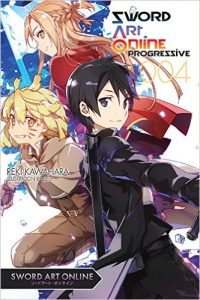
Argo is here, as you might have guessed from the cover, and she gets quite a lot more to do than usual, from dueling with Asuna to show off that she actually *can* take care of herself thank you very much, to hen showing us that she too can be vulnerable, as the new changes to the 5th floor boss almost end up taking her out. She’s a great character, and I am quite pleased that Kawahara continues to use her even though she doesn’t show up in the original series. Fans continue to debate whether this reboot will eventually reach the same points as canon – i.e., Kirito and Asuna will separate for a long period, and things will proceed as from the original. I think Kawahara realizes he doesn’t have to care about that for the next several books, and that he’s happy to simply rewrite Aincrad with new experience and better characterization than he had years ago. (He’s also written Progressive plot and characters into some of his unofficial doujinshi work – Argo shows up in one story during Kirito and Asuna’s honeymoon, and another story tells of the fate of the Dark Elves (who aren’t in this book, by the way, though I suspect they may be in the next one).)

And then there’s the other big reason this is the best of the Progressive books – a genuine threat from something outside the game itself. The second book showed us Morte, a player who seemed to want to cause chaos. We see him again here, working on more of the same, and also meet his boss. The discussion of why players would want to kill other players is brought up by both Kirito and Asuna, but both of them shy away from the actual reason – it’s a thrill and they can get away with it. The boss’ name isn’t mentioned, but signs are good that it’s PoH, who later heads up the guild Laughing Coffin, which we’ve discussed before. Again, part of the fun of reading Progressive is seeing he seeds being set for later events, and PoH is a creepy psycho. He’s clearly one of the major antagonists of the series. Even now that we’re a few years out of Aincrad, I wonder if he’ll pop up again.

So all this, plus the usual excellent battle scenes, and slightly less fanservice than usual (courtesy Asuna, who demands she and Argo be clothed during their bathtime duel). If you enjoy Sword Art Online even a little bit, you should love this one. Get ready to wait for the 5th volume, though – it’s not even scheduled in Japan yet.

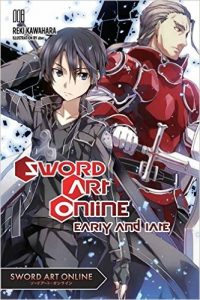
Sword Art Online, Vol. 8: Early And Late

By Reki Kawahara and abec. Released in Japan by ASCII Mediaworks. Released in North America by Yen On. Translated by Stephen Paul.

This is the second of two short-story collections in the SAO series, though two of the three stories aren’t so short. The Safe Haven Incident was written early enough to actually be used in the first season of the anime, though they sadly cut the funniest scene. Calibur (as in Excalibur) is more recent, and was adapted into the 2nd season. The final story here, The Day of Beginnings, was written specially for this book, and is also the darkest story in the book, showing off a scared, desperate Kirito and why he’s so insistent on being a solo player. All of the works are good, fleshing out this world further and giving fans a bit of a treat before we jump headlong into the next arc, which is ten whole volumes long.

sao8

The Safe Haven Incident is a murder mystery, though the murder and its investigation are probably the least interesting part of it. What is good is seeing Kirito and Asuna bond with each other immediately, almost despite themselves, and showing off the two of them seamlessly working together before they became a couple. (Kawahara apologizes to the reader for the continuity not matching the first two books precisely. Given that SAO: Progressive has kicked continuity in the groin and stolen its stuff, I think that’s the least he has to worry about.) We also see Laughing Coffin here, including some retroactive setup for the Phantom Bullet arc that we get as readers even if Kirito doesn’t. As always, a group of players who kill for fun are chilling. The best part of the story, though, bar none, is Kirito and Asuna’s talk with Heathcliff in a ramen restaurant. From Heathcliff’s deadpan hatred of the ramen (his asking “why is this restaurant even here?” is twice as funny after you know his secrets) to Asuna saying the ramen “felt lonely” and determined to figure out how to make soy sauce in Aincrad, it’s pure comedy gold, and it’s a crime the anime had to cut it.

Calibur is more lighthearted, even with a sort of apocalyptic deadline forced on the story. It takes place in Aflheim, so there’s no danger of actual player death, but there is a very real chance the game might ruin itself by starting Ragnarok. But mostly it’s an excuse to see the full cast all reunited one last time and working towards a common goal as a unit. Even Klein gets in on the action, and in fact it’s his samurai desire to help a lady in distress that accidentally ends up winning the day, though of course Klein does not get the girl. Oh, and more comedy cold, as Kirito’s immature pulling of Sinon’s tail (Kawahara tries not to state outright that the tail pull’s effect on its characters is arousing, but it’s somewhat obvious) results in her getting epic revenge later by taking advantage of the fact that every girl in the group is in love with Kirito.

The new story is last, but in terms of continuity it’s first, as it shows what Kirito did immediately after leaving Klein when the game first began. For all the times we’ve seen players complain about “beaters”, here we see they had a point – Kirito absolutely it trying to level up as fast as possible using knowledge only the beta players have, and that will adversely affect the area for other players. We also meet another player, Kopel, who contrasts with Kirito by trying to kill him to save his own skin, though Kirito is not as far from Kopel as he might like. As I said, this is a dark and sad story showing us how a somewhat antisocial young man becomes even more so in a game of death.

This isn’t a book to get if you haven’t read any of SAO before – there’s too much continuity, broken or otherwise, going on – but it’s a nice little addition to the series, and a bit of a breather after the drama of Mother’s Rosary. In the meantime, there’s another Progressive in October, and then in December SAO begins its epic arc: Alicization. Be afraid.